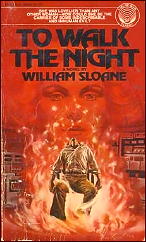
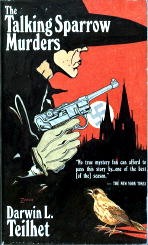
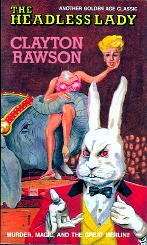
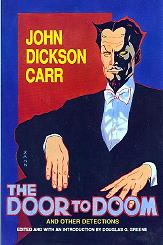
Covers


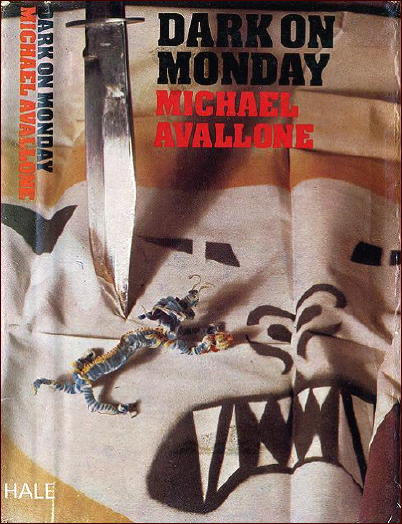
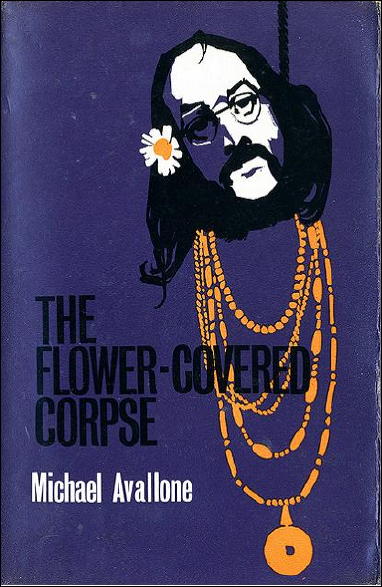
   If you check back, it was a year ago yesterday that I announced here on the blog that I’d uploaded an article by John Pugmire about one of his favorite subgenres of mystery fiction, Locked Room Mysteries. (Mine, too, of course.)

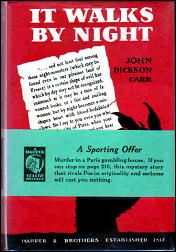
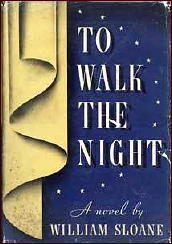
   It’s largely a list of such stories considered to be the best by a couple of noted panels of experts — I’ll leave the details to the article itself — along (and here is where I came in) with cover images of as many of them as John and I could come up with — or nearly 100 or so.

   Some time ago — and longer ago than I’d rather admit — John sent me images of five more covers, one an improvement over one that we’d used to fill a gap, plus four that are brand new. I’ve finally gotten around to doing what I do, and that’s get them online at last.

   The page is on the primary M*F website, and even if you’ve seen it before, I think it’s worth a look. Here’s the URL: http://mysteryfile.com/Locked_Rooms/Library.html, and here are a couple of the newly added covers:

Locked Room Mystery      Locked Room Mysteries

   It’s been a long time in getting it finished (the last update was sometime in January) but the Mystery House section of Bill Deeck’s Murder at 3 Cents a Day Lending Library website is ready for viewing. Thanks to the assistance of Bill Pronzini, whose collection has been of great use, cover images of almost all of the books published by Mystery House between 1940 and 1948 are now online.

   Mystery House was revived as an imprint in 1952 and continued on until 1959, but rather than doing any of these, what Bill and I will be tackling next are the covers of the lending library mysteries published by Arcadia House between 1939 and 1947. Arcadia House also began publishing mysteries in 1952, but here again we’ll concentrate on the ‘Golden Age’ titles first.

   Here are a couple of the Mystery House covers. For the others, you’ll have to follow the link above:

ED DOHERTY   SCOTT MICHEL

M. K. LORENS - Ropedancer’s Fall.

Bantam; paperback original; 1st printing, August 1990.

M. K. LORENS

   I’ll begin with a confession of sorts. Back when M. K. Lorens’ first book, Sweet Narcissus, came out, it looked particularly appetizing and I gave it a try, but I didn’t get very far. Whether I wrote a review of the book, as far I as read, I have no idea. I suspect not, but I might have. Isn’t giving up on a book worth pointing out, as long as you say so very clearly and carefully? And point out just why it was that you came to a dead end with it, without loudly and vociferously saying how greatly the author’s fault it was? (Even though in large part it may have been?)

   In any case I haven’t come across it recently, “it” referring to the review which I may or may not have written, so the point is moot.

   But the second book in the series recently surfaced, and remembering my earlier experience, I said to myself, here’s my opportunity to give the author another chance.

   Lorens’ detective is the key attraction, a gent by the name of Winston Marlowe Sheridan who writes a “Gilded Age” series of mystery fiction himself, but under the well-disguised pseudonym of Henrietta Slocum. Slocum’s character in turn is named G. Winchester Hyde. How can one resist?

   A portly fellow, Sheridan himself is a professor of literature at a New England college, and on occasion he finds himself involved in cases of murder, for which he places his sense of deduction on the line to solve.

M. K. LORENS

   In this case the dead man in Ropedancer’s Fall is John Falkner, whose one novel won a Pulitzer, but who was never able to write another one and who had been recently been reduced to being to PBS talk-show host, albeit a very good one. And as he was a long-time on-and-off friend of Sheridan’s, as well as a hopeless reclamation project, Sheridan takes his death very personally.

   All well and good, but – and you knew this was coming, perhaps? – the telling is dense and nearly impenetrable – over 260 pages of small print – filled with Sheridan’s enormous entourage of friends and acquaintances, some closer than others, and their multitude of spouses and ex-spouses and intermingled offspring and foster children. And as the book goes on, the list of the above gets longer and longer – a snowballing effect figuratively if not literally.

   But given some time to get to know them, the list of characters does becomes manageable, and the writing, while dense, is also delightfully incisive and witty. Eventually, though, it begins to dawn on the reader (or at least this one) that the investigation is going absolutely nowhere. Wheels within wheels, but all of them are spinning and spinning, and spurting up little but slush.

   Skipping to the end, after about 160 pages, and sure enough, nothing happened in Chapter Twenty that couldn’t have been predicted after reading Chapter Two.

   Recommended if you’re a fan of clever, witty repartee between clever, witty people. (Do NOT read any sense of sarcasm into this statement.) Not recommended if you like a hands-on mystery to solve in your detective fiction.

      BIBLIOGRAPHIC DATA. [Expanded from Crime Fiction IV, by Allen J. Hubin.]

LORENS, M(ARGARET) K(EILSTRUP). 1945- . Pseudonym: Margaret Lawrence. Series Character: Winston Marlowe Sherman, in all. [The distinctive artwork for the covers you see is by Merritt Dekle.]

      Sweet Narcissus. Bantam, pbo, August 1989. [corrected year !]
      Ropedancer’s Fall. Bantam, pbo, August 1990.
      Deception Island. Bantam, pbo, November 1990.

M. K. LORENS

      Dreamland. Doubleday, hardcover, April 1992; Bantam, pb, March 1993.
      Sorrowheart. Doubleday, hc, April 1993; Bantam, pb, April 1994.

LAWRENCE, MARGARET. Pseudonym of Margaret Keilstrup Lorens. SC: Midwife Hannah Trevor, in the first three; her daughter Jennet, who is deaf, appears in the fourth. Setting: Maine, 1780s.

      Hearts and Bones, Avon, pbo, October 1997. [Nominated for Edgar, Agatha, and Anthony awards]

Martha Lawrence

      Blood Red Roses, Avon, pbo, October 1998.
      The Burning Bride, Avon, pbo, September 1999.
      The Iceweaver, Morrow, hc, July 2000. Trade paperback: Harper, July 2001.

Martha Lawrence

GEORGE HARMON COXE - Fashioned for Murder.

Dell 678; paperback reprint; no date stated, but probably 1953. Hardcover edition: Alfred A. Knopf, 1947.

COXE Fashioned for Murder

   Take a look at the cover of the paperback edition and compare with the one on the hardcover. Both are appropriate for their respective venues – sales mostly to libraries for the hardcover, where the artwork on dust jacket was all but incidental, versus sales on newsstands and drugstore spinner racks. The one on the paperback is nothing but eye-catching, and it does its job well. Besides telling you something about the story itself, wouldn’t it make you a whole lot more in the mood to fork over the 25 cents to took back than to take it home?

   And in the credit-where-credit-is-due department, the Dell cover was painted by Fred Scotwood, a new name to me, but done in very much a 1950s style, and it’s a pretty good example of GGA (Good Girl Art) as well. (According to Google, Scotwood appears to have done at least two other covers for Dell in the same time period, but so far, that’s all that I’ve found out about him.)

   As for the book itself, assuming that you’ve not tired of this mini-symposium on the author that’s developed this week, it’s one of Coxe’s non-series books, and without attempting to soften my comments any, it’s not one of his better ones, series or not.

   It starts out as a yawner, and in subsequent events it never manages to work its way up any higher than that. Even the hero’s name, Jerry Nason, a young fashion photographer based in Boston, bothered me. It reminded me too much of that book in which Atlas Poireau, Trajan Beare, Spike Bludgeon, Mallory King, Sir John Nappleby, Jerry Pason, Lord Simon Quinsey, Miss Fan Sliver, and Broderick Tournier all combine efforts to solve a murder together. (You do know the one I mean?)

COXE Fashioned for Murder

   That’s a minor quibble. Forget I brought it up. Fashioned for Murder begins with Pason taking a series of photos of a model wearing some costume jewelry she happened to bring with her. The two of them hit it off, but a date they’d scheduled for later failed to come off. Pason decided to write it off as just one of those things until they meet again at another shoot.

   The jewels, it seems, have caught someone’s eyes, Linda Courtney has become very popular, and she needs to tell Jerry about it. Not only that, when she does, Jerry becomes a target, too. The two of them are held up in his studio, and the fake jewels are stolen. (This is were the front cover comes in.)

   Now you know as well as I do that the jewels are not phony, but it seems to take way too long for Linda and Jerry to catch on, even though he follows her back to Manhattan where she lives to check into some of the other strange things that had happened to her.

   When one of the participants in the aforementioned activities comes to Linda’s apartment only to collapse dead on the carpet, Jerry commits an amateur detective’s most common mistake – he becomes an amateur detective. He decides to investigate the dead man’s flat himself and holds back evidence from the police, for reasons that almost sound good, but in reality are as substantial as the dental floss the rest of the story is stitched together from.

   I even figured out who did it, which I have to confess does not happen all that often, so when it does happen, it is not my desire to pat myself on the back about it. As I said earlier, this is not one of Coxe’s better stories, but at least Linda and Jerry wind up in each other’s arms at the end.

RICHARD ELLINGTON - It’s a Crime.

Pocket 756; 1st printing, Dec 1950. Hardcover: William Morrow, 1948.

   Richard Ellington (1914-1980) wrote only five mysteries, and all five featured a Manhattan-based private eye named Steve Drake. This is the second of them, and for the record, using Al Hubin’s Revised Crime Fiction IV as a basis, here’s a list of all five, along with (eventually) paperback covers for all of them:

      Shoot the Works. Morrow, 1948; Pocket #624, 1949.

RICHARD ELLINGTON

      It’s a Crime. Morrow, 1948; Pocket #756, 1950.

      Stone Cold Dead. Morrow, 1950; Pocket #813, 1951.

RICHARD ELLINGTON

      Exit for a Dame. Morrow, 1951; Pocket #941, 1953.

RICHARD ELLINGTON

      Just Killing Time. Morrow, 1953; Bantam #1286 as Shakedown, 1955.

RICHARD ELLINGTON

   Thanks to the Cook-Miller index to digest mystery magazines, we learn that Ellington also published three short stories in Manhunt and one in Mike Shayne Mystery Magazine:

       “Fan Club” Manhunt, April 1953.
       “The Ripper” Manhunt, August 1953 .
       “Shadow Boxer” Manhunt, February 1954.

RICHARD ELLINGTON

       “‘Good-By, Cora’” Mike Shayne, February 1968

   At least the first of these is a Steve Drake yarn as well. I’m not sure about any of the others. According to the brief biography of Ellington inside the front cover of this paperback edition, he was heavily involved with radio both before and after the war: acting, announcing and writing. What he ended up doing after the career in writing mysteries ended I don’t yet know; perhaps writing for television? (A later search on www.imdb.com turned up nothing.)

RICHARD ELLINGTON

   The cover of the paperback edition of It’s a Crime will give you an idea of the kind of mystery it is, or if not, at least it’s a portrayal of the one scene that the people at Pocket thought might sell the book. Paul Kresse is the artist, and in the center foreground is the butt end of a gun being grasped by the barrel (only part of the fingers showing) and being used to clout a man in the head. Side view, tie askew, he’s obviously in excruciating pain.

   Quoted from the text: “My gun-butt smashed his skull.”

   Granted that the scene is in the book, and so is another in close proximity of the same guy with a tommy gun, firing away at Drake before he gets away, only to turn the tables, as shown on the cover, but …

   Steve Drake is really only medium-boiled, about 6 or 7 on a standard HB (hard-boiled) scale ranging from 1 to 10. I’ll quote Mr. Drake, who tells his own story, from pages 60-61:

    “She was dead, of course. Just the limp position of the arm hanging over the tub told me that. Don’t let anyone kid you. It’s only in very rare cases that you have to listen for heartbeats and feel pulses. They look dead, they don’t look the way they did before. If you don’t believe me, go to the morgue, go to a funeral, go join the police force, wait for the next draft … What the hell am I talking about? Okay, it scared me. It made me jittery. It always does. It would you, too. You might throw up. You might even faint. I didn’t. But then I’m a tough guy.”

   Drake actually has two cases in this adventure. The first is a wandering husband caper. The second is a case of blackmail, the victim being the male half of a famous Broadway husband-and-wife duo. That the two cases are connected comes as no surprise to anyone who has read as many mysteries as you and I, but Drake himself takes it in with a slightly perplexed stride.

   What is surprising, and it really shouldn’t have been, is that this prime example of lower-echelon tough-guy fiction turns out to have a complex and finely tuned detective story plot to go with it. There are many, many people with access to the dead girl’s apartment, and before her death there were enough of them going in and out that it would take a minute-by-minute timetable to keep it all clear.

RICHARD ELLINGTON

   After the non-essentials have been eliminated, all of the suspects that remain have iron-clad alibis, and takes a huge effort in deduction on Steve Drake’s art to crack one of them. It’s a plot worthy of Ellery Queen, say, without quite the same finesse – relying on what seems like sheer chance on the part of the killer, and of course the aforementioned coincidence that involves Drake in both cases to begin with.

   It’s a neat double combo, in other words, and very much worth seeking out. I’d especially like to locate my copy of the next book in the series. The love affair that Drake seems to find himself in as this one goes along seems to bloom very quickly, and if I read the last couple of pages correctly, Drake proposes marriage and the same time he says he going to be spending the money he made on this case on a trip to St. Thomas. Does she go too, or will she wait for him patiently at home?

   These are things an inquiring minds like to know.

— December 2003


[UPDATE] 06-28-08.    Prompting my posting this review from the past was an email this morning from SF writer Robert Silverberg:

    “Something led me to your web site this morning and an old entry about the forgotten mystery writer Richard Ellington. You ask what he did when he stopped writing mysteries.

    “What he did was open a hotel in the Caribbean — perhaps on St. Thomas. (I don’t remember which island, really — it was a long time ago.) I visited it somewhere in the early 1960s and spent a pleasant afternoon exchanging shop talk with him, he talking about mysteries and me about science fiction. As I say, a long time ago, and I have no other details to offer.”

   Then from a follow-up email:

    “A little googling reveals that he was a delegate to the 1964 Republican convention, representing St. John in the Virgin Islands. Since I visited St. John in that era, that must have been where his hotel was.”

— Robert Silverberg

   A brief introduction from me seems to be in order. What follows below was originally a comment left by Keith Chapman (in his alter ego guise as Chap O’Keefe) following my recent review of Edgar Wallace’s The India-Rubber Men. I thought what he had to say informative and interesting enough for me to create a brand new post out of it. And so here it is.

— Steve


EDGAR WALLACE MYSTERY MAGAZINE

   A fascinating thread! As has been observed, Edgar Wallace was a very big name in thriller fiction in the 1920s and ’30s, but he was not, of course, part of the Golden Age of Detection, which makes comparisons with Christie — even Symons — in many ways inappropriate. Wallace was still a big name after the Second World War and right up to the 1960s, when I founded and edited the Edgar Wallace Mystery Magazine. At that time, his books and stories were already regarded as having a quaint flavor, which a daughter, Penelope Wallace, was largely responsible for trying to remove by supplying publishers with revised versions.

   Such revisions are, of course, an ultimately futile exercise and may even remove future points of appeal — something I realized even then though I was only 21 years of age. For the short time I ran the magazine, I concentrated on the “action” end of the mystery field, running the kind of stories Americans would have called “pulp fiction” and which I believe were written by authors who were worthy successors of Wallace himself. I also used full-color, vigorous pictorial covers that reflected this content.

EDGAR WALLACE MYSTERY MAGAZINE

   Ultimately, the publishing company running the magazine — and employing me as the editor of it and a raft of digest-size “pocket libraries” — ran into financial difficulties and the Wallace family took over the magazine. I was replaced by a “more experienced” editor: elderly writer Nigel Morland who was said to be a family friend, and as a contributor to the magazine had previously flattered me with consistently favorable comment on my editorial work and policies.

   The illustrated covers were replaced by wholly typographical, two-color covers that at best were a poor imitation of Ellery Queen’s. The content changed, too, certainly abandoning what I considered the true Wallace tradition in preference for material that had more of a “whodunit,” intellectual slant.

   From the online FictionMags Index:

Edgar Wallace Mystery Magazine

Publishers
      Aug-1964 – Nov-1964: Micron Publications, Micron House, Gorringe Park Avenue, Mitcham
      Dec-1964 – Jun-1967: Edgar Wallace Magazines Ltd., 4 Bradmore Road, Oxford
      1969? – 1970?: Edgar Wallace Magazines Ltd., 50 Alexandra Road, London SW19

Editors
      Aug-1964 – Nov-1964: Keith Chapman
      Dec-1964 – Jun-1967: Nigel Morland
      1969? – 1970?: Leonard Holdsworth, Kurt Mueller & James Hughes

   Another copy of COMPLETE DETECTIVE NOVEL MAGAZINE from my collection. It’s been a while, so please go back to this previous post for more information about the project this is a part of.

COMPLETE DETECTIVE NOVEL MAGAZINE November 1931

November 1931. Number 41. Total pages: 144, not including covers.

      * 8 * John T. McIntyre * Blows in the Dark * novel * illustrated by Leo Morey

      * 85 * Ward Andrus Scranton * The Almost Perfect Crime * short story (reporter Jimmie Reed)

      * 95 * Jack Martin * The Subway Murders * short story (reporter Hemming Byrd)

      * 114 * Ray Torr * The Doctor Crippen Case * true crime article * continued on page 116

      * 115 * Samuel Davenport * Final Extra! * short short story

      * 117 * James W. Poling * Steps of Death * short story

      * 132 * James Moynahan * Rat Poison * short story

Comments: Reporters seem to have been quite the rage, as far as the short fiction in this issue is concerned. The leading character in “Blows in the Dark,” which does not seem to ever have been published anywhere else, is Bob Craige, an adventurer recently returned from Mexico and Central America, only to find waiting for him in New York City a dying man, a beautiful girl, and a Chinese gentleman (I believe I am using the term lightly) named Hong Yo.

   As for John T. McIntyre, here is his entry in Crime Fiction IV, by Allen J. Hubin. I’m quite positive that this is the same author as the one who wrote “Blows in the Dark.”

McINTYRE, JOHN (Thomas)

* In the Toils (play) Penn 1898
* -The Ragged Edge (n.) McClure 1902
* In the Dead of Night (n.) Lippincott 1908 [New York City, NY]

JOHN T. McINTYRE In the Dead of the Night

* -The Street Singer (n.) Penn 1908
* Ashton-Kirk: Investigator (n.) Penn 1910 [Ashton Kirk; New York City, NY]
* Ashton-Kirk: Secret Agent (n.) Penn 1912 [Ashton Kirk]

JOHN T. McINTYRE Ashton-Kirk

* Ashton-Kirk: Special Detective (n.) Penn 1912 [Ashton Kirk; New York City, NY]
* Ashton-Kirk: Criminologist (n.) Penn 1918 [Ashton Kirk; New York City, NY]

JOHN T. McINTYRE Ashton-Kirk

* “Slag” (n.) Scribner 1927
* The Museum Murder (n.) Doubleday 1929 [New York City, NY]

JOHN T. McINTYRE The Museum Murder

* Steps Going Down (n.) Farrar 1936 [Philadelphia, PA]

JOHN T. McINTYRE Steps Going Down

* -Signing Off (n.) Farrar 1938

   One of the books is available online. Follow the link above. About Ashton-Kirk, I’ve found a blogger who has said:

    “Until you read the Conan Doyle imitators who were roughly his contemporaries, you can’t understand how reasonable, comparatively, Sherlock Holmes is. Ashton-Kirk is clearly based on Holmes, and yet…

    “He’s one of those young, aristocratic cultured gentlemen. And yes, his eyes are piercing, and his fabulous house is in a bad neighborhood, and he’s irritatingly cryptic, but it’s all part of the formula.”

   This observation is corroborated by Jess Nevins on his Pulp and Adventure Heroes website, where he says in part:

    “Ashton-Kirk, one of the more obvious Holmes homages, was created by John T. McIntyre and appeared in The Popular Magazine and in four collections starting in 1910. Ashton-Kirk is much younger than Holmes, being only in his mid-twenties, the scion of wealth and an ancient line. He has an excellent physique and mind, capable of feats of deduction quite similar to Holmes’ own. Like Holmes, he has a talent for disguise and amateur theatrics, and has a Watson-like assistant.”

[UPDATE.]   Regarding the previous entry in this series, the lead novel for which was “The Murders at Hillside,” by Virginia Anne Roth, Bill Pronzini had this to say about the author, after I mentioned to him that I had all of her novels, but I haven’t read one yet:

    “I think you’ll enjoy the Rath novels. Good, solid Golden Age plotting, background, and characterization. A suggestion: Start with DEATH AT DAYTON’S FOLLY, her first for Crime Club and one of her best.”

« Previous PageNext Page »