Sun 24 Jun 2012
A Western TV Review by Mike Tooney: GUNSMOKE “The Fourth Victim.”
Posted by Steve under Reviews , TV Westerns[10] Comments
“The Fourth Victim.” An installment of Gunsmoke: Season 20, Episode 8. First broadcast: 4 November 1974. James Arness (Matt), Ken Curtis (Festus), Milburn Stone (Doc), Buck Taylor (Newly), Leonard Stone, Ben Bates, Alex Sharp, Al Wyatt Sr., Frank Janson, Biff McGuire, Lloyd Perryman, Victor Killian, Woody Chambliss, Howard Culver, Paul Sorensen, Ted Jordan. Writer: Jim Byrnes. Director: Bernard McEveety.
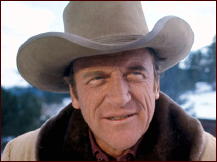
Genuine whodunits set in the Old West are certainly rare, which makes this episode of Gunsmoke from its final season slightly more interesting.
A serial killer (seen only in silhouette and shadow) equipped with a .30-caliber rifle and a silencer is stalking Dodge City, murdering at will, sniper-style. Since there seems to be no obvious connection of the victims with one another, his motive is completely opaque.
Marshall Matt Dillon must turn detective to find the connection, which he does — and yet, technically speaking, he really doesn’t — halfway through the show, prompting him to think Doc Adams will be the next victim.
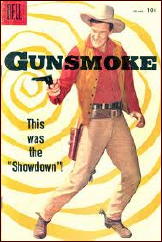
Using a willing Doc as bait, Dillon sets a trap, which is only partially successful, resulting in a severely damaged chair in Doc’s office and a wounded and therefore doubly dangerous sniper — who courteously sends Matt a note swearing revenge on him for interfering in his plans and calling him out for a midnight showdown — alone.
Feeling he has no better choice, Dillon appears on the deserted streets of Dodge, unaware that Doc and Festus have a surprise in store — but now fully aware of who the sniper really is ….
Since the plot centers on a woman, it’s interesting that there are no speaking parts for them in this episode. (By this time, Amanda Blake [Miss Kitty] had left the show after an argument with the producer.)
Unusually for this series, the episode takes place entirely on indoor sound stages.
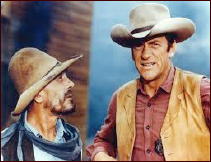
Ben Bates makes an appearance in the same scene with James Arness, which is of interest since he was Arness’s stunt double throughout the run of the Gunsmoke series.
The mystery and suspense level of “The Fourth Victim” is gratifyingly high, although experienced mystery aficionados should be able to figure it out early on. If only the writer had surreptitiously introduced the final clue sooner, say in the first act, Matt’s solution near the end wouldn’t have had that rabbit-from-a-hat feel to it.
As it is, however, “The Fourth Victim” is still worth a view. It can be seen in its entirety on YouTube here.
June 25th, 2012 at 10:20 am
I was a big fan of GUNSMOKE when it first began, which was 1955. I’m not sure whether I watched the first one or not, the one that was introduced by John Wayne.
Probably not, but my memory sometimes would like to think so.
When I watched the opening to this particular episode on YouTube, it took me by surprise that was in color, which was Dumb, because of course it was. But I don’t think I ever saw an episode in color before.
I had to look it up. The first season in color was 1966. By this time I was married, in grad school, and if we had a TV, it was a black and white one. We probably didn’t watch even GUNSMOKE. On a Saturday night? We were at the movies.
I have the first season on DVD and have begun watching it, but I’m stretching it out so I don’t overload by watching too many at once. I see the first half of Season 6 will be released in August. It will be long time before they get to Season 20, but I’m sure they will before I do.
June 25th, 2012 at 11:44 pm
Jim Byrnes worked over fifty episodes of GUNSMOKE so it is not surprising he wanted to (and was allowed to) try something different.
It didn’t feel like a Western, with its modern TV suspense soundtrack and the unbelievable weapon of choice. More clues would have been nice, but some suspects would have been better as the killer was no surprise. The killer’s motive was hinted at when Matt gets the guys together to patrol the curfew. And they played fair, with the killer not using his wounded arm to do something after the last death.
It was a good TV suspense story but I wonder if the regular viewers wanted a good TV Western instead.
Most Westerns had a moral. This one’s was “Kill ’em all and let God sort it out.” If only Sam Peckinpah had told Doc and the others earlier.
September 14th, 2018 at 2:21 pm
I just watched this episode on TVLand and didn’t think much of it. They’re looking for a gunman who shoots from a high angle, but keep patrolling the streets below. Hmm. How about camping out in a hayloft or a balcony?
Who goes to all the trouble of SEWING a metal plate into a chair? Why not just prop it in the chair? Was it imperative that Doc be comfortable? The gunman isn’t going to inspect it.
This didn’t have the feel of a Gunsmoke episode. I know Doc is stubborn but he was ridiculous in this one. No good Festus moments. All in all, awful. A poor mystery even on Hart to Hart.
August 11th, 2019 at 7:10 am
I’ve seen every gunsmoke movie at least a dozen times & still watch them every day. I missed something on this one though. When Potter hits Saxbe in the barn, he’s wearing brown. He turned right around, climbs the ladder & he’s dressed in blue. Explain that one for me.
July 21st, 2020 at 9:44 pm
This episode features references to Chester Goode aned Quint Asper (played by Dennis Weaver and Burt Reynolds, both long gone from Gunsmoke by season 20). It includes brief explanations of their in-story departures, and seems to directly refer to Weaver’s last appearance as Chester, in a ninth season episode titled “Bently.” Is there a connection between that earlier episode and this one? Does anyone know?
July 22nd, 2020 at 5:29 am
I’m sure there are GUNSMOKE experts out there who know, but since I’m not one of them, we’ll have to wait for one of those experts to come along. Sooner, rather than later, I hope!
January 15th, 2021 at 11:39 pm
It might be a very fine episode or it might be flawed. I couldn’t say one way or t’other. All I can say is: it definitely doesn’t sound like a plot from John Meston, Les Crutchfield, Anthony Ellis, Marian Clark, Herb Purdom, or Kathleen Hite! The always unsung, overlooked, forgotten stars of Gunsmoke…
January 16th, 2021 at 1:42 pm
Just a BTW: wasn’t the character ‘Quint Asper’ named above, more properly named, ‘Print Asper’?
January 16th, 2021 at 2:59 pm
Yes, indeed, you are correct. It’s a strange name, but Print Asper it is!
January 30th, 2021 at 12:29 am
Aha. ‘Chalk one up’ for the green whelp around here. I’m usually a poor hand when it comes to historical factoids. Not much of a head for recalling fine detail.
But Print Asper –his brother –and his father John Asper –is one of the most beautiful episodes of the radio Gunsmoke; (a series which contains many, many dozens of enthralling installments). John Asper is played by ‘regular’, Joseph Kearns (you know kearns as ‘mr. wilson’ on the ‘dennis the menace’ tv series).
This particular installment depicts a 2-day horseback trek across Kansas for a rancher’s hotheaded son and touches on the fine art of reading terrain.
I feel like an utter oddball mentioning it. But the storytelling skills are sublime.
Unusual (often deeply Biblical) character names are a frequent feature of the audio ‘Gunsmoke’. Series writer John Meston (western native) paid faithful attention to this trait of early Kansas and ‘the territories out west’.