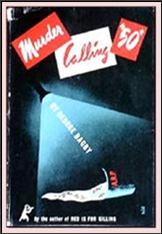
LAWRENCE FISHER – Death by the Day. Berkley G520; paperback original; 1st printing, April 1961.

   Bellboy Nick Paulson, a punk with big dreams, cuts himself in when he discovers that three new arrivals at the hotel (two men and a woman) have plans to snatch$75,000 in local jewels.

   A paperback original, totally obscure. Pure pulp. Very little plot. Sometimes Paulson noses around for pages, doing nothing but feeling sorry for himself. He’s probably got that right. No one else would.

— Reprinted from Mystery.File.3, February 1988.

TIM AKERS “A Murder of Knights.” Published in Sword and Planet, edited by Christopher Ruocchio (Baen Books, trade paperback, 2021).

   As the story begins, two men are on a quest, one they apparently have been ordered to be upon. We gradually learn what they must do. We never do quite learn who ordered them, but since the thrust of the tale does not depend on that, it does not matter. At some short length, they arrive at an isolated village where the mayor’s daughter has been abducted by a broodmother (think of something comparable to a monstrous spider-like creature, but worse).

   The question of the quest, and the tasks they are bound to do are now apparent.

   It is never quite clear on what world they are in. It may be Earth, it may not. It most probably isn’t. Technology seems to have previously existed on the planet. It does not now. Life is primitive in the world they are. The weapons they have are little better than swords, but magic also plays a part in their attack on the monster they must kill — or be killed by.

   There is, of course, little that is new in this tale. Many of us have read this short adventure many times, and for some of us, for a long time. Tim Akers, the author, tells it well. Here’s a short example:

   “… length of the blade, turning the blunt edge sharp, awakening the weapon’s divine power. I stared at it in horror, my mind frozen in place. I barely lifted my sword in time to block the slice that would have cut me in half if it had landed. The force of the blow shoved me off my feet. The sound of godsteel striking godsteel shrieked across the chamber. I hit the ground and slid.”

   
   You might think Mr. Akers is a young fellow, as I did when starting this tale, but he is 53 and has written several novels and short stories, perhaps all in a similar vein, but none of which have I noticed before. From the ending, I thought a sequel could easily have followed, but so far, such an event has not occurred.

   I would happily read it if it had.

THE SAINT DETECTIVE MAGAZINE – September 1957. Editor: Hans Stefan Santesson. Overall rating: ***

LESLIE CHARTERIS “The Good Medicine.” Simon Templar (The Saint). Novelette. The Saint brings pills to the rescue of a man whose wife has used him to build up a large pharmaceutical business. Pills guaranteed to keep away insects, but not the Saint’s brand of justice. (4)

AARON MARC STEIN “Battle of Wits.” A man patiently builds up a lot to get rid of his wife, but it fails by being smarter than the sheriff it’s supposed to fool. (3)

AUGUST DERLETH “Adventure of the Little Hangman.” Solar Pons. Novelette. Solar Pons discovers the murderer, but provincial solidarity keeps the man from prison, in its own form of absolute justice. (4)

LOUIS GOLDING “The Vandyke Beard.” A man’s return from prison, and his effect on his family and relatives. (3)

RICHARD HARDWICK “He Came Back.” Murder on a shrimp boat, and retribution, pulp-style. (3)

RICHARD SALE “Ghosts Don’t Make Noise.” Daffy Dill. Novelette. Published previously as “Ghosts Don’t Make No Noise” in Detective Fiction Weekly, 07 June 1941. Daffy Dill is almost convinced that a ghost does exist, and this fact helps trap the murdered man’s killer. (3)

FREDRIC BROWN “Mr. Smith Kicks the Bucket.” Henry Smith. Published previously in Detective Story Magazine, August 1944, as “Bucket of Gems Case.” Mr. Smith, insurance investigator, is on the scene when a candy jewel is stolen, and then has the real one, to the surprise of all. (4)

SAX ROHMER “The Headless Mummies.” Morris Klaw. Published previously in The New Magazine (UK) October 1913, as “Case of the Headless Mummies.” Morris Klaw knows the secret of why museum mummies are being decapitated. Oriental poppycock. (1)

CHARLES FRITCH “First Job.” Illuminating story of how a juvenile delinquent is born. (2)

— April 1969.

THE MASK OF DIMITRIOS. Warner Brothers, 1944. Peter Lorre, Sydnay Greenstreet, Zachary Scott. Faye Emerson, Steven Geray. Screenplay by Frank Gruber, based on the novel A Coffin for Dimitrios, by Eric Ambler. Director: Jean Negulesco.

   When a mystery writer named Leyden (Peter Lorre) is shown the body of a man identified as Dimitrios Makropoulos (Zachary Scott) in a morgue in Istanbul, he becomes obsessed in learning more about the man’s career as an international spy and criminal agent.

   Much of the film that follows comes in the form of a series of flashbacks taking place across Europe and finally to Paris, where a man who calls himself Peters (Sydney Greenstreet) makes him an offer that moneywise is hard to refuse.

   While the movie follows the book extremely well (as I recall), the stories that have taken place in the life of Dimitiros are, while interesting in themselves, tend to meander a little. Until, that is, the setting changes to that of a small apartment in Paris, when the pairing of Peter Lorre and Sydney Greenstreet and the plans they make together (and how those plans work out) make for an insidiously sinister plot in true film noir fashion.

   Those two actors, when playing in the same film, are more, somehow, than their individual roles, a fact that is difficult to explain, but together they were the best in the crime and espionage business, filmwise at least.

         ___

PLEASE NOTE: While I have done my best to avoid telling you too many details of the story, the clip provided above comes toward thee end of the film. As such, if you have not seen the movie, and you think you might care to, please watch the clip judiciously.
   

A 1001 MIDNIGHTS Review
by Kathleen L. Maio


MICHAEL GILBERT – The Black Seraphim. Hodder & Stoughton, UK, hardcover, 1983. Harper & Row, US, hardcover. 1984. Penguin, US, paperback, 1985.

   Michael Gilbert is one of the most versatile and prolific practitioners of the British mystery since the Golden Age. He has published over 300 short stories and over twenty mystery novels, of which The Black Seraphim is but the latest. He has published thrillers, novels of intrigue, police procedurals, and classic detective puzzles-and has shown himself to be competent or better at all of them.

   The Black Seraphim qualifies as a classic mystery puzzle with modern flourishes. The amateur sleuth is no amateur but a professional pathologist, James Scotland, on an R-and-R visit to a British cathedral town. When the archdeacon is killed, Scotland’s rest turns into a stress-filled busman’s holiday.

   The detection is handled along traditional lines. Gilbert, however, is interested in more than a puzzle. He enjoys examining the conflicts within the cathedral close, as well as the tensions between the secular community and their religious neighbors. With young Dr. Scotland as sleuth, there is an additional opportunity for an occasional debate over faith versus scientific inquiry.

   The puzzle is worked out nicely, the characterization is excellent, and there is even a love story for them that likes ’em. Not one of Gilbert’s finest novels, The Black Seraphim is nonetheless very fine indeed.

   Outstanding among Gilbert’s other non-series books are The Family Tomb (1969). The Body of a Girl (1972; Inspector Mercer’s only appearance in a novel, although he is featured in a number of short stories), and The Night of the Twelfth (1976).

     ———
   Reprinted with permission from 1001 Midnights, edited by Bill Pronzini & Marcia Muller and published by The Battered Silicon Dispatch Box, 2007.   Copyright © 1986, 2007 by the Pronzini-Muller Family Trust.

ELSPETH HUXLEY – Murder on Safari. Inspector Vachell #2. Methuen, UK, hardcover, 1938. Harper & Brothers, US, hardcover, 1938. Perennial Library, US, paperback,1982. Viking, US, hardcover, 1989.

   Superintendent Vachell of the Chania Police [in Kenya] is brought in when Lady Baradale’s jewels turn up missing, then finds murder on his hands when the lady is found dead, near a pond full of hippos but shot between the eyes.

   [A replica of a] small isolated English village taken to an extreme – one hundred miles from the nearest civilization. Most satisfying. The only whodunit (outside of Carr?) with footnotes to [point out] the clues – all fairly stated and still not much more.

— Reprinted from Mystery.File.3, February 1988.


      The Inspector Vachell series —

Murder at Government House, 1937.
Murder on Safari, 1938.
The African Poison Murders, 1939.

FRANK GRUBER – The Laughing Fox. Johnny Fletcher & Sam Cragg #5. Farrar & Rinehart, hardcover, 1940. Serialized earlier (?) in Short Stories magazine, July 10 through August 25, 1940. Penguin, paperback, May 1944. Belmont-Tower, paperback, 1972.

   Book salesmen Johnny Fletcher and Sam Cragg, on the scene at a midwestern cattle convention, are forced to act as detectives when a man is found murdered in their hotel room. The man was a fox breeder, with enemies among the other exhibitors, but he was killed as the consequence of a mystery involving a missing heir who disappeared twenty years before.

   With a story meant primarily as fun, Gruber has too casual an attitude toward his plot, Fletcher and Cragg are happy scoundrels who mostly enjoy the scrapes they get into. But on page 49 [of the Penguin edition], Fletcher tells the police the whole story of how they found the body in their room, then on page 99, he is confronted with the story as if the previous episode had never happened.

   Not for serious deduction

Rating: **

— April 1969.


NOCTURNE. RKO Radio Pictures, 1946. George Raft, Lynn Bari, Virginia Huston, Joseph Pevney, Myrna Dell. Screenplay: Jonahan Latimer. Director: Edwin L. Marin.

   When the death of womanizing songwriter is ruled a suicide by the coroner, a stubborn police lieutenant refuses to quit investigating the case. His primary suspect, however, is a woman he could easily fall in love with (even take home to his mother).

   Raft is as stiff an actor in this movie as he ever was. Even his love scenes with Lyn Bari lack any kind of spark. The bit players are what make this movie at all worth seeing – the mystery is only so-so, with the murderer essentially confessing to make it easy.

— Reprinted from Movie.File.2, April 1988.


Reviewed by TONY BAER:


   Criminal confessions constitute some of the earliest hardboiled crime writing. This was back when people still believed in heaven and hell, and a forgiving God, who in exchange for a pure confession, might allow the soul of a repentant convict to traverse the pearly gates.

   Jesse Strang abandoned his wife in Ohio, assumed the name Joe Orton, and ended up in Albany, New York, a guest at Cherry Hill mansion.

   He’s at a bar, and there’s a wild girl there, pretty inviting. ‘Joe’ tells his buddy at the bar he wouldn’t mind playing hide the salami with the chick. And his buddy says he’s had her himself, and she’s there for the asking.

   Her name is Elsie Whipple. That’s Mrs. Elsie Whipple to you.

   And they flirt. She’s also a denizen of Cherry Hill mansion. They pass notes. Agreeing to burn after reading.

   She wants to know his intentions. She says she loves him, she never thought love was possible, til now. She wants to run away with him, but she can’t, at least not until she gets her hands on $1200 to open a pub.

   See, she had money. But old Mr. Whipple took it. She’d love to be a wife to Joe — but she wants them to do it right. Hence the need for money.

   Maybe he’d kill Mr. Whipple for her. Do you love me enough to do that for me? He beats me. Please kill him — or else I’ll have to kill myself.

   She gives him a taste of how good it can be, in the barn, in the spare bedroom. It’s pretty great.

   Okay okay. He’ll do it. So they can be together.

   And he does.

   She immediately turns him in. And shows his letters to the cops.

   And so, the hangman.

   And the confession.

   This sordid tale’s been around long before James M. Cain. Cain just honed down the prose and made it sing. Like Mrs. Whipple.

   Read it here.

A 1001 MIDNIGHTS Review
by Kathleen L. Maio


ANTHONY GILBERT – Mr. Crook Lifts the Mask. Arthur Crook #38. Random House, US, hardcover, 1970. Beagle, US, paperback, date?. Published earlier in the UK as Death Wears a Mask (Collins, UK, hardcover, 1970).

   Lucy Beatrice Malleson’s mystery-writing career spanned almost fifty years and well over fifty novels. While she started her career as Anthony Gilbert with a polished and gentlemanly sleuth, Scott Egerton, Liberal M.P. and man about town, she is best known and loved for a very different kind of detective. In 1936 she introduced Arthur Crook. cockney lawyer, detective, and “The Criminal’s Hope.”

   Of course, Crook’s clients are always innocent. And like Perry Mason, with whom he otherwise has very little in common, Crook always proves his client’s innocence by bringing the real murderer to justice.

   In this late Gilbert title, Arthur Crook plays advocate and protector for a spunky spinster named May Forbes. On her nightly sojourn to “Broomstick Common” to feed the wild cats, she stumbles upon a man (in balaclava helmet and mask) about to bury a suspiciously large bundle. While fleeing this fearsome figure, May retreats into a noisy pub, and so into the life of Mr. Crook.

   The bundle turns out to be the body of a young woman of loose morals and avaricious ambition. There are plenty of men who might have wanted the victim dead. One young fellow (not surprisingly, an out-of-towner) is arrested for the crime, but since May is sure of his innocence, Crook investigates.

   The puzzle of Mr. Crook Lifts the Mask is perhaps a little too easy to guess. but the characters, especially May (or “Sugar,” as Crook calls her) and her man-hating. sharp-tongued friend, Mrs. Politi, are a delight. Arthur Crook. with his irrepressible optimism, his colorful slang. and his ancient yellow Rolls, “The Superb,” is a memorable sleuth. And Gilbert is skilled at creating tidy puzzles and eccentric characters.

     ———
   Reprinted with permission from 1001 Midnights, edited by Bill Pronzini & Marcia Muller and published by The Battered Silicon Dispatch Box, 2007.   Copyright © 1986, 2007 by the Pronzini-Muller Family Trust.
Next Page »