Uncategorized


Reviewed by Tony Baer:


VICTOR HEADLEY – Yardie. The X Press, UK, hardcover, 1992. Pan Books, UK. paperback, 1993, 2018. Atlantic Monthly Press, US, hardcover, 1992.

   D. is a mid-level coke dealer in Kingston, Jamaica. His outfit sends him to London with a British passport and a couple bags of coke. He’s met by the London contacts at the airport and they head for a house to complete the deal.

   D.’s job is to hand over the coke, get the money, hang out for a bit, and fly home with the dough.

   But D.’s got bigger plans.

   At the London dealer’s home, D. asks to use the toilet, and escapes out the bathroom window (protected by a silver spoon), with half the goods in tow.

   D.’s got some buddies in the London slums (which are high living compared to the Kingston ghettos), including Donna, a woman he’d come to know biblically in his youth.

   D. is smart with his stake, and leverages it to become a kingpin in the London crack trade.

   The Jamaican drug lords have much less ruth than their non-Jamaican competitors, having been de-moralized by rabid conditions back home. They are quick to kill, and quick to a drug hued hegemony, to greater and greater wealth and power.

   And then an international syndicate moves in….

           ——

   It’s a good mob book, a 90’s Jamaican Little Caesar set in London with pitch perfect dialect, Caribbean vibes, and parties with a dub soundtrack. My only real complaint is an unfinished ending, feeling like the writer wanted to make sure he didn’t do anything too drastic, lest spoiling options on a sequel.

Codes and Ciphers
by Robert C. S. Adey.


   Originally published in The Mystery Lover’s Newsletter, 1969. Vol II No. 6, pp. 10/11:
   

   Like so many other things, Mr. Edgar Allan Poe started it all, though this time the illustrious forerunner was not the much-cited “The Murders in the Rue Morgue”, but instead that equally fine quintessence of its form, “The Gold-Bug.” Published in 1843 and yet, today, still as readable as ever, it is the first detective story where the major detection was not that of a crime or of a criminal, but of a vital message contained in a cipher.

   And then in the highest tradition of the detective story, Sir Arthur Conan Doyle followed on from Poe, and produced his Sherlock Holmes masterpiece, “The Adventure of the Dancing Men”. This time the cipher concealed (amongst other things) a sinister warning to a victim rather than the clue to a lost treasure.

   However, both stories contain the same basic element, a secret message put before the reader in its clandestine form and then later, carefully, clearly and minutely translated into plain words by the ingenious inventor.

   And after Sir Arthur? Well, certainly not the deluge. Since those matchstick men danced their way off the last page of their story, few indeed have been the short story writers who have ventured cautiously into the demanding world of the code and the cipher. The rigorous and exacting nature of the work, however, has had its compensations (for the reader, at any rate), inasmuch as only the most painstaking and articulate of authors have managed to sell a convincing product on this market.

   If you happen across a good example of this kind of short story, then you can lay odds that it will be exclusively good and fashioned by a master-craftsman.

   The reason for this, on reflection, is self-evident. To succeed the story must contain the original cipher or coded message – it cannot be so simple that it is effortlessly construed by the reader and yet must not be so complicated that it defies any sort of comprehensible and communicable translation.

   The author must, therefore, not only be able to conceive a formula of secret writing, but must also be able to translate it for his reader in a clear and intelligible way. No great wonder, then, at the smallness of that illustrious band who have succeeded in doing all of these things within the confines of a short story.

   In fact, just who are the members of this select company? Poe and Sir Arthur we have already mentioned, but what of those who followed on? Careful examination of my library and an intensive brain-wracking session eventually brought forth — somewhat reluctantly — more names. The ingenious Melville Davisson Post, R. Austin Freeman (inevitably), that brilliant writer Dorothy L. Sayers, O. Henry and F.A.M. Webster. A list was drawn up and appears as follows:

      Author       Story       Book

(l) Edgar Allan Poe. The Gold-Bug, from Tales
(2) Sir Arthur Conan Doyle, The Adventure of the Dancing Men, from The Return of Sherlock Holmes
(3) R. Austin Freeman, The Moabite Cipher. from John Thorndyke’s Cases
(4) Melville Davisson Post, The Cuneiform Inscription, from The Bradmoor Murder
(5) Melville Davisson Post, The Great Cipher, from Monsieur Jonquelle
(6) O. Henry. Calloway’s Code, from Whirligigs
(7) F.A.M. Webster. The Secret of the Singular Cipher, from Old Ebbie Returns
(8) Dorothy L. Sayers, The Fascinating Problem of Uncle Meleager’s Will, from Lord Peter Views the Body
(9) Dorothy L. Sayers, An extract, from Unnatural Death

   (This last item, in fact, was not written as a short story; but part of chapters 26 and 29, in combination with the whole of chapter 28, form a separate story and probably the cleverest example of all.)

   Thus far I had a total of only nine short stories when every fibre in my orderly being was crying out for a nice symmetrical list of ten. I began to pound mercilessly through my list of likely authors again. Ellery Queen? Surely the master of· the cryptic clue would qualify for a place? But no, the nearest I could find were a couple of ineligible dying-message short stories, plus a number of novels (including “Face to Face,” “The Scarlet Letter” and “The Finishing Stroke”) which could in no way be distilled to the size of a short story. (Who would, want to distill Ellery Queen anyway?)

   Agatha Christie? Despite such promising titles as “N or M?” and “The A.B.C. Murders,” I could find no short story of hers to fit the bill. Then for a brief illusory moment, I thought I had it and dug out from an old Ellery Queen magazine “The Message on the Lawn” by T.S. Stribling. The title sounded just right, but on re-reading the story I found that it didn’t quite suit the occasion, Poggioli or no Poggioli.

   I had reached a point of desperation and was manfully steeling myself to the arduous task of battling my way through all my old favorites, Allen, Anderson, Bailey, Bennett, Bentley, Berkeley, etc., — right through to Zangwell, when suddenly a bombshell of an idea exploded in my vortex of a mind.

   Why should I do all the work, I asked myself, when there are dozens of readers out there, idling away their time, who could do it for me? Dozens of readers who, in combination, would have a much wider knowledge than I could possibly have and would be able, without difficulty, to supply that elusive tenth title (and perhaps disagree with the other nine)’ At one fell swoop I would be introducing a competitive element, gain an introduction to lots of interesting stories and, last but certainly not least, save myself a great deal of time and trouble. A positive masterstroke!

   And so, without apologies, this is what I am doing, leaving it to you, the perceptive and omnivorous reader. There are no prizes, other than perhaps the egotistical satisfaction of seeing your name in print. The editor, in being able to decide whether or not a suggestion shall be printed, is, ipso facto, the final arbiter. For my part I shall sit back in my easiest easy chair and await your comments with an appropriate air of self-satisfied detachment— and a good detective story.

   (Mr. Adey, 27, works as a civil servant in the Department of Health and Social Security, Birmingham, England. He reports that he likes his detective fiction literate and has a preference for the “set piece” mysteries of Queen, Millar, Carr, Christie, Brand, Berkeley, etc. His chief grouse is “with the so-called literary critics who dismiss a book simply because it is a detective story.”)

         ****************************************

   Some replies to the plea for readers’ help were printed in the next Vol. III, No. 1, October 1969, pp. 15/16, with the magazine now renamed as The Mystery Reader’s Newsletter.

      From Amnon Kabatchnik, Binghampton, N.Y.

   In order to help Adey relax into his easy chair let me add the following Code and Cipher stories to his list: THE PUZZLE LOCK by R. Austin Freeman from “The Puzzle Lock and Other Stories”; THE STOLEN CHRISTMAS BOX by Lillian de la Torre from “Dr. Sam Johnson, Detector”; THE WHITE ELEPHANT by Margery Allingharn from “Mr. Campion, Criminologist”; THE FOUR SUSPECTS by Agatha Christie from “The Tuesday Club Murders”. There must be more.

      From Joe Christopher, Stephenville, Texas

   In re: Adey’s “Codes and Ciphers”. Anthony Boucher has a very brief but tricky cipher in “The Numbers Man” (EQMM, June 1953). Another Boucher cipher (which I haven’t read) is “QL 696.C9” (EQMM, May 1943). An example of a cipher from John Dickson Carr is “The Adventure of the Wax Gamblers” in Carr and Adrian Conan Doyle’s THE EXPLOITS OF SHERLOCK HOLMES.

      From Michael Wahl, Los Angeles, Calif.

   For Robert C.S. Adey, I recommend the following stories:

Elsa Barker, The Key in Michael, from The C.I.D. of Dexter Drake (EQMM, May 1942)
R. Austin Freeman. The Puzzle Lock, from The Puzzle Lock
E.C. Bentley, The Ministering Angel, from an early EQMM [September 1943]
M.R. James. The Treasure of Abbot Thomas, from Ghost Stories of an Antiquary
Anthony Boucher, QL 696 .C9, from EQMM, May 1943
Agatha Christie. The Four Suspects, from The Tuesday Club Murders
Edgar Wallace, Code No. 2, from EQMM, Spring 1942
Harvey O’Higgins, The Blackmailers, from Detective Barney
Margery Allingham, The White Elephant. from Mr.·Campion, Criminologist
Alfred Noyes, Uncle Hyacinth, from Walking Shadows
Lillian de la Torre, The Stolen Christmas Box, from Dr. Sam Johnson, Detector

   The above stories are all available in Famous Stories of Code and Cipher, edited by Raymond T. Bond, published originally by Rinehart and now in print as a Collier paperback.

A 1001 MIDNIGHTS Review
by Marcia Muller


EDITH PIÑERO GREEN – Rotten Apples. Dearborn V. Pinch #1. E. P. Dutton, hardcover, 1977.  Berkley, paperback, 1982.

   Dearborn V. Pinch is described by one of Ms. Green’s publishers as “the world’s oldest and cleverest detective.” At well over seventy, the former at least may be true.

   Pinch, a charming and enterprising old gentleman who still has a sharp eye for the ladies, receives a visit from old flame Antoinette Ormach, who reveals her long-standing membership in the Rotten Apple Corps. This group of eleven, founded in the Thirties, had one characteristic in common: All had committed some sort of minor crime — from poisoning a rival’s dog on the eve of a dog show to plagiarizing a poem that later won a national award. Now the remaining members of the group have begun to die in suspicious circumstances, and Antoinette is afraid she may be next.

   Dearborn has been known lo help out friends with delicate problems they do not wish to take to the police, and Antoinette asks him to look into the matter. Dearborn declines, but when Antoinette is murdered, he undertakes an investigation out of a sense of obligation. As Dearborn probes into the lives of the Rotten Apples, he becomes convinced that one of the group wishes to see the others dead — a true rotten apple; and as he crisscrosses New York City in search of that person, he encounters more peril than any septuagenarian is entitled to.

   Dearborn is an endearing character and, with the exception of L.A. Morse’s “Old Dick,” the horniest old man in mystery fiction. This entertaining elderly sleuth (who combines the best of the little-old-lady detectives with quirks of his own) reappears in Sneaks (1979) and Perfect Fools (1982).

———
   Reprinted with permission from 1001 Midnights, edited by Bill Pronzini & Marcia Muller and published by The Battered Silicon Dispatch Box, 2007.   Copyright © 1986, 2007 by the Pronzini-Muller Family Trust.

Back to the Wells, Part 6:
The Food of the Gods
by Matthew R. Bradley


   Paul Lehr’s vivid 1967 painting to illustrate H.G. Wells’s The Food of the Gods and How It Came to Earth (1904) is the least representational of his quintet for my beloved Berkley Highland editions. In muted earth tones, it depicts rocky hills and a plain occupied by tiny crowds of people and several giant eggs, plus a huge, newly hatched chick; the largest is in the foreground, with a crack through which what appears to be a mammoth eye can be seen. Standing in front is an indistinct green, robed and hooded figure suggesting a bizarre hybrid of the Statue of Liberty and the Grim Reaper, with one arm upraised, and the other holding what might be a book, yet also seems to evoke the tablets bearing the Ten Commandments.

   Book I, “The Dawn of the Food,” introduces Bensington, a Fellow of the Royal Society and former president of the Chemical Society, and Professor Redwood, a physiologist in London University’s Bond Street College, “grossly libelled by the anti-vivisectionists.” A “mere first cry of astonishment from Bensington,” who formally names their discovery the “nutrition of a possible Hercules,” the title phrase (hereinafter FOTG) is used by the nameless narrator for the breakthrough iteration, Herakleophorbia IV. Redwood (who’d suggested Titanophorbia, “Food of Titans”) posited that irregular growth is due to “some necessary substance in the blood,” periodically used up and “only very slowly replaced.”

   Bensington isolates this substance; sets up an Experimental Farm at Hickleybrow, near Urshot in Kent; hires Alfred Newton Skinner (whose lisp Wells tiresomely transcribes) and his wife to oversee its use on chicks; and sees success in seven months. Ominously, he also sees enormous ratholes upstairs, a wasp eating the FOTG in the room where the slovenly Skinners mix it with meal and bran, and feline bones, “picked very clean and dry.” Shown one of the chicks, Redwood reveals that when his son—attended by former pupil Dr. Stephen Winkles—wasn’t putting on weight, he slipped a little into Edward’s bottle: he “can’t get on with his ordinary food again, anyhow. He wants some more…”

   Trouble begins as the hens escape, after “seven weeks of steady, uninterrupted growth,” and Godfrey, a keeper on the estate of Lieutenant-Colonel Rupert Hick near Maidstone, kills the first of the giant wasps, which claim a grocer. As Skinner tells the scientists the effects of their carelessness upon fauna (e.g., earwigs) and life-threatening flora (stinging nettles, canary creeper), his wife decamps—with two tins of the FOTG—for her married daughter’s in Cheasing Eyebright. Meanwhile, the pullets wreak havoc in Hickleybrow and Urshot, but the news Skinner, back from London, gleans from the locals at the Jolly Drovers does not include his wife, and he vanishes after heading for the farm to seek her.

   Two pullets are caught by a Tunbridge Wells circus proprietor; two nights later, a doctor barely escapes an attack on his buggy by giant rats near Hankey; the next day, Redwood reports that Teddy continues to grow, his eventual height estimated by Bensington at 35 feet. Cossar, a civil engineer, rallies the pair and five others for a “fight with insurgent Bigness,” blowing up the wasps’ nest, shooting the rats, and burning the farm along with the carcasses—while Mrs. Skinner is feeding the FOTG to her grandson, Albert Edward Caddles. In a “spreading circle of residual consequences about the Experimental Farm …a power of bigness…radiated from that charred but not absolutely obliterated centre.”

   Wells shifts focus to Bensington, suddenly famous amid public indifference to Redwood, while the FOTG—dubbed “Boomfood” by Punch — is fed by Cossar to his three sons and by Winkles, whose interest is increasingly proprietary, to the Princess of Weser Dreiburg. There is talk of outlawing its manufacture or circulating knowledge of it, while the Prime Minister’s cousin, Caterham, proposes one of several societies to regulate or suppress it. Cossar builds a giant nursery for his and Redwood’s boys as we learn that upon reaching adolescence, children no longer require periodic doses of the FOTG; by adulthood, they stabilize at “the new scale,” c. 40 feet high, and are capable of producing giant offspring.

   When Redwood refuses to reveal the formula for the FOTG, Winkles experiments with it at his summer cottage in Keston, where—about to be entrusted by the Royal Commission on Boomfood with control of its preparation and sale, having persuaded them that further accidental leakages are impossible—he creates one. Lukey Carrington, a teacher seeking algae samples in a pool tainted with the residuum, is attacked by blood-sucking larvae of the Dytiscus beetle, saved with garden shears by a lad clipping Winkles’s hedges. These are followed by various species and centres of distribution: Ealing (flies and red spiders), Sunbury (eels “that could come ashore and kill sheep”), and Bloomsbury (cockroaches).

   They were later found to correspond to Winkles’s patients, but the public indignation was turned on Bensington, rescued from a Caterham-extremist Hyde Park mob’s lynching by a clerk, who takes him to another flat via the fire escape in a ventilator shaft, and Cossar, who smuggles him away in drag. Retiring to the Mount Glory Hydrotherapeutic Hotel in Tunbridge Wells, he passes out of the story as Book II, “The Food in the Village,” finds it spreading worldwide, the Children of the Food growing steadily as leakages make history and Caterham’s influence waxes and wanes. As a microcosm of these events, Wells uses the Kentish village where the Caddles baby’s growth spurt begets reports of Hypertrophy.

   These bring Redwood, telling Mrs. Skinner not to reveal her role, but the brouhaha over the FOTG forces exposure; threatened with damages, he proposes withholding it, aware that the deprived child’s yelling will level Cheasing Eyebright. Albert gets a rudimentary education from the Vicar, and Lady Wondershoot—the “village tyrant” on whose charity the family depends—insists that he be employed, eventually working her chalk quarry at Thursley Hanger singlehanded. Adolescence prompts thoughts about class division and, observing a kissing couple in Love Lane, all the things from which he is excluded, while Mrs. Skinner, Lady Wondershoot (self-exiled to Monte Carlo), and the Vicar pass away.

   In Book III, “The Harvest of the Food,” a convict pardoned after 20 years emerges to find the world much changed by the Boomfood, and falls under the sway of Caterham, who as the General Election approaches has demonized the Children. Her arranged engagement to a normal-sized Prince understandably problematic, the Princess has been kept ignorant of other giants until, visiting England, she and young Redwood are “mated” at first sight, but as scandal threatens to part them, royalty and commoner seek refuge with the Cossar boys. Meanwhile, young Caddles rebels, wrecks the chalk pit, and heads for London, yet the recently elected “Jack the Giant-killer” has imposed restrictions on their movements.

   After Caddles is killed in a confrontation with the police, Redwood pére is arrested as the conflict widens, with 13 giants killed and his son wounded approaching the Cossar camp, where the survivors gather and bombard London with the FOTG. Caterham calls a truce and sends Redwood (who tells Cossar, “We have made a new world, and it isn’t ours”) to offer his terms: they will live in a “great region” set apart for them, make no more Food, have no children, and then end forever. Cossar’s son vows to “fight not for ourselves but for growth, growth that goes on for ever. To-morrow, whether we live or die, growth will conquer through us. That is the law of the spirit…To grow according to the will of God!”

   The Food of the Gods was “adapted” not once but twice by Bert I. Gordon (1922-2023), as Village of the Giants (1965) and under its own title in 1976, although it seems unlikely that Wells would recognize, or at least acknowledge, it as the source of the former, where boy chemist Genius (“Ronny” Howard) discovers the growth-enhancing substance that he dubs “Goo.” The property was ideal for “Mr. B.I.G.,” who directed, produced, co-wrote, and/or created the special visual effects for more than a dozen genre films. While he was active through the 1980s, he is best known for works epitomizing the monster movies of the ’50s, and featuring oversized fauna of the two-, four-, six-, and eight-legged varieties.

   Gordon featured photographically enlarged lizards in King Dinosaur (1955), irradiated locusts in The Beginning of the End, and a 25-foot giant in The Cyclops (both 1957). He came into his own, and began an association with American International Pictures (AIP), with his signature film, The Amazing Colossal Man, inspired by The Incredible Shrinking Man (both 1957). This led to a sequel, War of the Colossal Beast, and such follow-ups as Attack of the Puppet People and Earth vs. the Spider (all 1958), as well as the children’s fantasy The Boy and the Pirates , the ghost story Tormented (both 1960), and one of his most polished productions, The Magic Sword (1962), with Gary Lockwood as St. George.

   Village was scripted by Alan Caillou, from Gordon’s screen story, and opens with Jack Nitzsche’s instrumental theme song, “The Last Race,” used as the main title for Death Proof, Quentin Tarantino’s half of the faux double feature Grindhouse (2007). Fred (Beau Bridges) leads a group of troublemaking teens: Rick (Bob Random), Pete (Tim Rooney), Harry (Kevin O’Neal), and their girlfriends Merrie (Joy Harmon), Jean (Tisha Sterling), Elsa (Gail Gilmore), and Georgette (Vicki London). When they crash their car outside fictional Hainesville, California, during a severe storm, Fred remembers meeting local girl Nancy (Charla Doherty), Genius’s older sister, and they decide to look her up.

   Meanwhile, Goo is lapped up accidentally by both a stray cat and the family dog, Wolf (Higgins), and deliberately fed to two ducks by Nancy’s boyfriend, Mike (Tommy Kirk), who envisions a lucrative end to food shortages. Top-billed Kirk, whose homosexuality torpedoed his Disney stardom, devolved into AIP’s Beach Party series with Pajama Party (1964), opposite Disney co-star Annette Funicello, and Ghost in the Invisible Bikini (1966). Fred’s gang occupies a deserted theatre, then repairs to the local go-go, where the fugitive fowls’ “dancing” is a hit; the ducks are followed there by Mike and Nancy, out of whom Jean and Fred, respectively, try to worm the “million-dollar secret,” but without success.

   As suggested by their friends Horsey (Johnny Crawford) and Red (Toni Basil, the film’s choreographer), the couple barbecues the ducks and feeds the town at a picnic, where the gang learns that Genius created Goo. After Mike electrocutes the giant spider threatening Nancy, they sneak into the house, triggering his DIY burglar alarm but making off with a sample following a rumble with Mike and his friends, including Chuck (Hank Jones). On a whim, the gang eats the Goo, soon outgrowing their clothes in a mildly titillating scene, and in at least a thematic nod to the novel, they decide to turn the tables on the adults who have always pushed them around: “This isn’t their world anymore—it’s gonna be ours.”

   Turning the theatrical costumes into inevitably revealing makeshift outfits, they gyrate to “The Last Race” (shown, colorized, behind the opening credits), as Merrie clasps Horsey to her ample cleavage. The gang takes over the town, cowing the Sheriff (Joseph Turkel) by holding his daughter, Cora (Debi Storm), hostage, and confiscates all their guns; while Mike fetches them Chicken Delight, one is shown reading Famous Monsters of Filmland #23 (June 1963), with Gordon’s Colossal Beast on the cover. Seen in Stanley Kubrick’s The Killing (1956), Paths of Glory (1957), and The Shining (1980), Turkel had a brief but unforgettable role as ill-fated Replicant creator Dr. Eldon Tyrell in Blade Runner (1982).

   After an abortive attempt by teens driving hot rods (including designer Ed “Big Daddy” Roth’s Surfite, a tiny yellow beach buggy complete with surfboard) and motorcycles to lasso Fred as a hostage of their own, Nancy is taken to join Cora. As Mike plays David to Fred’s Goliath, distracting the others, Horsey, Chuck, and Fatso (Jim Begg) drug the guard, Merrie, with ether, free the hostages, and recover the guns. Genius discovers an antidote and sprays the giants with it from his bicycle, whereupon they return to normal and are run out of town, with Mike decking Fred, but as they reach the wrecked car, they see a septet of “little people,” directing them to Hainesville, “where they have the Goo.”

   The film features second-generation actors Bridges, the son of Lloyd and elder brother of Jeff; future Oscar-winning film director Howard, whose father, Rance, plays the deputy; Sterling, the daughter of Robert and Ann Sothern; and Rooney, the son of Mickey. The songs are performed by musical “guest stars” the Beau Brummels, Freddy Cannon, and Mike Clifford. Frank Inn trained four-legged co-stars Higgins, later the lovable mutt in Benji (1974), and Orangey Minerva, aka Rhubarb, the only two-time feline winner of the American Humane Association’s PATSY (Picture Animal Top Star of the Year) Award, the Oscar’s animal equivalent, also seen in Shrinking Man and The Comedy of Terrors (1963).

   Jones, who appeared in numerous live-action Disney films during the 1960s and ’70s, told me that his “main memory was during the film’s post-production when I attended the first screening at the studio [it was made for Joseph E. Levine’s Embassy Pictures]. My Dad was visiting L.A. on business that night, and I invited him to go along with me to the screening. The movie progressed its showing, and as it went along it was obvious to both of us that it certainly was no Citizen Kane [1941]. The movie continued on until it arrived at a sequence when the young cast, me included, got into a big free-for-all fight/melee where fists were flying—both with the boys and the girls in the mix [and a] big dog-pile of flailing bodies…

  “[F]rom the bottom of the pile I popped up holding a large woman’s bra and yelling, ‘Hey—who’s a size 40???’ My Dad, whose mouth gradually had been falling open from the [start], then leaned over to me…and said, ‘FOR THIS—YOU WENT TO STANFORD!!??’ [But ]ong-lasting friendships grew out of this crazy movie for me, especially with character actor Jim Begg and Johnny Crawford. It was Jim and I who lowered Johnny down into a huge mock-up of Joy Harmon’s mammoth bazooms which Bert Gordon created that endear the film to its many buffs (Joy was unforgettable in the sexy car-wash sequence of Cool Hand Luke [1967]. She later attained fame running the best cake-bakery in Burbank).”

   After Village, Gordon directed the supernatural stories Picture Mommy Dead (1966) and Necromancy (1972), the presumably self-explanatory How to Succeed with Sex (1970), and the police thriller The Mad Bomber (1973). He then returned to his favorite theme of gigantism with back-to-back Wells adaptations for AIP of Food (credited, with unusual forthrightness, as being “based on a portion of the novel”) and, extremely loosely indeed in 1977, “The Empire of the Ants” (The Strand Magazine, December 1905). Gordon’s wife, Flora, aided him in various capacities—most notably with the effects—on Village and many others, serving on Food as the unit production manager and assistant director.

   Football players Morgan (Marjoe Gortner) and Davis (Chuck Courtney) and their P.R. man Brian (Jon Cypher) seek some R&R on an isolated island in British Columbia where Davis, separated from the others while riding, is found dead and deformed. Seeking aid at a nearby farm, Morgan sees giant chickens in the barn of Mrs. Skinner (Ida Lupino); she believes that the strange substance bubbling up from the ground is Heaven-sent, but fears that rats are eating it. Indeed they are: the murine monsters kill her husband (John McLiam) as he returns from negotiating on the mainland with selfish businessman Jack Bensington (Ralph Meeker) to market the Food, while huge worms injure Mrs. Skinner.

   Also returning from the mainland are Morgan and Brian, whom the coroner has told that Davis appears to have been stung to death by 250 wasps, and Bensington arrives with his assistant, bacteriologist Lorna Scott (Pamela Franklin, a veteran of Necromancy). After Morgan and Brian blast the giant wasps menacing Bensington, blow up the nest, and save Lorna from a rathole, Thomas (Tom Stovall) and pregnant lover Rita (Belinda Balaski)—stranded on the island—flee their rat-besieged R.V. and take refuge at the farm. They are briefly protected when Morgan electrifies a fence in the lake, but rats wreck the generator and kill Brian; Bensington dies trying to retrieve the Food that Morgan dumps in his rage.

   With the survivors barricaded inside the farmhouse, Morgan and Thomas slip out to blow up the dam with pipe bombs as Mrs. Skinner and a rat engage in mutual destruction and, in the hoariest of clichés, Rita chooses that moment to go into labor. The humans take to the roof while the otherwise brown rats drown, unable to swim due to their colossal size, and Morgan clubs their white leader to death with a rifle. The carcasses are destroyed in a huge bonfire, along with the contents of the remaining jars labeled “F.O.T.G.,” yet in a typical sting-in-the-tail ending, one makes its way downstream to a mainland dairy farm, and we see children drinking the tainted milk—a cue for a Village of the Giants remake?

   The cast is eclectic, to say the least: former child evangelist Gortner had villainous roles in Earthquake (1974) and Viva Knievel! (1977), while Franklin started at the top as Flora in The Innocents (1961), also appearing in the Richard Matheson adaptation The Legend of Hell House (1973). Of the old guard, Meeker had made an indelible Mike Hammer in Robert Aldrich’s brilliant Kiss Me Deadly (1955), and Lupino parlayed her leading-lady status during the 1940s into a pioneering directorial career in film and television. Balaski would begin a decades-long association with Joe Dante on Piranha (1978), and McLiam memorably played the crusty old drunk in Robert Wise’s The Andromeda Strain (1971).

   It would be tempting to make a joke along the lines of, “A story so big [ha ha], it needed two movies to tell it!,” but in fairness, rather than simply repeat himself, Gordon chose—in his own uniquely exploitative way—to focus on very different aspects of the sprawling saga. Food and Empire certainly jumped on the bandwagon of Nature strikes back/eco-horror/“when animals attack” films epitomized by Willard (1971), its sequel Ben, Frogs (both 1972), Jaws (1975), Grizzly (1976), Day of the Animals, Kingdom of the Spiders (both 1977), et derivative cetera. However, the less said about the in-name-only Gnaw: Food of the Gods II (1989), in which a growth serum turns lab rats into giants, the better.

   Coda: I see from my diary that on July 25, 1976, I conned my father into taking me to see this, which he described as “the pits” of his filmgoing experience; way to go, Bert!

      .Edition cited/works consulted:

Brosnan, John, Future Tense: The Cinema of Science Fiction (New York: St. Martin’s, 1978).
Hardy, Phil, editor, The Overlook Film Encyclopedia: Science Fiction (Woodstock, NY:Overlook, 1995).
Internet Movie Database (IMDb)
Internet Speculative Fiction Database (ISFDb)
Wells, H.G., The Food of the Gods and How It Came to Earth (New York: Berkley Highland, 1967).
Wikipedia

      Online sources:

https://archive.org/details/1965-village-of-the-giants.

   Portions of this article originally appeared on Bradley on Film.

JOHN FARR – The Deadly Combo. Ace Double D-301, paperback original; 1st printing, 1959. Published back-to-back with Murder Isn’t Funny, by J. Harvey Bond (reviewed here).

   Mac Stewart us only a cop in a prowl car, but when the body of Dandy Mullens is found, the captain gives Mac the freedom he needs to bring the killer in. Dandy was a great musician, once upon a time, and Mac was a friend, even when the other man fell upon hard times.

   The first half of this story has a beat, the beat of the city, the jazz clubs, the midnight hours, the strippers — the beat of the street. The second half does not match the first half, and the solution to the mystery is as rushed as an obligation unfelt.

— Reprinted from Mystery.File.5, May 1988.

PHILIP K. DICK – Galactic Pot-Healer. Berkley X1705, paperback original; 1st printing, June 1969. Cover art: Sandy Kossin. Reprinted a number of times.

   Joe Farnwright, pot-healer, living a spider’s existence in a garish, nightmarish world on Earth, afraid of failure, lacking in self-knowledge, is hired by Glimmung, of Plawman’s Planet, to help in the raiding of the ancient cathedral Holdscalla.

   Glimmung corresponds to Faust, never satisfied, willing to sacrifice himself to learn the extent of his abilities. Glimmung also contends with the continuing Book of the Kalneds, which tells of the past, the present, and of the future. The book says he will fail. (See page 102 for a discussion of probability.)

   Much wit, much for discussion, but the book does not succeed as a story. The plot is overblown, with too many wild concepts to be taken completely seriously, The last line is a winner.

Rating: ****

— June-July 1969.


J. HARVEY BOND – Murder Isn’t Funny. Mike Lanson #3. Ace Double D-301, paperback original, 1959. Published back-to-back with The Deadly Combo, by John Farr (to be reviewed here on this blog soon).

   J. Harvey Bond was the pen name of Russ Winterbotham (1904-1971), who was probably better known as a writer of science fiction, both novels and short stories, starting as far back as 1935 and “The Star That Would Not Behave” as R. R. Winterbotham in the August issue of Astounding SF for that year.

   All of Winterbotham’s detective novels were written as by J. Harvey Bond, and all four were mysteries tackled by a newspaper reporter by the name of Mike Lanson. Murder Isn’t Funny is the second of the four.

   Thus were the opening three paragraphs of my review of Kill Me with Kindness , which was the third of the four. You can find it reviewed here. What follows is the original review I wrote for Murder Isn’t Funny.

   Newspaper reporter Mike Lanson gets involved with murder again – he was the hero of all four of Bond’s ,mystery novels — this time of the artist-creator of the “Dream Man” comic strip. It’s science fiction, high adventure stuff, and it sounds pretty bad.

   And so’s the book. But maybe it’s not all the author’s fault, What it reads like is like watching a movie edited for TV, with chunks cut out here and there to make it fit the time slot. When Lanson breaks the killer’s alibi, I didn’t even know he/she had one.

— Reprinted from Mystery.File.5, May 1988.

BADMAN’S TERRITORY. RKO Radio Pictures, 1946. Randolph Scott, Ann Richards, George ‘Gabby’ Hayes, Ray Collins, Chief Thundercloud, Lawrence Tierney, Tom Tyler, Steve Brodie, Isabel Jewell. Director: Tim Whelan.

   Back in the late 1800s, or so, as the narrator of this film tells us, the Oklahoma panhandle was a land of without law, where gangs of gunslingers congregated and ruled the towns they lived in. Enter Randolph Scott, a lawman in search of his brother, facing every outlaw in the West.

   I messed up on this one. I watched a 98-minute movie crammed into a 90-minute time slot, less commercials. The plot is there. Little things like motivations are not. Maybe there weren’t any, but who could tell? A full report some other time, perhaps.

— Reprinted from Movie.File.2, April 1988.

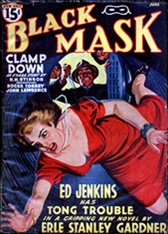
C. P. DONNEL, JR. “The Fourth Degree.” Duc Rennie #2, First appeared in Black Mask, February 1941. Reprinted in Ellery Queen’s Mystery Magazine, December 1953.

   I don’t know very much about C, P. Donnel, Jr., the teller of this tale, nor his hero Doc Rennie. I believe in fact that this is my first time reading anything by the author. In a post on his Pulpflakes blog, Sai Shankar tells us that Donnel (1906-1977) was “a crime reporter on the Norfolk Virginian-Pilot for a decade before switching to writing fiction.” He wrote several dozen stories for the better detective pulp magazines in the 40s, of which 14 or 15 were Doc Rennie yarns.

   We don’t learn much about Rennie in “The Fourth Degree,” but elsewhere on the Internet, I discovered a short squib (since lost) describing him as a psychiatrist, perhaps retired or perhaps working for the government. He lives now is a small rural town where he helps he local sheriff solve the cases he comes across. (It is the latter who tells the stories.)

   In this story the two protagonists are convinced they know who one of the culprits in a local kidnapping case is. The problem is that they can’t get him to talk. Not a word out of him, no matter how hard they try, and as always, time has a way of running out. It may have been a new idea in 40s, but the scheme they come up with is that of “continuous catastrophic noise” (my phrasing), and it saves the day.

   The plot is minor, and keeping one of the players off the page for much of story was not the best idea, either. Donnel is a good writer, though, based on this story, but if his name was on the cover of the issue he next appeared in, it wouldn’t induce me to come up with the fifteen cents to obtain it, not even a small notch in the right direction.

Next Page »