Wed 4 Mar 2020
Movie Review: MURDER ON THE CAMPUS (1933).
Posted by Steve under Mystery movies , Reviews[14] Comments
NOTE: This review from the past was first posted on this blog on August 24, 2012. The video link had gone black, so in the process of replacing it, I decided to allow everyone the chance to read it again.
—
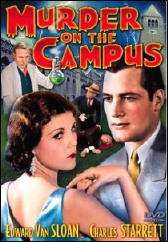
MURDER ON THE CAMPUS. Chesterfield Pictures, 1933. Shirley Grey, Charles Starrett, J. Farrell MacDonald, Ruth Hall, Dewey Robinson, Maurice Black, Edward Van Sloan, Richard Catlett. Based on the novel The Campanile Murders, by Whitman Chambers (Appleton, 1933). Director: Richard Thorpe.
Obviously a change in title from the book to the film was in order, since I’m sure that not one person in a thousand knows what a “campanile†is, then or now. Though you could look it up on your own, what it is, is a bell tower, such as commonly found on college and university campuses. And the significance of that is, is that is where the body of a student is found, shot to death in the temple with the wrong hand.
What makes this otherwise ho-hum of a mystery interesting is that he was the only one at the top of the building. He was playing the carillon when the music suddenly stopped, and a shot rang out. No one is seen leaving the tower. The only door at the base was watched by a throng of students. No one is found in the tower, either. The building is too high and too far out of range for a bullet to have killed him from outside. It is definitely murder, though. There is no gun in the building, and there are no powder marks on the body.
The detective in charge of the case, Police Captain Kyne (J. Farrell MacDonald), a grizzled veteran of the force who doesn’t seem to mind brash young reporter Bill Bartlett (Charles Starrett, boyishly handsome and long before he became the Durango Kid) tagging along as he randomly interrogates suspects and hunts for clues.
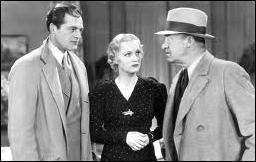
Bartlett has his own reasons for keeping an close eye on him. Besides getting the scoop for his paper, he’s in love with one of the chief suspects, Lillian Voyne (Shirley Grey). The latter is not only a student at the school (unnamed, unless I missed it) but she’s also a singer at a local night club. Strangely enough, she’s seen studying for a chem exam for all of two minutes in the movie and not singing once at all, not for an instant. I don’t know why, but I found myself disappointed.
The school does have a chem lab where professor C. Edson Hawley (Edward Van Sloan) hangs out, but as for classrooms, I don’t remember seeing a one. The dead student, it seems, was not doing well in his course work, failed to meet expectations as a member of the track team he was recruited for, and according to head of the fraternity house where he lived, “he lacked the cultural background a college man should have.â€
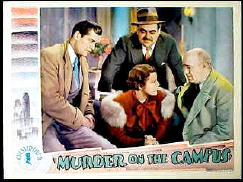
Which is an attitude beside the point, I suppose, or it is? But I have not forgotten about the locked room aspect of the murder, along with the mysterious fact that the gun that used to commit the crime was somewhere else at the time.
The gimmick, as I would readily agree to call it, is a good one, and it would be even better if the investigation conducted by both of the separate parties (police and reporter) made more sense.
What I really like to do is to read the book and say that the original author did a much better job with it. I have a strong feeling that he did, but the fact is I don’t own a copy, nor is there one offered for sale right now by anyone on the Internet.
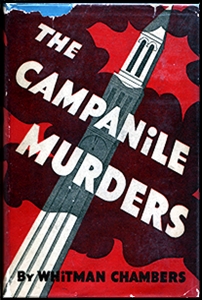
UPDATE [03-05-20]: In conjunction with his Comment #8. Bill Pronzini sent me a cover image of The Campanile Murders, by Whitman Chambers. And here it is:
August 25th, 2012 at 9:28 am
I found part of the book in the Milwaukee “Sentinel” July 16 1933. It was apparently serialized in “American Weekly” section of the paper.
It gave a recap of what had happened before then ran Chapter 10.
I found it at Google.com/newspapers, not the easiest place to use. I’ll try for the direct link…
http://news.google.com/newspapers?nid=1368&dat=19330716&id=GE9QAAAAIBAJ&sjid=Sg0EAAAAIBAJ&pg=6814,2714532
August 25th, 2012 at 9:30 am
Coincidentally, I just saw and enjoyed this movie a month ago. It is a rare Hollywood film of an impossible crime.
Have been unsuccessfully trying to track down this book too. It is praised in Robert Adey’s bibliography LOCKED ROOM MURDERS AND OTHER IMPOSSIBLE CRIMES.
Have read a few pulp short stories by Whitman Chambers.
They are blandly written, in terms of story telling. But they have some solid mystery plots.
IIRC, “campanile” is the standard Italian term for bell tower, especially near a church. It is much less common in English.
August 25th, 2012 at 12:41 pm
Michael (Comment #1)
Thanks for the link. If there’s an easy way to move around the scanned pages so you can read them, I sure wasn’t able to find it.
But I can tell you that the film stuck very closely to the part of the novel I was able to read. I found only minor changes, such as changing the name of nightclub owner from Whitey Atwater to Blackie Atwater. Some of the dialogue sounded word for word.
The book, though, has to fill in a lot more about the characters. That’s where the presentation in the movie seemed the skimpiest.
The installment shown in the newspaper supplement comes early in the novel, so there’s no way of telling how close the ending of the film came to the end of the book, but I can’t see any reason why they shouldn’t be the same.
August 25th, 2012 at 12:45 pm
Mike (Comment #2)
My copy of Adey’s book on Locked Room mysteries has temporarily gone missing. It’s usually right next to me by the desk I’m sitting at now.
So thanks for letting me know that The Campanile Murders got some favorable notice there. Makes me wish the book weren’t so hard to find. The writing is a bit crude by today’s standards, from the portion I was able to read through Michael’s link, but the same might be true about most mysteries written in 1933.
August 25th, 2012 at 12:52 pm
It had slipped my mind until I was in the middle of typing up that last comment, but I posted a review I wrote of another Whitman Chambers mystery just over three years ago:
https://mysteryfile.com/blog/?p=1366
The title is DEAD MEN LEAVE NO FINGERPRINTS, and what’s more it’s another locked room mystery. Here’s what I had to say about it, in part:
“While the murder method may be a bit far-fetched (and Chambers makes it sound as though it just might work, maybe), the motive(s) is/are — well, let’s just say ‘interesting’ is the key word, without saying how likely it (or they) may be.”
November 12th, 2019 at 11:14 pm
I think the review is mean-spirited. Unlike so many movies, the denouement is believable. The villain could not blast our hero because of the noise. It’s a rare film – I don’t mean just for the excellent writing, directing and acting – but because the villain is on the loose at the end.
And how come no-one mentions that amazing dance with the big balloon ball by I believe Sally Rand.
I will look for more films with these people in them.
Pat
November 12th, 2019 at 11:20 pm
Patrick
I don’t believe my review was mean-spirited. I never try to be. I just think you liked it more than I did, and I’m glad you did. Given a chance, I’d watch it again!
March 5th, 2020 at 12:30 am
The film follows THE CAMPANILE MURDERS fairly closely, but the book is much better — the characters reasonably well delineated and the impossible crime more clearly explained. Not a great LRM novel, but nonetheless deserving of Bob Adey’s praise. One of the small presses would do well to reissue it.
March 5th, 2020 at 1:39 pm
Well, I certainly hope that some small press is listening. I’ve just checked and just as when I first posted this review, there are no copies of this book being offered for sale by anyone on the Internet.
And thanks for sending me a photo image of the cover you have of the book, Bill. Who knows, your copymay be one of a kind!
March 5th, 2020 at 6:12 am
Did my review inspire this re-post?
I didn’t think your review was mean spirited or unfair to the movie, which was fun and had plenty of charm, but the plot and clueing were far from perfect. However, I loved watching actors from the 1930s act out an actual locked room mystery from the period. It gave the movie something that even the best modern adaptation can never replicate.
I agree with Bill that Whitman Chambers’ locked room mysteries need to be reprinted.
March 5th, 2020 at 1:46 pm
TomCat
As a matter of fact, the answer to your question is Yes. I saw your review (link below) and I said to myself, I remember seeing that movie. I wonder if I ever wrote up a review of it. Turns out the answer was yes, I had, and Voila!
http://moonlight-detective.blogspot.com/2020/03/for-whom-bell-tolls-murder-on-campus.html
March 5th, 2020 at 11:48 am
A classic from the past. Speaking of which what is the latest on the future of Mystery*File? Will reviews such as this and or the comments still vanish at the end of the month? I continue to look forward to posting and reading M*F but consider the lost of the past content a pop culture tragedy.
March 5th, 2020 at 1:50 pm
Michael
I probably should have kept everyone appraised of the situation as time has gone on, but until it’s a fait accomplie, I’ve been hesitant in getting anyone’s hopes up. But since you’ve asked, let me say that I’m cautiously optimistic. No high fives yet, in other words, but we’re working on it.
March 6th, 2020 at 11:27 am
My fingers are crossed, Steve!