Sun 24 Feb 2013
A TV Series Review by Michael Shonk: BARBARY COAST (1975-76).
Posted by Steve under Reviews , TV Westerns[23] Comments
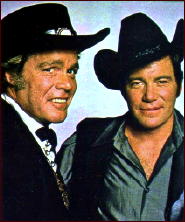
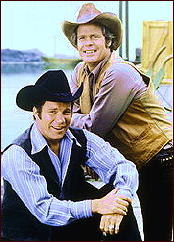
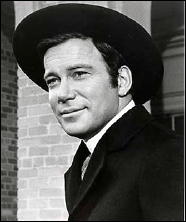
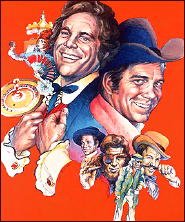
BARBARY COAST. ABC, 1975-76. Fancy Productions Inc., in association with Paramount. Created by Douglas Heyes. Executive Producer: Cy Chermak. Cast: William Shatner as Jeff Cable, Doug McClure as Cash Conover, Richard Kiel as Moose Moran and Dave Turner as Thumbs.
To read my earlier review of the BARBARY COAST TV-Movie, click here.
The series kept the TV Movie basic premise. Jeff Cable, master of disguise and undercover agent for the Governor of California (in the TV movie Jeff called himself a cop, in the series he called himself a spy) was out to bring law and order to the wild 1880’s Barbary Coast. Aiding him is the less than willing Cash Conover, owner of the Golden Gate Casino, Moose Moran the Golden Gate barker and bouncer, and Thumbs the casino’s piano player.
But changes were made. Most important, gone was creator Douglas Heyes, replaced by producer Cy Chermak (THE VIRGINIAN, IRONSIDE, KOLCHAK THE NIGHT STALKER) who lacked the experience in adult light drama/comedy of Douglas Heyes (MAVERICK, ALIAS SMITH AND JONES, BEARCATS!).
The series tone became lighter, more appropriate for a younger audience. Gone was Dennis Cole as Cash Conover, the biggest crook on the Barbary Coast. Doug McClure (THE VIRGINIAN, SEARCH) had a lighter more likeable persona than Cole and was better at the show’s growing comedic tone.
It had been awhile since TV had had a successful Western, but those paid by advertising agencies to forecast what shows would attract an audience believed BARBARY COAST Western format would attract more than the Science Fiction series INVISIBLE MAN airing opposite on NBC. They were wrong. But it didn’t matter as the CBS Top 10 lineup of RHODA and PHYLLIS destroyed both of them.
From the first week the ratings were basically the same. For September 8th BARBARY COAST finished 63rd out of 66 with a 12.0 and 21 share. NBC’s INVISIBLE MAN had a disappointing 16.3 and 28 share (30 share was usually needed to avoid cancellation). Both CBS’ RHODA with a 22.8 and 40 share and PHYLLIS with a 25.2 and 42 share finished in the top ten.
By late October ABC decided to switch BARBARY COAST with another rating disaster MOBILE ONE, and October 31,1975 BARBARY COAST moved to Friday at 8pm opposite NBC’s major hits SANFORD AND SON and CHICO AND THE MAN, and CBS’ BIG EDDIE and MASH. BARBARY COAST remained in the bottom five of the ratings and was cancelled by mid-November.
The reviews were bad. “Broadcasting†(September 22.1975) published excerpts from various newspaper TV critics reviews.
Morton Moss of the Los Angeles “Herald Examiner†wrote, “…a couple good actors, William Shatner and Doug McClure, and various gaudy ingredients that could add up to a vibrant western swashbuckler. But it doesn’t…â€
From the Chicago Tribune Gary Daab, “It is hilarious to watch one of American’s raunchiest era – the 1880s Barbary Coast – being sanitized into a hunkey-dorey juvenile cartoon suitable for TV’s new family hour. Almost, but not quite, beneath contempt.â€
This was the first season for FCC ordered “family hour.†No one knew what to program in the time slot. But a fun entertaining grown-up Western with bad men and easy women such as the TV Movie version of BARBARY COAST belonged in the 10pm time period not at 8pm when the kiddies where watching. In a fatale mistake ABC decided to adapt the series for the time slot.
From “Broadcasting†(August 2, 1976): “Last September, ABC’s BARBARY COAST, CBS’s THREE FOR THE ROAD and NBC’s THE MONTEFUSCOS and FAY were handicapped right from start (and were cancelled early) when pre-empted by affiliates that either had their own locally produced hours to put in primetime or had expensive syndication properties such as ITC’s SPACE 1999 that needed primetime airing to recoup prices.â€
So, a premise that needed a more adult time slot, competed against top ten rating hits, and had fewer stations than normal airing the program meaning fewer people available to watch, all virtually dooming BARBARY COAST to failure.
I have seen four episodes of the series. I remain interested in seeing the series first episode “Funny Money†written by Douglas Heyes and with Flame (Bobbie Jordan), Cash’s lover still in the cast (according to IMdB).
EPISODE INDEX:
Check out this clip containing scenes from episodes “Crazy Cats.†“Jesse Who?†and “Guns For the Queenâ€:
https://www.youtube.com/watch?v=3RPR5bgBvZ8
“Crazy Cats.” (9/15/75) Written by Harold Livingston Directed by Don Weis Guest Cast: Eric Braeden, Joanna Miles and Andrew Prine. *** Jeff needs to find and return to the Chinese government two priceless Jade cats stolen while on view in California.
Entertaining, but predictable. Perhaps its biggest weakness was a disappointing action ending that was too much filler and silliness (why set bombs to block your exits?).
“Jesse Who?” (9/22/75) Written by Howard Berk Directed by Bill Bixby Guest Cast: Rosemary Forsyth, David Spielberg and Lloyd Bochner. *** A man calling himself Jesse James is robbing banks in San Francisco.
The femme fatale and her motives make this predictable story almost interesting.
“The Ballad of Redwing Jail.” Teleplay by William D. Gordon and James Doherty. Story by Matthew Howard (Douglas Heyes). Directed by John Florea Guest Cast: Andrew Duggan, Ralph Meeker and James Cromwell. *** Jeff and Cash have to find some way to recover money buried inside the Redwing Jail without the greedy Sheriff finding out.
This episode made me sad, as the production values that had been a plus had now virtually disappeared, revealing Paramount’s loss of faith in the show.
Burdened with a dumber script than usual the only reason to watch this is to see Ralph Meeker show a surprisingly believable light comedic side.
“Gun for a Queen.” (10/6/75) Teleplay by William Putman Story by Matthew Howard (Douglas Heyes). Directed by Don McDougall. Guest Cast: John Ericson, Fred Beir and Joan Van Ark *** An old girl friend of Jeff and Cash arrives with a new husband who is there to buy some stolen guns for a revolution.
Some good twists but flawed by the near slapstick action scenes.
I remember liking this series when it was on. Watching it now there are moments when it is entertaining and fun, but overall the series is disappointing, one of failed potential.
February 25th, 2013 at 9:39 am
This is not a series I remember seeing, but from the video clips, it looks like one I’d enjoy watching. (This is the longest write-up about it that I’ve ever read.)
But looking at the shows it was up against, I never watched any of them either. We must have had plenty of other things to do at the time.
February 25th, 2013 at 10:56 am
Like so many of us you were reading alot of books, especially mystery novels and SF. In your case you were also reviewing alot of novels for your mystery fanzine. I believe this was prior to the great run of Guy Townsend’s MYSTERY FANZIER, so you didn’t review for that magazine until the 1980’s.
When did you review for one of the Hartford newspapers? That’s something you don’t see much of anymore: book reviews!
February 26th, 2013 at 1:02 pm
In 1975, ABC was in the ratings wilderness.
For the whole first half of the decade, nothing they tried seemed to work. This is what led to ABC’s hiring Fred Silverman away from CBS late that year.
Because Silverman arived too late to do anything about the fall schedule, he simply let everything on the network fend for themselves, meanwhile kick-starting development on anything he could find and putting all the chips on whatever even halfway was working.
What that means is that ABC’s 1975 fall schedule had already been given up for lost by the time Barbary Coast had its series premiere.
This also held for all of ABC’s other fall newbies – with the sole exception of Welcome Back, Kotter, which Silverman protected and promoted into mild hit status, which ultimately grew into major hit status once teen viewers saw John Travolta.
Given these circumstances, it makes little difference whether Barbary Coast was itself good or bad; all that mattered was that Fred Silverman had had no say in either its creation or its scheduling, and so didn’t care about developing any potential it might have had.
Two semi-irrelevant side notes for your amusement:
– The brief mention of Mobile One, which swapped Titanic deck chairs with Batbary Coast that fall, was a show I had a kind of soft spot for, for a kind of odd reason.
This was a Jack Webb production about a TV news unit, with Jackie Cooper as an intrepid reporter. It followed the Adam-12/Emergency template, with sequential stories set against workplace vignettes at the TV station.
When Mobile One was announced, I was intrigued to see that the line producer would be William Bowers, one of Hollywood’s grteat screenwriters (best known for The Gunfighter), and also one of its great characters.
Once the series underway, I was delighted to see that Bowers (who’d done some cameo acting before) had given himself the on-camera part of the TV station’s weatherman, for comic relief. He only managed to get into a few of the episodes, but I enjoyed seeing him; he had bloodhound features and a wonderful growly voice, and was a pure delight.
The rest of the series – meh.
(Oh, if you’d like to see Bowers in something really good, he’s the chairman of the Senate committee investigating Al Pacino in Godfather II.)
– Even more irrelevant:
Your passing mention of The Worst TV Critic Ever, Gary Deeb of the Chicago Tribune (then, anyway).
That, by the way,is his real name – Deeb. I think it’s Lebanese.
Deeb was a self-promoter, a front-runner, and an incorrigible feuder with just about anybody, whether on the air, on rival papers, or even on his own paper.
Deeb had two major agendas when he came to Chicago from Buffalo, NY in the early 70s:
– to win a Pulitzer Prize for his TV columns:
– to become an on-air personality himself.
He never came close to the first, in part because he diligently antagonized the management of every Chicago paper he worked at (actually it was only two – the Tribune and the Sun-Times – but they were the only two papers left in town by the end of Deeb’s time in Chicago).
Deeb did manage to get some on-camera work after he’d destroyed his newspaper career:
as a daily “TV critic” at the local ABC station, and on a short-lived NBC prime-time gossip series hosted by Rona Barrett.
We in Chicago got some laughs at these appearances;
For years in his columns, Deeb had savagely maligned ABC’s management at both network and local levels, always in negative comparison to NBC.
Deeb had also loudly derided Rona Barrett and her gossip empire as “non-journalism” and “cheap celebrity worship”.
These assessments suddenly vanished when Deeb found himself employed by both entities.
Gary Deeb pretty much vanished from the Chicago scene circa 1990 or thereabouts. Apparently he returned to his native Buffalo and “semi-retirement” – which I make to be code for “unemployable”.
I suppose I ought to say something about Barbary Coast, so here goes:
Loved that theme music.
February 26th, 2013 at 1:43 pm
While we are off-topic: Mike Doran, I loved your sidebar on Gary Deeb; reading about how he dreamed of winning a Pulitzer and how he “antagonized the management of every Chicago paper he worked for” had me thinking of Carl Kolchak. Ironic, then, that this Time magazine article (alas, fully available to subscribers only — damn those firewalls) references his reputation as the “wolf-man of the airwaves — the sourest, crudest ravager of the medium since Spiro Agnew.”
http://www.time.com/time/magazine/article/0,9171,913782,00.html
February 26th, 2013 at 1:45 pm
There was a period when “Broadcasting” magazine would reprint small excerpts from various newspapers reviews of new shows. I find the worst TV critic at the time was New York “Times” John O’Connor.
I rarely cared who wrote the review. In Los Angeles I enjoyed Michael Wilmington. I usually enjoy reading Peter Travers of “Rolling Stone.” Rex Reed was always the most reliable, if he liked it I hated it and if he hated it I would like it. Reed may be a poor excuse for a human being, but he is helpful.
As for Gary (Daab is how “Broadcasting” spelled it) except for the cheap shot at the end he best expressed one of the major problems that killed the doomed series.
February 26th, 2013 at 1:45 pm
Chermak, I should add, was a producer on the Kolchak: The Night Stalker TV series!
February 27th, 2013 at 12:05 pm
After I posted yesterday, curiosity got the better of me and I started looking up Gary Deeb and what had happened to him.
I’ve had some luck in the past tracking down “lost celebs” on the net, but the sheer lack of info about Gary Deeb surprised me.
One thing that surprised me was learning that he’d been in Chicago as late as 1995. That was about 5 years after he’d lost his TV gig at the ABC station; it apparently took that long for Gary to realize that nobody wanted to hire him.
The most recent story about Deeb that I was able to find was about how he was selling letters that had been written to him by well-known media people, both local and national, during his tenure as a “critic”.
And he was selling them on E-Bay – to the highest bidders.
Why anyone does something like that with personal keepsakes is, of course, their own business, but my understanding is that this sort of thing usually happens after somebody passes on, to replenish a
February 27th, 2013 at 12:14 pm
(continued from a misstruck key)
… to replenish a depleted estate.
I also learned that Deeb had just gone through a divorce (his second) before leaving Chicago, which might account for some of that depletion.
Deeb doesn’t even have a Wikipedia entry (none that I could find, anyway), and you don’t get deeper into obscurity than that.
But then, nobody ever earned obscurity more than Gary Deeb.
Went a little off-track here, didn’t I?
Sorry.
It’s just that even after all these years, Gary Deeb is somewhat of a legendary figure here in Chicago.
Sort of like the Clavey Road Sewage Ditch.
(And for the same reason.)
Maybe next time I’ll think of something to say about Barbary Coast …
February 27th, 2013 at 3:18 pm
Weird that I remember the theme tune for BARBARY COAST note for note after all of these years. My sister and myself were probably drawn to watch it because we were STAR TREK fans, and whenever a cast member turned up in something new we felt a sort of responsibility to support it.
There’s a mention of the show in Shatner’s autobiography. He recalls how you could tell the show was failing because every week the number of extras in the background got less and less. By the end the bar looked like a ghost town.
February 27th, 2013 at 6:22 pm
Also in the book #9 BRADSTREET noted Shatner “wrote,” about how the number of costume changes each episode grew less and less. In one episode he claimed he wore one costume for the entire episode.
He mentioned he was “thrilled” when they were cancelled so he could do his “favorite” thing, look for another job.
In “Shatner Rules Deluxe” by Shatner with Chris Regan, Rule 21 was:
“in 1975, I starred in a television series called BARBARY COAST, in which I played a nineteen-century government agent and master of disguise. I think it was a great show, but I notice I’m never invited to speak at BARBARY COAST conventions.”
February 28th, 2013 at 1:33 pm
Hey, that’s pretty funny about how Barbary Coast extras became an endangered species, in view of the whole Star Trek “redshirt” phenomenon. Now there’s a show that knew how to treat its extras, gaining them eternal fame.
February 28th, 2013 at 4:14 pm
I liked how they cut back on costumes for a series where the lead is a master of disguise. That is really not caring any more.
January 25th, 2014 at 9:58 pm
I remember seeing Barbary Coast when I was about 13, just one episode, the one where some poor guy was mistaken for John Wilkes Booth, the assassin of President Lincoln. Jeff Cable and Cash Conover had to save him from being lynched. The show reminded me of Wild Wild West and I watched it mainly because of William Shatner in Star Trek, although I also liked Doug McClure, who
was previously Trampas on The Virginian. The theme song was my favorite part of the series. In retrospect, it really wasn’t all that bad.
Back in those days, the initial competition
as I recall was David McCallum’s Invisible Man series on NBC (I only saw the pilot movie but have the show on commercial DVD now) and Rhoda and Phyllis (which I personally despised) on CBS. No wonder
Barbary Coast ended up moved and then
cancelled altogether.
I have found a little of the series on
DVD from collectors. The pilot movie
The Barbary Coast co-starring the late Dennis Cole as Cash Conover (prior to
Doug McClure) was aired in syndication
during the 80’s but not since then. I have it (poor quality) and 4 of the episodes
that aired on TV Land briefly in the 90’s
as part of the Saturday “TV Land Goes West”
lineup. I am looking for the remaining 8,
which seem nowhere to be located. Since Paramount seems to own the rights to it,
it would be nice if somehow it were eventually released on commercial DVD
one of these days as Bearcats (another
show created by the late Douglas Heyes)
recently was (except for its pilot movie
Powderkeg, which is owned by other parties
separate from the series).
I always wondered why Doug McClure replaced
Dennis Cole in the Barbary Coast series.
I have heard a story about what possibly happened but out of courtesy for the memory of Mr.Cole who passed away in 2009 I will not repeat it here.
Interestingly, the front entrance of the
Cash Conover’s Golden Gate Casino had a
brief cameo appearance later on in the
1995 short-run Western-science fiction
TV series Legend starring Richard Dean
Anderson and John De Lancie, which once
upon a time aired on the now-defunct
UPN (Paramount). The episode in question
was “Clueless In San Francisco”; Cash
Conover and Jeff Cable naturally had
been long gone and no mention was made
of their present whereabouts whatsoever.
I found that amusing. I assume the set
has since been torn down.
I liked the show but as a master of disguise
in comparison to Wild Wild West and with all
due respect to Mr. Shatner, the late Ross Martin as Artemus Gordon on Wild Wild West
did it a whole lot better and was far more
believeable especially when it came to the
dialects he used for his undercover roles.
I did read in a magazine interview years ago around the time of the Star Trek movies that
Mr. Shatner said that he remembered Barbary Coast well and was not ashamed of his role in it. The main problem with his Jeff Cable
role was that he was too closely identified
with Star Trek and Captain Kirk, I would imagine, as was Doug McClure with Trampas.
That’s just my opinion, however, but I will
admit, their characters Cable and Conover
were quite likable.
I also remember Conover’s quote–used by
Cole five times in the pilot–“Cash makes no enemies.” McClure even used it in at least
one episode. And those are my memories
of Barbary Coast.
January 26th, 2014 at 1:56 pm
Jim, thanks for dropping by here and at the review of the TV movie pilot to share your memories.
I discussed some of the changes in my review. It was basically because the network wanted a lighter kid-safe tone. McClure was better for the light comedy style.
CBS actually owns the rights. Some years ago CBS and Paramount were both owned by Viacom run by Summer Redstone. CBS bought all the rights to Paramount’s TV series. Then CBS split off from Viacom and Paramount (though Redstone controls both).
This series was going to be a big thing for Paramount and the studio turned a large part of its lot into creating the Western exteriors. As the show began to fail the amount of the exteriors began to shrink. I suspect the saloon survived quite awhile and made it into more than one Paramount Western.
February 2nd, 2014 at 4:53 pm
Just for fun and having nothing really better to do, I recently went back and watched my copies (acquired from other classic TV show collectors some years ago) of the Barbary Coast pilot movie and 4 episodes (the latter aired on TV Land once upon a time). My only regret is, I wish that TV Land would have at least run the first episode of the series, “Funny Money” even if they didn’t air the entire 12 episodes of the William Shatner-
Doug McClure version of Barbary Coast.
It would have been nice to have seen that.
I guess Shatner and Doug McClure fans are
fortunate enough just to have had the
opportunity to watch the 4 episodes alone.
Interestingly, I saw that Doug McClure
used the “Cash makes no enemies” quote
started by his predecessor Dennis Cole
in 2 of the 4 episodes: # 5 The Ballad
Of Redwing Jail and # 6 Guns For A Queen.
Whether he used it in the remaining 8
episodes that are missing or not remains
to be seen. I know for a fact it was not
used in either # 3 Crazy Cats or # 4
Jesse Who? Dennis however holds the record
for the most times it was used–4 in the
pilot movie. Shatner meanwhile was in
disguise 7 times as Jeff Cable in the pilot.
The statement made by critics and others
elsewhere that the show was a “rip-off” of
Wild Wild West I find inaccurate and was undeserved, as I am a long-time fan (since 1969) of the latter. Wild Wild West as I recall started off in its first season as
part-Western, part-spy show, and part-fantasy. When creator Michael Garrison
tragically passed away in 1966 during that
series second season, Bruce Lansbury was
brought in as executive producer and added
the science-fiction element which lasted
for the remaining 3 seasons of the series.
As far as Barbary Coast was concerned,
there was NO science-fiction in it
whatsoever as was in Wild Wild West.
Unless as everyone remembers William
Shatner was best known as Captain
James T. Kirk in the original 1960’s
Star Trek, that may have been as even
remotely close to science-fiction that
Barbary Coast ever had the chance to get!
Cable and Conover only went after normal
run-of-the-mill crooks, not the mad
megalomaniacs determined to take over
the West or the world as Jim West and
Artemus Gordon had to deal with.
If there is any sort of resemblance between
Barbary Coast and Wild Wild West, in my
opinion it would be because the late
Charles Aidman (Jeremy Pike, Ross Martin’s
temporary replacement in 4 episodes during
the fourth season) and Richard Kiel (Dr.
Loveless henchman Voltaire in 3 episodes
during first season) both guest-starred
in the pilot movie. Also Jeff Cable worked for then-General Ulysses S. Grant during the war as stated in the pilot. I’m sure that Douglas Heyes intended for it to be a totally opposite series on its own.
Perhaps it was inspired by Wild Wild West as later series Wildside (1985, ABC), The Adventures Of Brisco County, Jr. (1993, Fox) and Legend (1995, UPN) were. The fact that both shows were set in the West were purely coincidental. Wild Wild West was set in
the 1870’s, Barbary Coast in the 1880’s.
Two completely different shows. Granted, William Shatner and Doug McClure were no
Robert Conrad and Ross Martin by any stretch of the imagination, but they were good enough for me. Bill Shatner and Doug McClure
have nothing to be ashamed of. They gave it
their best efforts and made Barbary Coast like Wild Wild West a lot of fun to watch,
and still do. What little there is of it,
that is.
Kiel who went on to have the supporting role of Golden Gate Casino bouncer Moose Moran in the series and had the role of Jaws in the James Bond movie Moonraker after that, it should be humorously noted–who last I heard is still living as far as I know–in recent years became a minister and an author of children’s books after his acting days.
Maybe if Shatner/McClure/Barbary Coast fans
are lucky, Barbary Coast might get released
as other 1-season 1970’s cancelled shows–among them Man From Atlantis (1977, Patrick Duffy), Logan’s Run (1977, Gregory Harrison), Invisible Man (1975, David
McCallum), Kolchak–The Night Stalker
(1974, Darren McGavin), Bearcats (1971,
Rod Taylor, Dennis Cole), and Nichols (1972,
James Garner) have been recently–on DVD
where they all rightfully belong. Considering Warner Archive just announced
that Search (1972, Hugh O’Brian, Doug
McClure, Tony Franciosa) the complete
series is going to be released in 2014
as a Manufacturer-On-Demand DVD release
as the pilot movie Probe was in 2011,
that just goes to prove anything is possible. Will Barbary Coast be next?
All we the fans can do is wait and see.
February 2nd, 2014 at 7:44 pm
#15. Jim, Barbary Coast is unfortunate to be Paramount (now CBS owned) not Warners. Warners Archive has its own streaming site to profit and has become the most active studio with its library of TV and movies. And despite it being the best studio in releasing its own shows there are still too many still buried in a vault such as Delphi Bureau.
CBS has recently signed a deal with Amazon Prime to supply its library of old and new TV series. So it is possible.
There are only a limited number of premises for fiction. Barbary Coast does share some similar points with Wild Wild West. Both featured a government agent, both used disguises, both were set in Post-Civil War era and in the pilot the villain wanted to take over the country but had failed in the South due to Cable. While Barbary Coast had all the differences from Wild Wild West you mention, none were original to Barbary Coast. The gadgets in Wild Wild West were less science fiction and more James Bond.
I am happy Search will finally make it to DVD so many more will notice how much CBS’ current Intelligence owes to the old series.
March 1st, 2014 at 5:17 pm
Hi, Michael,
Thank you for your favorable comments on
Barbary Coast as always. Unfortunately
my late wife Terry hated it and called
it an outright “rip-off” of Wild Wild West
which seems to be a popular consensus of
some individuals online but I disagree
completely with that viewpoint. As for me,
I liked it for both William Shatner and
Doug McClure. Then again, I’m a long-time
original Star Trek series and Captain James
T. Kirk fan so I can’t help but like it.
I don’t think Barbary Coast’s creator
Douglas Heyes ever intended for it to
be an imitation of Wild Wild West.
I think if he had continued to be
involved with the series after the
pilot movie it would have better
and perhaps even stayed on the air
longer than it did.
By the way, Search if anyone is interested
is available for purchase on Warner Archive
for $ 50.00 US. I’m waiting for someone else
like Amazon to sell it and lower the price
myself. $50 is a little too high for me.
It was released Feb.4th.
March 1st, 2014 at 5:18 pm
P.S. For now I guess I’ll have to settle
for my mere 5 episodes (VHS to DVD)
consisting of the pilot and 4 TV Land-
aired episodes until Paramount/CBS
sees fit to release it eventually on DVD.
March 2nd, 2014 at 2:24 pm
Jim, Amazon is now selling SEARCH, but don’t expect too much of a price break. There are always sales time but I find WBStore usually to be lower in price when it comes to TV series DVD.
March 11th, 2014 at 10:16 pm
RLJ Entertainment (aka Image and Acorn Media) has announced plans to release BARBARY COAST on DVD on June 3, 2014.
Yay!
March 12th, 2014 at 12:02 pm
Is there any information on whether the
pilot movie The Barbary Coast is to be
included in the DVD set with the other
12 episodes of the TV series?
Bearcats DVD set from Timeless Media
did not include the pilot movie Powderkeg
which was owned by someone else. I had to
find it separate and found an old VHS tape
of it on Amazon. It’s on DVD there but
buyer reviews of that release have not
been very good. So I was just curious.
March 12th, 2014 at 12:48 pm
The news came from the great website TVShowsonDVD.com and you can find it at Image Entertainment website. Neither mention the TV Movie but since they say 14 episodes and I think the series order was for 13, I would expect the TV Movie to be included.
March 12th, 2014 at 4:25 pm
Thanks, Michael. There’s about 2 months to
wait for it but I’ll be on the lookout for
more information (cover box art and so forth).
The Powderkeg VHS tape I got was pretty good
condition for a used rental tape from 1988.
Only paid $5 and shipping for it from an
Amazon seller. Beats the DVD Amazon sells
that appears to have been made in Serbia
(VHS to DVD transfer).