Fri 31 Oct 2025
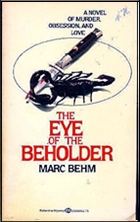
A PI Mystery Review by Tony Baer: MARC BEHM – Eye of the Beholder.
Posted by Steve under Reviews[6] Comments

MARC BEHM – Eye of the Beholder. Dial Press, hardcover, 1980. Ballantine, softcover, 1981, 1999. Film #1: Produced in France in 1983 as Mortelle Randonnée, and released in the US as Deadly Circuit. Film #2: Released in 1999, with Ewan McGregor & Ashley Judd.
An old, washed up private eye. At an agency. Divorced. Drinks, smokes. Had a daughter: Maggie. Hasn’t seen her in years. All he’s got left is a 1st grade class photo sent from his ex-wife, on the back, saying I bet you don’t even know which one is her, asshole. And he didn’t. He’d think about her though. In the photo, there were a few candidates that could’ve been her. And he’d pick one and create a whole life, graduation, marriage, kids….
The boss assigns him a case. Rich elderly couple. Their son, Philip, has taken up with some skank, and she’s probably just after his dough. Can you look into her, her background, get some dirt, and watch them, there’s something about her we don’t much trust.
So the Eye follows them, next day, they get married, she and Philip, elope, and honeymoon in a little cottage upstate. The Eye’s watching. Always watching. She’s beautiful. Absolutely stunning. And about the age of his daughter. Hell, maybe it is his daughter. And he watches. Watches as Philip gets ready for bed, the wedding night. I’ll take a quick shower, he says. And he does. And she makes a couple of cognacs, and empties a vial of poison into Philip’s, and before you know it, he’s dead. She buries him in the yard.
And the Eye? He just keeps watching. Enthralled.
The Eye calls his boss, says the happy couple split for Montreal, but don’t worry, tell Philip’s parents the Eye is on their trail.
So Philip’s parents bankroll the Eye’s voyeurism, as he travels from town to town, trailing this beautiful woman who keeps marrying rich young men and murdering them.

And that, my friends, is that. He trails her and watches her and her sordid life, fantasizing that she’s his child, looking out for her, helping her where he can, without her ever knowing, even until the end. Which comes for all of us. Some sooner than others.
It was fine. But I don’t understand the whole hullabaloo, as the book got lots of hype for being something amazing and unique in pi fiction.
Me? I don’t see it. PI’s obsessed with femme fatales? Nothing new under the sun. Thinking the femme fatale’s your daughter? Gross and perverted.
So from me? A meh. It was fine. But it’s not as good as many PI novels, and I don’t see what’s supposed to be so special about it. Behm says he’s not even into the PI genre, doesn’t think much of it. And it shows.
November 1st, 2025 at 2:45 am
Part of the hype was the fact the book was more in line with its French cousins in the Serie Noir style than most of its American brethren (like Serie Noir novels is it quite short), more Simenon, Japrisot, or even the Swiss Durrenmatt (it is mindful of his THE PLEDGE in many ways) than Chandler, Macdonald, or Hammett.
As such I enjoyed it in the same way I appreciate the European writers who work in that style (and the actual style of the novel is closer to that voice than most of its American cousins) not taking the more plot and pulp path of most traditional Eye stories.
There is room for both, and I enjoy both, but I do see where this one can be frustrating for readers more in tune with the American model.
As I said it has more in common with Durrenmatt’s THE PLEDGE, Simenon’s STAIN ON THE SNOW, or Brion Gysin’s I SPIT ON YOUR GRAVE (no relation to the exploitation movies) than to Phlip Marlowe or Michael Shayne.
November 1st, 2025 at 3:32 am
Tony, I don’t think you appreciate the enormous favor Behm did us PI fans by lending his talents to our insignificant genre.
November 1st, 2025 at 11:48 am
The lack of a moral centre in this made me sick. I understand that noir has morally ambiguous characters but the lack of moral compass in the character of the woman which the author seemed to almost commend, was vomitive.
November 1st, 2025 at 1:58 pm
Combining Neeru and David’s comments led me to a bit of an epiphany. I think David’s right, that obsession is the focus of the novel, and that it is more of a piece with Stain in the Snow and The Pledge than American pi novels. But while in stain in the snow a psychopath was redeemed by obsessive love; and the pledge (reminiscent of the ending of A.I., with a submerged Haley Joel Osment begging the drowned Coney Island blue fairy to make him a real boy, in perpetuity, like Sisyphus), tragically condemning a man of justice to wait around for Godot to show up, so that he can fulfill his M.O., awaiting to avenge a dead girl by catching a killer who is no more; here, the obsession is the incestuous lust of a repentant absent father for a wayward psychotic daughter with an Electra complex. Or something. Anyway, while the obsession in Dirty Snow and The Pledge is something loyal and laudatory, here the obsessive father’s love is something loyal yet grotesque and abhorrent. Maybe that makes the novel more interesting than I gave it credit for. Maybe not.
November 1st, 2025 at 2:14 pm
Having not read the book, and deliberately so, I find myself unable to comment, but I am enjoying what the others of you have been saying. I still am unable to convince myself I ought to read it. Thanks for the review, Tony!
November 9th, 2025 at 1:01 am
That there is no moral center is the point, neither father or daughter can be redeemed. French popular literature of the period was coming out of a tradition of nihilism and much darker vision than noir alone,influences of Sarte,Celene, and Camus not just Hammett, Chandler, and Cain. Existential and not moral like American noir.