Wed 17 Dec 2025
Reviewed by Tony Baer: The confession of Jesse Strang, : who was executed at Albany, August 24, 1827, for the murder of John Whipple.
Posted by Steve under Reviews , True crime[3] Comments
Criminal confessions constitute some of the earliest hardboiled crime writing. This was back when people still believed in heaven and hell, and a forgiving God, who in exchange for a pure confession, might allow the soul of a repentant convict to traverse the pearly gates.
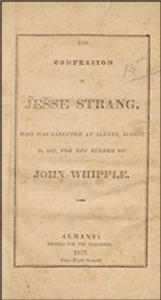
Jesse Strang abandoned his wife in Ohio, assumed the name Joe Orton, and ended up in Albany, New York, a guest at Cherry Hill mansion.
He’s at a bar, and there’s a wild girl there, pretty inviting. ‘Joe’ tells his buddy at the bar he wouldn’t mind playing hide the salami with the chick. And his buddy says he’s had her himself, and she’s there for the asking.
Her name is Elsie Whipple. That’s Mrs. Elsie Whipple to you.
And they flirt. She’s also a denizen of Cherry Hill mansion. They pass notes. Agreeing to burn after reading.
She wants to know his intentions. She says she loves him, she never thought love was possible, til now. She wants to run away with him, but she can’t, at least not until she gets her hands on $1200 to open a pub.
See, she had money. But old Mr. Whipple took it. She’d love to be a wife to Joe — but she wants them to do it right. Hence the need for money.
Maybe he’d kill Mr. Whipple for her. Do you love me enough to do that for me? He beats me. Please kill him — or else I’ll have to kill myself.
She gives him a taste of how good it can be, in the barn, in the spare bedroom. It’s pretty great.
Okay okay. He’ll do it. So they can be together.
And he does.
She immediately turns him in. And shows his letters to the cops.
And so, the hangman.
And the confession.
This sordid tale’s been around long before James M. Cain. Cain just honed down the prose and made it sing. Like Mrs. Whipple.
Read it here.
December 18th, 2025 at 8:57 am
That’s what Mr. Whipple gets for telling people not to squeeze the Charmin.
December 18th, 2025 at 4:51 pm
Probably a different branch of the Whipple family, but who knows. I think the connection between this case and anything James Cain wrote is a lot more likely, but not very, if you think about it. But then again, why not?
December 20th, 2025 at 12:12 am
Later variation on the Newgate Calendar version of crime doesn’t pay, but it sure is fun to read about how it goes wrong.