Tue 6 Jan 2026
A 1001 Midnights Review: MICHAEL GILBERT – Game Without Rules.
Posted by Steve under 1001 Midnights , Reviews[4] Comments
by Bill Pronzini
MICHAEL GILBERT – Game Without Rules. Calder & Behrens. Hodder and Stoughton, UK, hardcover, 1968. Harper & Row, US, hardcover, 1967. Carroll & Graf, US, paperback, 1988.
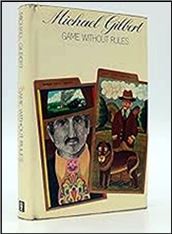
“The Road to Damascus,” the first of the eleven stories in this collection. begins: “Everyone in Lamperdown knew that Mr. Behrens, who lived with his aunt at the Old Rectory and kept bees, and Mr. Calder, who lived in a cottage on the hilltop outside the viJlage and was the owner of a deerhound called Rasselas, were the closest of close friends.
They knew, too, that there was something out of the ordinary about both of them. Both had a habit of “disappearing.” What the villagers don’t know is that Mr. Calder and Mr. Behrens are professional counterintelligence agents attached to the External Branch of the Joint Services Standing Intelligence Committee — a pair of very quiet and very deadly spies working at a job in which, as Mr. Calder has said, “there is neither right nor wrong. Only expediency.”
No one is better at expedient action than Mr. Calder and Mr. Behrens. In “The Road to Damascus,” they utilize the twin discoveries of a World War IT hidey-hole containing the skeleton of a murdered man and the fact that a former army colonel has been selling secrets to the Russians to fashion a trap that at once explains the mystery and eliminates the spy. In “The Headmaster,” it is guile and keen observation that allows them to unmask and dispose of a senior Russian agent.
Most of these cleverly plotted stories are set in England; “Heilige Nacht,” however, takes place in Germany, and “Cross-Over” the most exciting of the entries-features a lengthy trek through both Germany and France.
Gilbert’s style is wry, restrained, penetrating, and ironic. Reading one of these stories is like sipping a very dry martini, and the cumulative effect of two or three is also much the same — you begin to feel highly stimulated. However, there is a good deal of casual killing here, much of it done very coolly and professionally by Mr. Calder and Mr. Behrens (Rasselas, too, on occasion).
The atmosphere is amoral, to say the least. (In “On Slay Down,” for instance, a soldier who thinks he has accidentally killed a woman — who, in truth, was a turncoat shot down by Mr. Calder, buries the body to cover up the killing, and is rewarded by recruitment into the External Branch because he is just the sort of quick-witted fellow they want.)
The result of this is also cumulative and also like guzzling dry martinis: two or three may stimulate you, but eleven in a row tend to leave you rather ossified. There is a hangover effect, too. You don’t mind having hoisted (buried) a few with Mr. Calder and Mr. Behrens, but you’re not so sure you’d like to go spy-killing with them on a regular basis.
Those of you who have stronger constitutions will want to consult the second collection featuring these two dignified liquidators, Mr. Calder & Mr. Behrens (1982).
———
Reprinted with permission from 1001 Midnights, edited by Bill Pronzini & Marcia Muller and published by The Battered Silicon Dispatch Box, 2007. Copyright © 1986, 2007 by the Pronzini-Muller Family Trust.
January 7th, 2026 at 6:04 pm
I have a strong constitution so I’ve read all the Calder & Behrens stories. Yes, they are amoral, but then again spying is an amoral business.
January 7th, 2026 at 6:29 pm
I not only don’t have a strong constitution, but I wasl also completely turned off by the fate of Rasselas (in a later story perhaps).
January 7th, 2026 at 8:06 pm
I’m hit or miss on reading the Calder/Behrens stories, and only if they appeared in EQMM. But I’ve enjoyed the ones I have read and would certainly read more, given the chance. But if Rasselas appeared in any of them, it was only tangentially and I took little note. I’ll be more careful from now on.
January 17th, 2026 at 3:57 am
Eric Ambler among others praised the Calders and Behrens stories as among the best short spy fiction ever written, and as the spy story doesn’t really lend itself to short fiction that is high praise.
Rasselas, as noted dies bravely only to be replaced by virtual twin also named Rasselas. Among the stories in the second is the only novella, “The Executioners” which features a walk on by Gilbert’s Patrick Petrella, and an instance of Gilbert’s sometimes savage but civilized manners.
The amoral aspect was in many ways the point of these two rather quiet and withdrawn Englishmen who seem much more like someone from Last of the Summer Wine than James Bond, but the amorality bothered me no more than Frank McCauliffe’s Augustus Mandrell or Barry Perowne’s Raffles continuations.