Tue 20 Jan 2026
A 1001 Midnights Review: JOHN GODEY – The Taking of Pelham One Two Three.
Posted by Steve under 1001 Midnights , Reviews[7] Comments
by Bill Pronzini
JOHN GODEY – The Taking of Pelham One Two Three. Putnam’s, hardcover, 1973. Dell, paperback, 1974. Berkley, softcover, 2009. Penguin, softcover, 2012. Films: (1) United Artists, 1974. (2) ABC, made-for-TV, 1998. (3) Columbia Pictures/MGM, 2009.
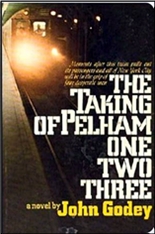
Grand-scale-caper novels, in which millions of dollars and the lives of scores of hostages are at stake, were the vogue in the 1970s. The Taking of Pelham One Two Three is among the best of these, and for two reasons became modest best seller and a reasonably good film with Robert Shaw, Walter Matthau, and Martin Balsam.
The first reason is that the caper involves the hijacking of a New York City subway car (Pelham 123) full of passengers and the holding of it for a ransom of $ 1 million cash — an audacious sort of crime that has an appeal for people who have never even ridden the New York subways.
The second reason is in the form of a neat logistical puzzle: On the surface (or rather, under the surface), it would seem impossible for the gang to escape with the loot, being themselves trapped underground with every tunnel exit watched by heavily armed men. So how are they planning to do it?

The head of the gang is a ruthless lunatic named Ryder who is not above knocking off a hostage or two to make sure the city of New York complies with his demands. Or killing anybody else who might be foolish enough to get in his way. The other three gang members arc a pair of toughs named Steever and Joe Welcome and an embittered ex motorman, Wally Longman, whose technical knowledge of subway operations is at the core of the entire plan.
The numerous additional characters (the novel is told in constantly shifting multiple viewpoints) include the various hostages, city policemen, subway workers, Transit Authority cops, members of the media and the Federal Reserve Bank, and the mayor himself.
Godey maintains a high level of suspense throughout, and deftly interweaves plenty of detailed information on the inner workings of the subway system. (Train buffs will find it fascinating; even casually interested readers will be impressed.) His characters arc well delineated, the writing smooth and effective. And the escape plan devised for Ryder and his gang is both simple and extremely clever, utilizing a certain “foolproof” piece of equipment.
John Godey (Mort Freedgood) began his career writing Crime Club whodunits in the late Forties and early Fifties, among them such titles as The Blue Hour (1948) and This Year’s Death (1953). In the late sixties he produced a pair of early-Westlake comedy/mystery pastiches, A Thrill a Minute with Jack Albany (1967) and Never Put Off Till Tomorrow What You Can Kill Today (1970).
After the success of Pelham, he devoted himself to the production of other large-scale suspense novels; among these are The Talisman (1976), The Snake (1981), and Fatal Beauty (1984), the last named about a political-extremist kidnapping in Italy with far-reaching implications.
———
Reprinted with permission from 1001 Midnights, edited by Bill Pronzini & Marcia Muller and published by The Battered Silicon Dispatch Box, 2007. Copyright © 1986, 2007 by the Pronzini-Muller Family Trust.
January 21st, 2026 at 8:40 am
The movie starring Walter Matthau and Robert Shaw is on TCM tonight at 8:30.
January 21st, 2026 at 1:17 pm
I didn’t know anything about that. Thanks, Chuck. What a massive coincidence!
January 21st, 2026 at 11:17 am
Loved the book and the movie! And another wonderful Bill Pronzini review!
January 21st, 2026 at 1:20 pm
The films are a lot better known than the book. I’m going out on a limb in saying the first movie is the best. I don’t know much about the one made for TV.
January 21st, 2026 at 2:03 pm
I agree Steve I liked the first movie much better. Matthau gives his usual great performance. Have not read the book.
January 25th, 2026 at 11:00 pm
A Thrill a Minute with Jack Albany was an entertaining romp made into a Disney caper film (Never a Dull Moment) with Dick Van Dyke, Edward G. Robinson, and Dorothy Provine.
February 2nd, 2026 at 2:11 pm
Been many years since I read the book, but I think I recall that Joseph Sargent’s first screen version—one of my favorite films—was pretty faithful to it. Among its countless virtues, it is one of the great New York movies of all time; both that and William Friedkin’s The French Connection (an even bigger favorite) were photographed by Owen Roizman, who captured the city I knew in my youth in its warts-and-all glory. It also has, IMHO, one of the best trailers ever, with a great moment in which, as they show the cover of the novel, the narrator intones, “Millions have read it—now you can LIVE it!” They don’t make ’em like that anymore. And David Shire’s score is riveting. It’s almost hard to believe that right after it, he wrote the hauntingly beautiful main-title theme for Mitchum’s excellent Farewell, My Lovely.