Wed 21 Jan 2026
SF Diary Review: A. E. van VOGT – The House That Stood Still.
Posted by Steve under Diary Reviews , Science Fiction & Fantasy[6] Comments
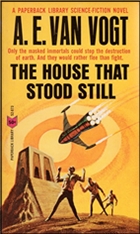
A. E. van VOGT – The House That Stood Still. Greenberg, hardcover, 1950. Detective Book Magazine, Winter 1952. Beacon 298, paperback, September 1960, as The Mating Cry. Paperback Librar 52-873, paperback, November 1965 (cover art by Jack Gaughan). Carroll & Graf, paperback, January 1993.
Van Vogt tries a clumsy hand at sex in the midst of a looseness in plot, and the result is predictably poor.
A massive, imperturbable house, dating from the pre-Spanish days of California, gives its inhabitants eternal life. And naturally the inhabitants command economic power enough to maintain the house in their possession through the years. Crisis comes about when nuclear war of Earth threatens them, and the group splits on the question of strategy.
There is a flavor of Spanish California in this book that is attractive, but the going of the arbitrary plot is jumpy and is not. There is no involvement withe the mixed-up characters, certainly not enough to bother seeing if the story really does fit together or to spend any time understanding a very poor ending.
It took a long time to read this one.
Rating: *
January 22nd, 2026 at 6:58 am
Van Vogt started his career in Sf as one of John Campbell’s wunderkids in ASTOUNDING, publishing a number of tales that grasped the reader’s imagination. his early success with short stories did not, in my opinion, transfer well to novels, many of which were fix-ups. He liked to pack his stories with a plentitude of ideas; reportedly, he aimed to insert one new and startling idea every 12 pages. He was also prone to rely on various theories of psychology, philosophy, and politics — many of which veered into pseudoscience — to underpin his works; he and his wife were early adherents to Dianetics, and he stopped producing new works for more than a decade (his wife stopped altogether). Most of his novels are jumbled messes that only vaguely hinted at the power and originality of his earlier short stories. Even his most noted books (SLAN, the WEAPONS SHOP novels, and the NULL A books pale once one goes behind their glitzy exteriors. I stopped reading the author after he returned from his long hiatus, realizing that whatever magic he once had was gone.
I once had a teacher who believed that the human brain could absorb only one new factoid every twelve seconds and would structure his lessons thusly. That may work for a classroom lecture but it falls flat when applied to fiction, especially fiction that attempts to inculcate philosophy…
January 22nd, 2026 at 1:54 pm
At one time, I think it was the early 60s, I was chosen to submit a list of favorite SF authors somewhere, possibly a fanzine of some note. As I recall, I ranked Philip K. Dick as number one, and A. E. van Vogt as number two. I don’t remember the date exactly, but I kind of think it was before I read THE HOUSE THAT STOOD STILL.
I’m fairly sure it was the WEAPON SHOP series that prompted the high rating. I still remember the books with a lot of fondness, and I think they would still stand up today. (I am not as sure I would actually read them again today, for fear of disillusionment, for lack of a better word, and in fact it is probably the best one.)
January 22nd, 2026 at 7:03 am
P.S., the clumsy hand at sex in the reprinted THE MATING CRY was added without permission by editor H. L. Gold when it appeared as a “GALAXY Novel” from Beacon Books.
January 22nd, 2026 at 1:56 pm
Well that does make sense. I never worried much about it, but it does ease my mind a little. Maybe even a lot. Thanks!
January 23rd, 2026 at 1:49 pm
I was impressed as a kid with A.E. Van Vogt’s WEAPON SHOP series as well as EMPIRE OF THE ATOM. Mostly, I liked Van Vogt’s work from the 1940s that ended up in paperbacks in the 1950s and 1960s. After that, I found his work dull and confused.
January 25th, 2026 at 11:06 pm
Van Vogt was extremely inventive, but not always disciplined as a writer. I liked him better as a younger reader impressed with his inventiveness more that plot and characterization. Maltby, the mixed man, was an interesting character in one of his better space opera fix ups.