Fri 30 Jan 2026
A 1001 Midnights Review: WILLIAM GOLDMAN – Marathon Man.
Posted by Steve under 1001 Midnights , Reviews[3] Comments
by Bill Pronzini
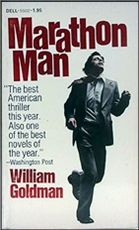
WILLIAM GOLDMAN – Marathon Man. Delacorte, hardcover, 1974. Dell, paperback, 1975. Other reprint editions include: Random House, softcover, 2001.
William Goldman, the well-known novelist and screenwriter (Butch Cassidy and the Sundance Kid), achieved his first major commercial fiction success with Marathon Man. The first half of the novel is some of the finest suspense writing committed to paper during the past three decades. Goldman weaves a complex plot involving a young budding intellectual/historian/student/marathon runner named Babe Levy, a superspy named Scylla, and Nazi war criminals on the loose in New York City. The characterization is excellent, the story line taut and fast-moving, and there are a couple of unexpected twists.
The last half of the book, however, might have been written by someone else, because the plot and everything else falls apart. The characters suddenly begin to think and act implausibly, there are several bizarre and unbelievable progressions, and the climax on the Jewish-controlled Diamond Exchange along Forty-seventh Street is unsatisfactory and filled with gratuitous and glorified violence.
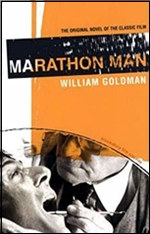
Goldman never seems able to make up his mind whether he wants to be funny or deadly serious; the fluctuation works surprisingly well in the first half and not at all in the second. (There is one nicely handled scene in the last half. a chilling interrogation by torture, simple and bloodless, that involves the use of a dental drill. This scene was likewise one of the highlights of the 1975 film of the same title, starring Dustin Hoffman.)
All in all, a potentially classic novel in the suspense field, weakened and made distasteful through mishandling of its material.
Goldman’s other suspense novels include No Way to Treat a Lady (1964; originally published as a paperback original under the pseudonym Harry Longbaugh) and Magic (1976).
———
Reprinted with permission from 1001 Midnights, edited by Bill Pronzini & Marcia Muller and published by The Battered Silicon Dispatch Box, 2007. Copyright © 1986, 2007 by the Pronzini-Muller Family Trust.
January 31st, 2026 at 1:06 am
The picture is memorable, but not in a good or strong way; at least not Dustin Hoffman or Larry Olivier, some of the supporting parts, just great. Roy Scheider, William Devane, and Marthe Keller.
January 31st, 2026 at 1:16 am
Based on what I remember about the film, I’d disagree with you about Dustin Hoffman’s role in it. He’s about all I do remember about it, and I think in a good way. If I were to watch it again, I suspect that I could be more easily persuaded to agree with you. Just maybe!
I have not read the book, and alas I probably never will.
February 1st, 2026 at 3:07 am
The book is near schizophrenic, it starts off fascinating and suspenseful with the reader eager to see how it all ties together then it never quite does all tie together the way I hoped.
Hoffman and Olivier seem at odds in the film, and there was slight friction (“Dear boy, it’s only acting,” Olivier allegedly commented of Hoffman’s method acting), and I’m seldom happy with Oliver hamming up accents. Still, that one scene almost redeems the second half of the film.