Mon 13 May 2024
Reviewed by TONY BAER:
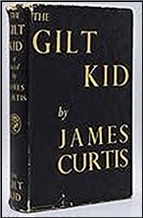
JAMES CURTIS – The Gilt Kid. Jonathan Cape, UK, hardcover, 1936. Penguin Books, UK, paperback, 1947. London Books, UK, hardcover, 2007.
Kennedy’s a burglar. A wide boy. A wise guy. And wide boys never work.
He’s read just enough of Das Kapital to think surplus value is theft. So he’s just taking from the capitalists what doesn’t belong to them in the first place.
He just got out of the clink and he’s ready for some action. He meets up with some of the boys he met in stir. They’ve got a job for him.
So he does a job. Gets some coin. And promptly gets nicked again.
Good, catchy slang. Sad sack tale. The prose is dazzling but the story’s ho hum.
May 13th, 2024 at 10:13 pm
Here’s the link to James Curtis’s Wikipedia page:
https://en.wikipedia.org/wiki/James_Curtis_(British_writer)
… and the first paragraph there:
“James Curtis (4 July 1907 – 1977) was a British writer who was best known for his novels, They Drive By Night and There Ain’t No Justice, both of which were made into feature films.”
May 14th, 2024 at 2:57 am
The films of They Drive by Night and There Ain’t No Justice are early examples of British noir and worth watching. The flaws with They Drive by Night are the need to meet the censor’s requirements by obscuring aspects and the appearance of Ernest Thesiger, who removed every film he was in from every aspect of realism.
May 17th, 2024 at 10:36 pm
THEY DRIVE BY NIGHT was a fairly important film in Trevor Howard’s career. The serious British Crime novel from this period tended to be fairly strong on character and social commentary, but a little weak on plot.
May 18th, 2024 at 2:29 pm
I think you’re thinking of another film, David L Vineyard. Emlyn Williams plays the lead in They Drive by Night and I don’t think Howard is in it at all.
My remark about Thesiger was praise. It’s just that this film didn’t benefit from his phantasmagorical presence.
May 20th, 2026 at 4:56 pm
The Gilt Kid throws Das Kapital to the floor because he can’t make quite enough head or tail way … and he’s drunk. I’d feel drunk, with my head falling off as well when reading what he’s reading. In the London Books 2007 edition page 173 (or page 171 in the Penguin 1947 paperback) the formula bit the Kid is reading, from Marx’s Chapter Seven, Rate of Surplus Value, doesn’t add up properly :
“…the value of this commodity may be (£400 const. + £90 var.) +£90 surpl. The original capital has now changed from C to C/, from £500 to £590.”
In Das Kapital the figure for const. is £410 not £400 – which, {if you are concentrating} with £90 plus £90 sums to a correct £590.
And this is how the Cape edition ‘first’ has it, i.e. ‘correct’, so to speak.
So how come it changed? It was certainly carried forward by London Books who used the Penguin, thinking no need to go find an amazingly expensive First as a source text. Did Curtis have a second thought that maybe this should be made more difficult to deliberately confuse both his character and his readers? I’d expect some tricky little po-mo frenchman to do that but – and let’s be honest – not Curtis. Did Penguin editorial do it out of reactionary spite, just so Marx would actually become incomprehensible and thus be dismissed by any reader, re-inforcing what the Kid concludes, that Marx is flogging a dead horse?Well, let’s be honest, even the Illuminati would put this past Penguin’s propaganda plotting.
So… it’s a typo. And strangely even reviewers and bloggers who cite Marx is quoted and thus give Curtis a higher brow than one would rate in a piece of pulp ‘ollox, these pundits heads can fall off.
and ..well … Mama Marx, does it 6 7 matter? Easy come. easy go, little high, little low ….