Tue 9 Jun 2026
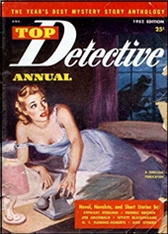
TOP DETECTIVE ANNUAL, 1952. (Volume 1, Number 3.) Editor: David X. Manners, Cover art: Samuel Cherry. Overall rating: **
HAROLD HELFER “The Cell.” Listed as a short story, it is more a short [two page] documentary of a man’s strange punishment for his sex crimes. (4)
STEWART STERLING “The Glass Guillotine.” Novella. Gil Vine. Originally published in Thrilling Detective, November 1940. Former FBI agent Gil Vine intervenes in a political kidnapping on the eve of the nominating convention. Mostly unbelievable. (2)
WILLIAM CAMPBELL GAULT “Four Kings and a Jack.” Originally published in Thrilling Detective, December 1942, The story of a jazz musician in murder trouble. (2)
FREDRIC BROWN “The Spherical Ghoul.” Novelet. Originally published in Thrilling Mystery, January 1943. A graduate student, whose thesis is on superstitions, and who works nights in a morgue, discovers a half-eaten corpse. Has good mood, but how did trigonometry get in there? (3)
DWIGHT V. BABCOCK “Jumbled Justice.” Originally published in Thrilling Detective, December 1934. The name “Ruby” turns out to be a last name. (2)
G, T. FLEMING-ROBERTS “Dig Three Graves.” Novelet. Originally published in Exciting Detective, Summer 1942. A nightmare face haunts a famed scientist, and murder threat make him decide to change his will. Melodramatic. (2)
HAL.K. WELLS “Green-Haired Murder.” Originally published in The Phantom Detective, August 1946. Strange circumstances do not make a mystery. (1)
WYATT BLASSINGAME “Shark River Manhunt.” Novelet. Originally published in Thrilling Adventure, January 1943. A hunt for a man hiding out in the Everglades for a crime he didn’t commit; he is guilty of subsequent crimes of murder, however. (2)
JOE ARCHIBALD “No Place Like Homicide.” Originally published in Popular Detective, April 1940. Willie Klump, president of the Hawkeye Detective Agency, fumbles around, Hard to take all this humor. (0)
RAY CUMMINGS “Psychological Approach.” Originally published in Black Book Detective, October 1947. Actually fails; it takes a woman’s touch. (2)
MURRAY LEINSTER “Chuckles.: Originally published in Popular Detective, December 1943, Killer is haunted by his victim’s laugh, (1)
WARD HAWKINS “Murder Beach.” Novelet. Originally published in Thrilling Mystery, July 1941. Murders seem to be committed by a fierce dog, Hints of werewolvery, but not really. (1)
June 10th, 2026 at 8:11 am
A mix of the good, the bad, and the mediocre — enough to give one a taste of Standard Publications fare from the early to mid-Forties, with one outlier from 1936.
Sterling’s Gil Vine has been featured in 13 stories and at least two novels. Archibald’s Willie Klump brought his zaniness to more than five dozen tales, indicating that at some people appreciated him, Steve.
Fleming-Roberts was a prolific pulpster who is highly respected for his work, including many of the SECRET AGENT X and GREEN GHOST novels, among others. Murray Leinster wrote in many genres but is best-known for his science fiction; much of his other work for the pulps and the slicks were good, but not remarkable. Also known for more for his science fiction than anything else was Ray Cummings, whose work in other fields was prolific but not very remarkable. I remember Wyatt Blassingame more for his weird terror stories than anything else, although he published a ton of stories in the detective, western and other pulps, as well as authoring a number of respected juvenile nonfiction books.
Brown and Gault are always worth reading; the
Brown story has been reprinted about a half dozen times. Ward Hawkins, who often wrote with his brother John, is sadly forgotten today but was a magazine headliner in the 40s and 50s; he later worked on television, notably on BONANZA and LITTLE HOUSE ON THE PRAIRIE. Babcock went from pulps to low-budget horror films and television; he is perhaps best known for his stories about Hannah Van Doren (A HOMICIDE FOR HANNAH, a.k.a. THE GORGEOUS GHOUL MURDER CASE). Hal K. Wells was mainly an author of lurid, forgettable science fiction. I’m not familiar with Harold Helfer, although he has a lengthy listing on the FictionMags Index.
As I said, this looks to be a pretty good overview of the field in the early Forties, and certainly worth checking out for thems what likes those things.
June 10th, 2026 at 12:27 pm
I’m thinking of this as an “All Star” issue at the time, or almost one. Most of the authors were well known to pulp readers at the time, and a few are still somewhat known today, although perhaps in this issue not with their best work. The best story is by the author who was the best writer, Fredric Brown, although William Campbell Gault is close on his heels. Is either well-known today? I’d like to think so, but the honest answer is probably not.
June 20th, 2026 at 12:11 am
Brown may be better known in SF circles though the reputation for Fabulous Clip joint and a few others are fairly high and he is well represented in ebook form and among pulp collectors.