Tue 16 Jun 2026
A 1001 Midnights Review: ANNA KATHARINE GREEN – The Leavenworth Case.
Posted by Steve under Uncategorized1 Comment
by Marcia Muller
ANNA KATHARINE GREEN – The Leavenworth Case. Dover, softcover, 1981. (Reprint of the 1878 hardcover edition.)
This is a cornerstone novel of the mystery genre — the nineteenth-century American best seller that brought the detective novel into the public eye and raised it to hitherto unknown .. “respectable” status. First published in 1878, it is the best known of Green’s more than thirty novels and is thought by many critics to set the pattern for subsequent detective stories. As Alma E. Murch points out in The Development of the Detective Novel (1958), “… Green not only made her detective the leading figure and formulated a plan of construction that later became conventional. She also introduced characters and incidents that were new in her day, though they have since become familiar in novels of this type….”
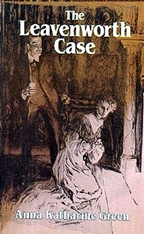
Indeed the contemporary reader will find nothing new or surprising about The Leavenworth Case. Mr. Leavenworth, a “retired merchant of great wealth and fine social position,” is found shot to death in the library of his New York City home. The murder weapon and the key to the library door are missing; a servant girl has mysteriously disappeared; the murder could not have been perpetrated by an intruder. The cast of characters present at the scene includes Mr. Leavenworth’s wards — Mary, who is his sole heir, and Eleanore, who stands to inherit nothing; Trueman Harwell, the dead man’s private secretary; assorted servants, including a butler; policeman Ebenezer Gryce, “a portly, comfortable personage with an eye that never pierced, that did not even rest on you”; and Everett Raymond, a young lawyer from the firm that represented Leavenworth and who is the narrator of the story.
An inquest is held and suspicion falls on Eleanore Leavenworth, whose behavior is odd at best. Clues tum up in unexpected places; entranced by Eleanore, Everett Raymond allows himself to become involved in the investigation; a dark secret surfaces; and Ebenezer Gryce, proving that his eyes are more piercing than they appear, sets a clever trap for the killer.
Told in what now seems a turgid style, this predictable (by current standards) tale is nonetheless interesting for the way Green integrates the various elements into a logical, . believable story. The Leavenworth Case is “must” reading for any serious student of the field, as well as a good choice for an evening when one is in the mood for the bloodless mayhem of a gentler age.
Green also created two other detectives, both women. Mrs. Amelia Butterworth (whom Michele Slung, in her excellent introduction to the Dover edition of The Leavenworth Case, claims is “the prototype for such elderly female amateur detectives as Mary Roberts Rinehart’s Miss Rachel Innes, Agatha Christie’s Miss Marple, Patricia Wentworth’s Miss Silver, and Stuart Palmer’s Hildegarde Withers”) appears with Ebenezer Grycc in such novels as The Affair Next Door (1897) and The Circular Study (1900). Violet Strange, a society-girl detective (whom Slung claims is a forerunner of Nancy Drew), appears in the 1915 short-story collection The Golden Slipper and Other Problems for Violet Strange.
———
Reprinted with permission from 1001 Midnights, edited by Bill Pronzini & Marcia Muller and published by The Battered Silicon Dispatch Box, 2007. Copyright © 1986, 2007 by the Pronzini-Muller Family Trust.
June 16th, 2026 at 9:25 pm
I’m a Green fan too.
Agree Amelia Butterworth anticipates Rinehart and Christie.
Don’t think she anticipates Hildegarde Withers.
Think Violet Strange is good.
But don’t get any relationship to Nancy Drew.