Wed 17 Jun 2026
Stories I’m Reading: H. C, BAILEY “The Superfluous Clues.”
Posted by Steve under UncategorizedNo Comments
H. C, BAILEY “The Superfluous Clues.” Reggie Fortune. First published (?) in Mr. Fortune’s Practice (Methuen, UK, hardcover, 1923), as “The Young Doctor.” Reprinted in Ellery Queen’s Mystery Magazine, March 1954.
H. C. Bailey is an author I sampled long ago – perhaps 50 or 60 years long past – and decided at the time that his work was not for me. I no longer remember why, but I held to the vow until I postedan old fanzine review of Call Mr. Fortune, and the short discussion of the merits of Mt. Bailey’s approach to writing detective fiction that followed brought back to mind the prior difficulties I had found in his work.
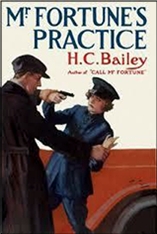
So when, by pure coincidence I came across this tale from his followup collection of Mt. Fortune stories, I said to myself, “This can’t be a coincidence. There must be higher hand at work here. I must read this story.” And so I have.
Some thoughts. A young doctor has been tried, convicted and jailed for robbing another resident of the same building where he resides. Found in his room a small collection of diamonds not belonging to him. Another man has claimed he saw the doctor of leaving the victim’s apartment and entering his own room.
The superfluous clues referred to in the title are minor, and neither the police nor Mr. Fortune claim otherwise. But by accident, now after the fact, some objects in the room are now seen to be German-made, and the doctor having known to have no interest in German-made items, it is a small puzzle. The doctor, now despondent, refuses to aid in the investigation that follows.
More important, however, is the fact that both the victim of the robbery and the witness that clinched the case against the doctor have completely disappeared. This is the extent of the case to be solved.
And it is a sterile one, at least it seems to me, through the telling. Lots of talking and events taking place off screen. It is a judgment based perhaps on how old the story is now, but it was my impression that Mr. Bailey’s world at the time of the story is far different from mine at any time of my life. There is some action in the second half of the tale – a mad chase down the rives Thames to nab the real culprits – that too seemed (unaccountably) slow and uninteresting.
It does not aid the story that the facts that help name the true culprits are largely nor available to the reader when it would have helped the most.
The detection is light and not convincing, the pace is slow, and even though I am very much aware that Mr. Bailey and his most well-known detective still have their fans today, I am forced to admit that I am not convinced, and that I remain to be not one of them.