Mon 13 Jul 2026
by Robert C. S. Adey/
Original published in The Mystery Lover’s Newsletter, Vol II No. 6, pp. 10/11:
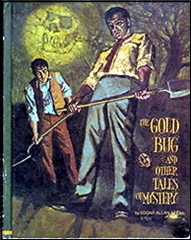
Like so many other things, Mr. Edgar Allan Poe started it all, though this time the illustrious forerunner was not the much-cited “The Murders in the Rue Morgue”, but instead that equally fine quintessence of its form, “The Gold-Bug.” Published in 1843 and yet, today, still as readable as ever, it is the first detective story where the major detection was not that of a crime or of a criminal, but of a vital message contained in a cipher.
And then in the highest tradition of the detective story, Sir Arthur Conan Doyle followed on from Poe, and produced his Sherlock Holmes masterpiece, “The Adventure of the Dancing Men”. This time the cipher concealed (amongst other things) a sinister warning to a victim rather than the clue to a lost treasure.
However, both stories contain the same basic element, a secret message put before the reader in its clandestine form and then later, carefully, clearly and minutely translated into plain words by the ingenious inventor.
And after Sir Arthur? Well, certainly not the deluge. Since those matchstick men danced their way off the last page of their story, few indeed have been the short story writers who have ventured cautiously into the demanding world of the code and the cipher. The rigorous and exacting nature of the work, however, has had its compensations (for the reader, at any rate), inasmuch as only the most painstaking and articulate of authors have managed to sell a convincing product on this market.
If you happen across a good example of this kind of short story, then you can lay odds that it will be exclusively good and fashioned by a master-craftsman.
The reason for this, on reflection, is self-evident. To succeed the story must contain the original cipher or coded message – it cannot be so simple that it is effortlessly construed by the reader and yet must not be so complicated that it defies any sort of comprehensible and communicable translation.
The author must, therefore, not only be able to conceive a formula of secret writing, but must also be able to translate it for his reader in a clear and intelligible way. No great wonder, then, at the smallness of that illustrious band who have succeeded in doing all of these things within the confines of a short story.
In fact, just who are the members of this select company? Poe and Sir Arthur we have already mentioned, but what of those who followed on? Careful examination of my library and an intensive brain-wracking session eventually brought forth — somewhat reluctantly — more names. The ingenious Melville Davisson Post, R. Austin Freeman (inevitably), that brilliant writer Dorothy L. Sayers, O. Henry and F.A.M. Webster. A list was drawn up and appears as follows:
Author Story Book
(l) Edgar Allan Poe. The Gold-Bug, from Tales
(2) Sir Arthur Conan Doyle, The Adventure of the Dancing Men, from The Return of Sherlock Holmes
(3) R. Austin Freeman, The Moabite Cipher. from John Thorndyke’s Cases
(4) Melville Davisson Post, The Cuneiform Inscription, from The Bradmoor Murder
(5) Melville Davisson Post, The Great Cipher, from Monsieur Jonquelle
(6) O. Henry. Calloway’s Code, from Whirligigs
(7) F.A.M. Webster. The Secret of the Singular Cipher, from Old Ebbie Returns
(8) Dorothy L. Sayers, The Fascinating Problem of Uncle Meleager’s Will, from Lord Peter Views the Body
(9) Dorothy L. Sayers, An extract, from Unnatural Death
(This last item, in fact, was not written as a short story; but part of chapters 26 and 29, in combination with the whole of chapter 28, form a separate story and probably the cleverest example of all.)
Thus far I had a total of only nine short stories when every fibre in my orderly being was crying out for a nice symmetrical list of ten. I began to pound mercilessly through my list of likely authors again. Ellery Queen? Surely the master of· the cryptic clue would qualify for a place? But no, the nearest I could find were a couple of ineligible dying-message short stories, plus a number of novels (including “Face to Face,” “The Scarlet Letter” and “The Finishing Stroke”) which could in no way be distilled to the size of a short story. (Who would, want to distill Ellery Queen anyway?)
Agatha Christie? Despite such promising titles as “N or M?” and “The A.B.C. Murders,” I could find no short story of hers to fit the bill. Then for a brief illusory moment, I thought I had it and dug out from an old Ellery Queen magazine “The Message on the Lawn” by T.S. Stribling. The title sounded just right, but on re-reading the story I found that it didn’t quite suit the occasion, Poggioli or no Poggioli.
I had reached a point of desperation and was manfully steeling myself to the arduous task of battling my way through all my old favorites, Allen, Anderson, Bailey, Bennett, Bentley, Berkeley, etc., — right through to Zangwell, when suddenly a bombshell of an idea exploded in my vortex of a mind.
Why should I do all the work, I asked myself, when there are dozens of readers out there, idling away their time, who could do it for me? Dozens of readers who, in combination, would have a much wider knowledge than I could possibly have and would be able, without difficulty, to supply that elusive tenth title (and perhaps disagree with the other nine)’ At one fell swoop I would be introducing a competitive element, gain an introduction to lots of interesting stories and, last but certainly not least, save myself a great deal of time and trouble. A positive masterstroke!
And so, without apologies, this is what I am doing, leaving it to you, the perceptive and omnivorous reader. There are no prizes, other than perhaps the egotistical satisfaction of seeing your name in print. The editor, in being able to decide whether or not a suggestion shall be printed, is, ipso facto, the final arbiter. For my part I shall sit back in my easiest easy chair and await your comments with an appropriate air of self-satisfied detachment— and a good detective story.
(Mr. Adey, 27, works as a civil servant in the Department of Health and Social Security, Birmingham, England. He reports that he likes his detective fiction literate and has a preference for the “set piece” mysteries of Queen, Millar, Carr, Christie, Brand, Berkeley, etc. His chief grouse is “with the so-called literary critics who dismiss a book simply because it is a detective story.”)
****************************************
Some replies to the plea for readers’ help were printed in the next Vol. III, No. 1, October 1969, pp. 15/16, with the magazine now renamed as The Mystery Reader’s Newsletter.
From Amnon Kabatchnik, Binghampton, N.Y.
In order to help Adey relax into his easy chair let me add the following Code and Cipher stories to his list: THE PUZZLE LOCK by R. Austin Freeman from “The Puzzle Lock and Other Stories”; THE STOLEN CHRISTMAS BOX by Lillian de la Torre from “Dr. Sam Johnson, Detector”; THE WHITE ELEPHANT by Margery Allingharn from “Mr. Campion, Criminologist”; THE FOUR SUSPECTS by Agatha Christie from “The Tuesday Club Murders”. There must be more.
From Joe Christopher, Stephenville, Texas
In re: Adey’s “Codes and Ciphers”. Anthony Boucher has a very brief but tricky cipher in “The Numbers Man” (EQMM, June 1953). Another Boucher cipher (which I haven’t read) is “QL 696.C9” (EQMM, May 1943). An example of a cipher from John Dickson Carr is “The Adventure of the Wax Gamblers” in Carr and Adrian Conan Doyle’s THE EXPLOITS OF SHERLOCK HOLMES.
From Michael Wahl, Los Angeles, Calif.
For Robert C.S. Adey, I recommend the following stories:
Elsa Barker, The Key in Michael, from The C.I.D. of Dexter Drake (EQMM, May 1942)
R. Austin Freeman. The Puzzle Lock, from The Puzzle Lock
E.C. Bentley, The Ministering Angel, from an early EQMM [September 1943]
M.R. James. The Treasure of Abbot Thomas, from Ghost Stories of an Antiquary
Anthony Boucher, QL 696 .C9, from EQMM, May 1943
Agatha Christie. The Four Suspects, from The Tuesday Club Murders
Edgar Wallace, Code No. 2, from EQMM, Spring 1942
Harvey O’Higgins, The Blackmailers, from Detective Barney
Margery Allingham, The White Elephant. from Mr.·Campion, Criminologist
Alfred Noyes, Uncle Hyacinth, from Walking Shadows
Lillian de la Torre, The Stolen Christmas Box, from Dr. Sam Johnson, Detector
The above stories are all available in Famous Stories of Code and Cipher, edited by Raymond T. Bond, published originally by Rinehart and now in print as a Collier paperback.