Sun 2 Aug 2026
MARY DURHAM, Mystery Writer: A Bio-Bibliographical Essay by Jamie Sturgeon.
Posted by Steve under UncategorizedNo Comments
A Bio-Bibliographical Essay by Jamie Sturgeon.
If you look in Hubin, the indispensable Crime Fiction Bibliography, amongst the authors, you will see the name Mary Durham, for eleven murder mysteries she had published in the United Kingdom between 1945 (Hate Is My Livery) and 1952 (The Devil Was Sick). No biographical details are given in Hubin or in any of her books.
Until now, nothing was known about the author, not even even whether Mary Durham was a pseudonym. Recently however I have discovered details about Mary Durham and her life, but before I reveal what I have unearthed, here is a summary of her books and publishing history.
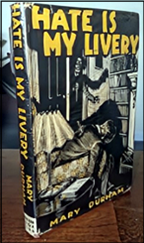
She had three different publishers: starting and ending with John Gifford (four books in total), with John Crowther (four books) and Skeffington (three books) issuing her other books. Her first book, Hate Is My Livery was published in June 1945 by John Gifford, with a Thriller Book Club edition as well. It is an excellent wartime mystery concerning the stabbing to death of an M.P. It has echoes of Freeman Wills Crofts and Christopher Bush in its alibi-busting solution — the detective is Inspector Randolph York who appears in three other titles, including the next Why Pick on Pickles?
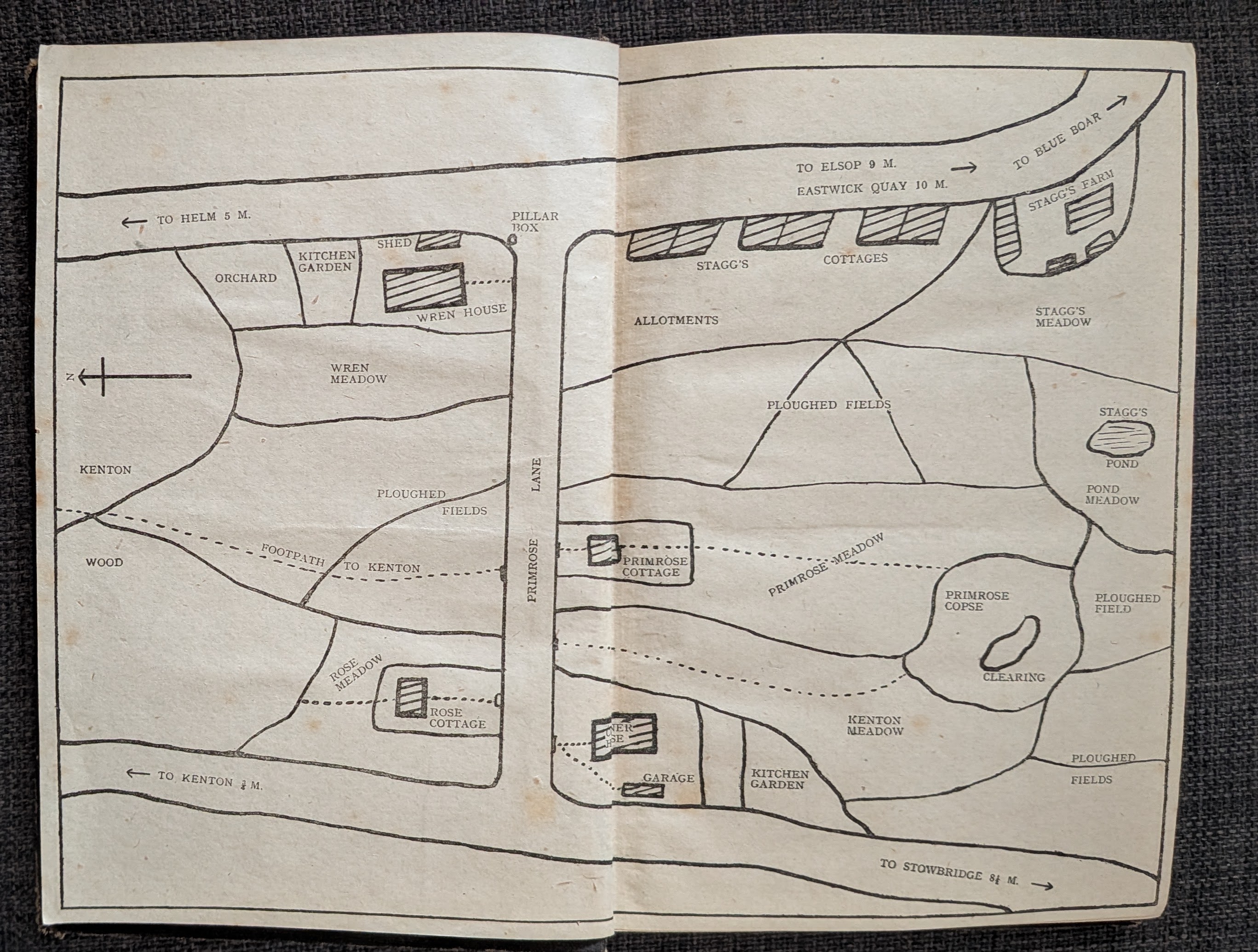
This second novel is set in the autumn of 1939, during the early days of the Second World War, when Chamberlain assured everybody that it was better to be bored than bombed. All who knew Frederick Ponsonby Pickles asked why such a harmless little man should have been the victim of a brutal murder; found throttled to death in the entrance lobby of his country cottage. It presents a puzzle for Inspector York to solve, which he eventually does with the help of his young assistant, Detective-Sergeant Noel Hammond. The book was published by the small firm of John Crowther as were the next three titles.
Her third book is a stand-alone title, Cornish Mystery. The body of a woman artist is found deep in a stagnant pool, there are many suspects, but all have alibis. The murderer is cleverly hidden, a feature that reoccurs in her next book, Keeps Death His Court.
Sir Philip Linwood, an English Baronet with a fearsome reputation, is found murdered during Christmas Eve in the grounds of his country estate in Yorkshire; another case for Inspector York to solve. It was reprinted in Italian in 2020 as a Christmas Mystery under the title Morte a Linwood Court.
York investigates again in her fifth book, Crime Insoluble. It starts with an intriguing premise: two unnamed characters are discussing the vengeance murder of another person, the toss of a coin to decide which of them will commit the crime. I thought I had worked out ‘whodunnit’, but there’s a clever twist at the end and I was wrong.
Then come three books published by Skeffington. I suspect they may have been her first written books: Murder by Multiplication and Murder Hath Charms are both set in the 1930s. In Murder by Multiplication a collection of ill-assorted guests is assembled at a country house for a weekend party and the house becomes the scene of a diabolically ingenious murder.
The book has a clever plot but has a very dull section in the middle where the narrator and one of the characters discuss where various people were at the time of the murder, the author uses lots of A’s & B’s X”s etc making it hard going to read. But it is redeemed by having a surprise murderer, found by the ‘suave but shrewd personality’ Inspector York.
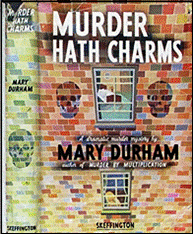
In Murder Hath Charms it takes Inspector Hilton exactly six days to lay his hands upon the murderer of Henry Phillips, who is found strangled on an afternoon in August 1935 after an attack of sunstroke. It appears impossible for any of the suspects to have committed the murder, but the author pulls a rabbit out of a hat with at the last minute the detective working out who did it and how.
Her third and last book for Skeffington Corpse Errant is her hardest book to find and I have never seen a copy. A contemporary newspaper review helpfully outlines the plot. It concerns a young woman who upon arrival at a new job as a secretary at Grover Court finds a dead body when it falls out of her bedroom cupboard. The body disappears and a series of amazing episodes ensue. Eventually Scotland Yard is called in, and Inspector Charles solves the mystery.
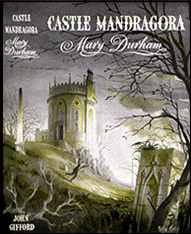
Her original publisher, John Gifford, published her final three books. Castle Mandragora is set in the early 1930s and is a first-person narrative. It is a crime thriller, with elements of the supernatural throughout, set in the Suffolk Brecklands and complete with a diagram of the castle layout. The police appear only briefly, and the explanation of the crime comes in an epilogue written by a friend and former colleague of the narrator.
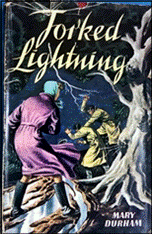
Forked Lightning introduces a new detective, Inspector Christopher March who also appears in her final book. The blurb starts: ‘When the attractive young novelist, Jessica Munro, sets out from her cottage one night in a heavy thunderstorm to post an urgent letter, she plunges straight into the heart of a nightmare. A flash of forked lightning reveals a terrifying scene, and Jessica cannot escape the consequences of what she witnesses’.
It seems there can be only one person who could have committed the murder that Jessica has seen but once again the author cleverly misdirects the reader and the actual culprit is not someone obvious.
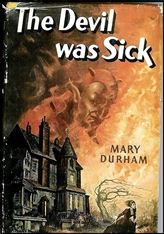
Her last book, published in April 1952, was The Devil Was Sick; in a review in the author’s local newspaper, it says that the book ‘presents the Sorrell family of writers whose oscillating passions cause a sequence of events ending in catastrophe’. There are too many with a motive for committing the crime and the change in character of the person who is murdered seems a little farfetched. The ending is disappointing as well.
Mary Durham Bibliography (from Hubin)
All the following books are set in England:
Hate Is My Livery -– John Gifford 1945 – Insp. (Chief Insp.) Randolph York
Why Pick on Pickles? — John Crowther 1945 – Insp. (Chief Insp.) Randolph York
Cornish Mystery — John Crowther 1946
Keeps Death His Court — John Crowther 1946 – Insp. (Chief Insp.) Randolph York
Crime Insoluble — John Crowther 1947 – Insp. (Chief Insp.) Randolph York
Murder by Multiplication — Skeffington 1948 – Insp. (Chief Insp.) Randolph York
Murder Hath Charms — Skeffington 1948
Corpse Errant — Skeffington 1949
Castle Mandragora — John Gifford 1950
Forked Lightning — John Gifford 1951 – Insp. (Chief Insp.) Christopher March
The Devil Was Sick — John Gifford 1952 – Insp. (Chief Insp.) Christopher March
So, who was Mary Durham? A few months ago, Mauro Boncompagni, a keen and very knowledgeable collector of crime fiction, told me he’d found for sale on eBay a letter from the author to a fan of her books, that gave her full address, which happened to be in Felixstowe, an East of England coastal town in the county of Suffolk. From this, it was a short step using the genealogical website Ancestry and the British Newspaper Archive to find details about her and her life.
Born Mary Edith Emily Hervey on the 24 February 1891 in Shotley, a village near Ipswich in Suffolk. She was the second daughter of the Reverend John Frederick Arthur Hervey, a rector of Shotley for 56 years, and had three siblings. Her grandfather was Lord Arthur Charles Hervey, a Bishop of Bath & Wells. Her great grandfather was the 1st Marquess of Bristol, Frederick Hervey.
Mary married Reverend John Francis Langton Durham in Felixstowe in September 1929. At the time he was an assistant priest at a church in London. He was an army chaplain from May 1939. She obtained a First Class Honours Degree (Bsc) in Economics from the London School of Economics in the same year. In the 1939 Register which was taken on 29 September, Mary Durham is listed as married and residing in Felixstowe with her mother and unmarried sister, but there is no mention of her husband John. There were no children from their marriage, and the couple separated, probably before the end of the Second World War.
Of her three siblings only her sister Patience Gertrude Hervey produced an offspring, a daughter Josephine Griffin, born in December 1928. Josephine was an actress; her films included the Francis Durbridge thriller Portrait of Alison, The Man Who Never Was, and The Purple Plain. Under her married name Josephine Filmer-Sankey she co-wrote a history of the Bayeux Tapestry, published in 1966.
A few months after Mary Durham’s second book was published, The Felixstowe Times newspaper reported in May 1946 in a brief piece entitled ‘Thriller With Local Setting’, that as well as writing thrillers she was a teacher of economics and had taken a flat in that town. It also reported that she had spent four years in Cornwall during the Second World War.
Mary Edith Emily Durham died in hospital in Felixstowe on December 28, 1972, aged 81.
If you want to try a new author who wrote in the Golden Age of Detection tradition Mary Durham is well worth seeking out. While some of her books are difficult to find, the Thriller Book Club editions of the last three John Gifford titles are easier, and cheaper! All her books will repay investment in them.