Thu 6 Aug 2026
A 1001 Midnights Review: GRAHAME GREENE – The Ministry of Fear.
Posted by Steve under Uncategorized1 Comment
by Marcia Muller
GRAHAME GREENE – The Ministry of Fear. Heinemann, UK, 1943. Viking Press, US, 1943. Penguin #530, US, 1946. Reprinted many times.
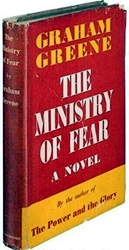
Graham Greene has a rigid-and pretentious-habit of classifying his own work into two categories: “entertainments” and “novels.” While all of his work is suspenseful and contains criminous elements, the “entertainments” are more action-oriented and their mystery elements are stronger. The “novels,” on the other hand, tend to be quieter and deal with the religious thematic material that is one of Greene’s preoccupations.
While the author appears to want to rank his “entertainments” as secondary within his body of work, it is apparent that no less effort goes into them than into the “novels”: all are well written, deeply characterized, rich in background, and highly suspenseful. In Greene’s case, whatever the label, the product is bound to be superior.
As the hero of The Ministry of Fear states, “It all began … with a cake.” Arthur Rowe is at a neighborhood fete in World War II London, a fair to benefit a charitable group called the Comforts for the Mothers of the Free Nations Fund. One of the attractions is a cake — “made with real eggs” — which people are invited to guess the weight of. Rowe makes a guess, wanders off, and goes into the fortuneteller’s booth. The sorceress, a Mrs. Bellairs, does not tell him his future, but she docs tell him the correct weight of the cake. Rowe changes his bet and wins the cake — and more trouble than he can handle.
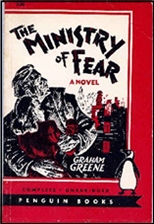
Before he leaves the fete, several people try to get the cake back from him- The next day a mysterious gentleman moves into his rooming house and partakes of the cake with Rowe, making thinly veiled hints that Arthur should tum it over to him — and crumbling each piece offered to him. A bomb from a German plane breaks up their tea party, the cake is destroyed, the stranger seriously injured. When Rowe later inquires after him at the hospital, he finds he was spirited away by friends. And Rowe remembers something odd about the taste of the tea just before the bomb exploded ….
Rowe becomes obsessed with finding out who tried to kill him-and why. His efforts involve him with a private inquiry agent named Rennit and his unfortunate assistant, Jones. A trip lo the offices of the Mothers of the Free Nations Fund brings him into contact with an Austrian brother and sister, refugees who will have a profound effect on the rest of his life. And a seance at the home of Mrs. Bcllairs, the erstwhile fortune-teller, ends in a murder and a narrow escape. A mental hospital where patients are held virtual prisoners, more dangerous episodes, and a touchingly ironic conclusion round out this tale of wartime intrigue.
This is a gripping novel, although somewhat oddly constructed. The business about the cake makes it fairly obvious what is going on, but there are enough surprises, and Greene makes one care so much about Rowe that you won’t want to put it down. Fritz Lang filmed a highly moody version in 1944 with Ray Milland.
———
Reprinted with permission from 1001 Midnights, edited by Bill Pronzini & Marcia Muller and published by The Battered Silicon Dispatch Box, 2007. Copyright © 1986, 2007 by the Pronzini-Muller Family Trust.
August 16th, 2026 at 12:19 am
Ms. Muller was a little out of date here. Greene stopped dividing his works into Entertainments and Serious works with The Comedians (1960’s), not all that late in his career. Our Man in Havana (1959) was the last book labeled as an “entertainment”. Somewhat similarly John Buchan soon stopped labeling his thrillers “Shockers” fairly early.
The Fritz Lang film of this is quite good and stars Ray Milland with Dan Duryea as one of the villains. It only softens the books devastating reveal as much as the Hayes Office required for an American production though Greene who decried all American productions of his work was a naysayer. There is a serialized Italian production of the novel done for television that is quite worth seeing as well.
This and This Gun for Hire (aka Gun For Sale)) were inspired by John Buchan’s pioneering The Power-House serialized in 1910 which Greene and Eric Ambler consider the first modern Spy Novel for its revelation of how dangerous urban life is beneath the surface, “the thin veneer of civilization,” when its hero Ned Leithen realizes he is no safer in Picadilly than he would be on the veldt if someone wanted to harm him after uncovering a conspiracy to undermine the great powers by a “rational fanatic” preaching a precursor of fascism and National Socialism (predicting Hitler, Mussolini, Nationalism, and Fascism all in 1910)..