Fri 14 Aug 2026
Diary Review: ELLERY QUEEN’S MYSTERY MAGAZINE November 1948.
Posted by Steve under Uncategorized[6] Comments
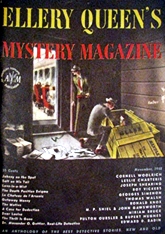
ELLERY QUEEN’S MYSTERY MAGAZINE November 1948. Cover by George Salter. Overall rating: **½
ROY VICKERS “The Death Position Enigma.” Department of Dead Ends story, Coincidence and a mistake combine to help solve an old murder case, Inverted detection. (2)
GEORGES SIMENON “L Chateau de L’Arsenic.” A curious doctor takes it upon himself to investigate a chateau about which rumors are flying. (3)
LESLIE CHARTERIS “Salt on His Tail,” The Saint salts a mine twice. Unbelievably obvious. (1)
JOSEPH SHEARING “Love-in-a-Mist.” An aged spinster allows her secret love to get away with murder. (3)
RONALD KNOX “The Motive,” First appeared in the Illustrated London News, December 1937, A John Dickson Carr “best,” Suicide as a motive for murder, (4)
THOMAS WALSH “Getaway Money.” Drake helps save an old friend’s son from a murder rap. (3)
FULTON OURSLER “The Thrill Is Gone.” First appeared in Collier’s, 1942. A daring man discovers that his wife really didn’t kill her first husband, (4)
M. P. SHIEL & JOHN GALSWORTHY “A Case for Deduction.” A challenge to the reader is the weirdest combination of circumstances that could be believed only if true. (0)
MIRIAM BRUCE “Dear Louisa.” A series of letters from a woman having troubles with her son. (2)
CORNELL WOOLRICH “Johnny on the Spot.” 1936. An attempt to go straight gets Johnny into trouble with gang, and it is up to his girl friend to stop then in time. Real suspense/ (4)
August 15th, 2026 at 12:33 pm
I have a soft spot for EQMMs from this era and this one features a lot of interesting and top notch authors. Fulton Oursler, for example. When young, he worked with Harry Houdini to expose phony mediums, and was later the editor of LIBERTY magazines during the 1930s. He is best known to crime afficionados as the author of the Golden Age Thatcher Colt mysteries, written as by Anthony Abbott. An avowed atheist from the age of fifteen, he converted to Catholicism with a vengeance as an adult, eventually penning his best-known (and best-selling) work, THE GREATEST STORY EVER TOLD. His co-author here was also interesting. Hughes was a prolific (and evidently much admired) author, biographer, short story writer, film director, and screenwriter. For me, the coolest thing about Hughes was that he was the uncle to THE Howard Hughes.
August 15th, 2026 at 12:58 pm
I seem to have slipped up here. I had added all sorts of prior publication data to the stories in the issue, when they applied, and that’s the version of this review that *didn’t* get posted. you’re right, Jerry. The Oursler story was co-written by both him and Rupert Hughes.
What struck me most about this particular issue is that half, maybe more, were reprints, published earlier in other places. Not so any more, of course. For many years now, there’s been at most one “classic” reprint per issue.
August 15th, 2026 at 4:31 pm
Steve, reprints were one of the great things about EQMM from that era. With the state of book publishing at the time and the scarcity of decent anthologies, many works were “lost” to readers; by reprinting these authors and these stories, EQMM helped provide a historical and literary background for the genre. Today, with so much available on the internet and elsewhere, such an approach is hardly necessary — although many modern readers do not take advantage of all the classic and historical goodies available to them. I, for one, feel that it is both good and healthy to be aware of the roots of my favorite genre.
August 15th, 2026 at 4:48 pm
Jerry, I agree with you 100%, and I’d go higher if I could. Too many readers today just don’t seem to care for the “old stuff” any more.
August 15th, 2026 at 11:46 pm
I found both the Vickers and Charteris stories better but otherwise agree. It’s a slender volume but the collection of Department of Dead Complaints stories featuring Inspector Rason is one of the classics well worth finding.
August 30th, 2026 at 3:16 am
Steve, Jerry,
We seem too busy erasing the past without bothering to understand it today a bit like living in Orwell’s 1984. Between the extremes of both Right and Left the only thing left will be the blandest of the bland, history and scholarship a blank slate rather than a rich if at times problematic tapestry.