Wed 19 Aug 2026
A 1001 Midnights PI Review: STEPHEN GREENLEAF – Death Bed.
Posted by Steve under Uncategorized[6] Comments
by Marcia Muller
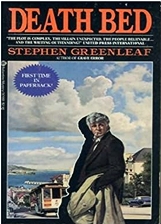
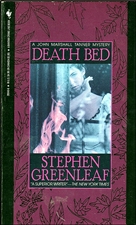
STEPHEN GREENLEAF – Death Bed. John Marshall Tanner #2. Dial Press, hardcover, 1980. Ballantine,paperback, May 1982; Bantam, paperback December 1991.
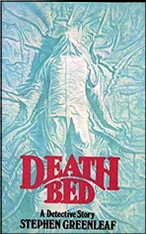
Stephen Greenleaf has received a great deal of critical acclaim for his novels featuring John Marshall Tanner. former lawyer turned private eye. Tanner’s territory is the San Francisco Bay Area, where his cases take him into the homes of the rich and powerful, as well as into the lowest dives in the city; the author draws heavily on his knowledge of politics, business, and local events to flesh out Tanner’s investigations. Greenleaf has been hailed as the successor to the Raymond Chandler/Ross Macdonald tradition, and it is easy to see why.
Like Philip Marlowe and Lew Archer, Tanner is less a fully developed character than an observer. Hints are thrown out about his past and private life, but they are not elaborated upon, and frankly the reader doesn’t care. Greenleaf makes extensive use of simile, as Macdonald did, but with far less success; often he seems to be stretching a point, reaching for a likeness that simply doesn’t come off.
He is a successor to the tradition of the hard-boiled private eye developed by these writers in the sense that he is an imitator, and his work makes one wonder why we need further imitations.
Death Bed begins with a scene reminiscent of Philip Marlowe’s meeting with Colonel Stemwood in The Big Sleep. Maximilian Kottle, dying millionaire, wishes to hire Tanner to find his estranged son, Karl. Kottle waxes philosophical about life and death — perhaps too much so for a man in such pain and close to death — and Tanner agrees to find his son for him.
Karl’s mother, flamboyant romance novelist Shelley Withers, can give few clues to her son’s whereabouts, but through solid detective work — one of the strong points of this series — Tanner traces Karl, and is getting close when Belinda Kattie, beautiful young wife of Maximilian, calls to say Karl has contacted his father and is coming to see him. Shortly afterward, Maximilian dies, and Tanner considers the case closed.
He is then free to undertake a search for missing investigative reporter Mark Covington, but soon discovers the Kottle case is not only still open, but also linked to the journalist’s disappearance.
There arc a few surprising twists here, but the case builds to a rather predictable conclusion. and the primary villain (there are many, of various sorts) is introduced so late in the narrative that the solution comes a little out of left field. Chandler and Macdonald simply did it better.
Other novels featuring John Marshall Tanner are Grave Error (1979), State’s Evidence (1982), and Fatal Obsession (1983 ).
———
Reprinted with permission from 1001 Midnights, edited by Bill Pronzini & Marcia Muller and published by The Battered Silicon Dispatch Box, 2007. Copyright © 1986, 2007 by the Pronzini-Muller Family Trust
August 20th, 2026 at 6:11 am
Fourteen novels and one short story from 1979-2000. My opinion of the character and of the books is more positive that Muller’s, and along the lines of Kevin Burton Smith, who wrote, “One of the very bravest and boldest private eye series of the eighties and nineties; endlessly engaging and not afraid to push buttons. Heartily and highly recommended.”
In 2006.,J. Kingston Pierce polled readers of THE RAP SHEET, asking “Which long-missing crime writer would you most like to see publishing new books again in the near future?” Jonathan Valin came out on top, with Stephen Greenleaf following very close behind:
https://therapsheet.blogspot.com/2006/10/please-come-back-kids.html
== Interesting reading, which may say more about a publisher’s quirks than about reader preference.
August 20th, 2026 at 6:09 pm
I agree with Jerry, I very much enjoyed the series and think Ms Muller was much more critical of his work than was generally accepted at the time. The author was pretty honest about patterning his work after Ross Macdonald, and said he knew it was time to end the series when the last book came out in hardcover and there were no offers for paperback rights.
He also wrote two stand alone legal novels that were very good, one “Impact” about a plane crash and the other “The Ditto List” about a divorce lawyer.
August 20th, 2026 at 10:24 pm
I think any PI writer in the 80s and 90s who had any following at all was of necessity always compared to Hammett and Chandler, whether there was any valid comparison or not.
Mostly it was Chandler that critics compared the new guy to, and having read about half of Greenleaf’s books, I’d have to agree that maybe the critics were right in talking about Greenleaf into that Chandler camp.
I’ve never tried playing that game very often, but as much as I enjoyed Greenleaf’s work, I don’t think he’s passed the test of time. I wish I could say otherwise, but I think Greenleaf has been forgotten, but Chandler’s work is still going strong.
The other PI writers of that era have fared as poorly. Valin, Tapply, Healy, all of them. Largely forgotten except by guys like us. Come back in another 20 years. Maybe their books will have made a comeback. I’d like to think so.
August 21st, 2026 at 6:57 am
I loved the PI books from the 80’s and 90’s, have to admit I haven’t gone back and read any in years, so not sure how they would hold up.
Writers like Bill Pronzini and Loren Estleman continue(d) to write PI stories along with their other work, so they were able to transition well, others maybe not.
Interesting that probably the three authors who started in the 80’s and are still writing and selling are ladies, Marcia Muller, Sara Paretsky and Sue Grafton (until she passed).
August 21st, 2026 at 11:14 am
I think the books from back then hold up as well as they ever did. The hoopla that came with them is what doesn’t.
August 30th, 2026 at 2:55 am
Greenleaf was far more late Macdonald than Chandler for my taste. I liked this one, but Greenleaf soon forgot the part about “a man walks in with a gun” whenever things are lagging. Tanner’s existence as a cypher dragged the whole literary bit down, as to be fair was true of later Archer and Macdonald for me.