Wed 2 Sep 2026
A 1001 Midnights Review: FRANK GRUBER – Brass Knuckles.
Posted by Steve under Uncategorized[7] Comments
by Bill Pronzini
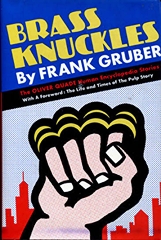
FRANK GRUBER – Brass Knuckles. Sherbourne, gardcover, 1966.
Frank Gruber’s first novel, The French Key (1940), so moved critic William Lyon Phelps that he rhapsodized: “[It] is the best of 8,000 murder stories I have read.” One wonders (a) what sort of godawful mysteries Phelps had been reading all his life; and (b) if he was senile at the time he made this statement.
The fact is, while The French Key may be an entertaining novel. it falls woefully short of being a masterpiece. Like all of Gruber’s novels, its prose shows the author’s pulp-magazine origins, the plot has some dubious motivation and other weak elements, and the whole thing suffers (as opposed to the works of many of Gruber’ s counterparts) from underwriting — scenes chopped off short of their potential, either through haste or lack of ability.
Still and all, Gruber had a pulpster’s knack for telling a lightning-fast story, and for creating oddball characters and integrating them into unusual backgrounds; for those reasons his work remains readable today. This is especially true of his short stories: his short fiction shows much more facility than his novels, as the ten novelettes in Brass Knuckles testify.
All ten of these stories feature Oliver Quade, the “Human Encyclopedia,” hawker of the 1200-page Compendium of Human Knowledge (every page of which he has memorized) and accomplished amateur sleuth. The Quade adventures began in Thrilling Detective in 1936; the following year Gruber moved the series to Black Mask, where all hut one of the entries in Brass Knuckles were first published.
< Quade is an amusing character, as is his sidekick, Charlie Boston (a name Gruber borrowed for use as a pseudonym on a 1941 novel, The Silver Jackass ). He and Charlie travel around the country looking for likely places to set up their spiel and getting into trouble as a result of their choices. In “Ask Me Another,” their appearance at the Great Chicago Auditorium Poultry Show has them up to their ears in murder, mayhem, and chickens.
Other creatures plague them as well-canines in “Dog Show Murder,” bangtails in “Oliver Quade at the Races,” and fighting cocks in “Death at the Main.” In “State Fair Murder,” it is the midway at the Minnesota State Fair and Confederate colonel William Clarke Quantrill that combine to land our heroes in hot water.
These stories are lightweight and pulpy, but pleasant diversions nonetheless — and representative examples of the state of the art in such magazines as Black Mask in the late Thirties and early Forties.
Despite factual errors and distortions, a thirty-nine-page introductory essay by Gruber entitled “The Life and Times of the Pulp Story” (which he later expanded into his 1967 memoir The Pulp Jungle) is compulsive reading and makes Brass Knuckles particularly commendable to anyone interested in the pulp era.
———
Reprinted with permission from 1001 Midnights, edited by Bill Pronzini & Marcia Muller and published by The Battered Silicon Dispatch Box, 2007. Copyright © 1986, 2007 by the Pronzini-Muller Family Trust.
September 3rd, 2026 at 10:27 am
I love BRASS KNUCKLES. I read it first from the library when I was in high school and just discovering all the hardboiled pulp authors. Years later I bought a copy and reread it, and I still love it, especially Gruber’s intro. I think Steeger Books is reprinting the whole Oliver Quade series. I haven’t picked up any of those volumes yet, but I’m sure I will.
September 3rd, 2026 at 12:12 pm
I think that Bill Pronzini’s suggestion that Gruber’s short stories were better (more fun to read) than his novels is right on, or at least that’s my thought as well. It could be that I’ve read the wrong novels, though. The ones I’ve read have come from either the beginning or the end of his career.
As for BRASS KNUCKLES, it came along at just the right time for me. I’d only begun reading pulp stories when I could find them (and only owned one or two real pulp magazines at the time), so not only were the stories fun, but Gruber’s long intro was even better. It made me start to think about the men (and a handful of women) who’d actually written them in a brand new light. A fascinating world that had only existed behind the scene before then had sprung up before my eyes.
September 3rd, 2026 at 2:37 pm
Like many a pulpster, Gruber was multi-genre and eventually graduated (if that’s the word!) to Hollywood and telling fledgling writers how to succeed. Go to blackhorsewesterns.com and read right to the end “Detectives in Cowboy Boots” on the March 2007 page. Gruber wraps it all up!
September 5th, 2026 at 12:14 pm
Keith, I think this link will take everyone directly to the piece on Cowboy detectives, lets call them:
https://blackhorsewesterns.com/bhe5/index.htm#Detectives
Relevant to Frank Gruber in particular, here’s a paragraph I’d like to bring up, snother side of Gruber’s writing credit:
“For the large and small screens, Gruber reputedly wrote more than 200 scripts or scenarios, mainly westerns. He created several television series, notably Tales of Wells Fargo, The Texan, and Shotgun Slade (1959-61). The last combined his favourite genres: Slade was a private eye in the Old West.”
September 5th, 2026 at 3:00 am
Gruber wrote several well done tales of international intrigue that worked better for me than his detective novels including Bridge of Sand and Twenty Plus Two (the latter a film with David Jannsen).
My intro to Oliver Quade was Ron Goulart’s The Hard-Boiled Dicks and I recall grabbing up Brass Knuckles when it was published.
A lot of the appeal of Gruber’s mysteries depends on how comfortable the reader is with the breezy screwball school of mystery fiction.
September 5th, 2026 at 12:23 pm
Oliver Quade was overall a minor player in the pages of detective fiction, but this collection of the pulp stories he was in made a big bang with quite a number of readers and collectors at the time, including both you and me, David.
September 5th, 2026 at 2:17 pm
Goulart’s THE HARDBOILED DICKS is quite possibly my favorite anthology of all time, but BRASS KNUCKLES was probably the second most influential on me during that era because of Gruber’s intro. I wanted to be the kind of writer he talked about in that essay.