Mon 1 Dec 2025
Diary Review: THRILLING DETECTIVE – Fall 1952.
Posted by Steve under Diary Reviews , Magazines[13] Comments
THRILLING DETECTIVE. Fall 1952. Overall rating: *½
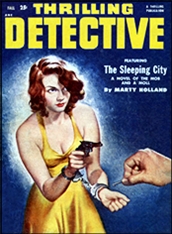
MARTY HOLLAND “The Sleeping City.” Novel. Plainsclothesman Wade Reed is assigned as undercover job posing as a Chicago gunman in town to help out with a bank robbery, In spite of a fiancee waiting for him, he falls for a monster’s moll and nearly turns criminal. Capture means the girl’s death and Reed’s resignation from the force. The literary symbolism which is included is forced, generally trying too hard (2)
JOE BRENNAN “Dive and Die,” A stunt diver, recently returned from Korea, investigates the death of his former partner. (1)
JEAN LESLIE “Dead Man’s Shoes.” The sad history of a pair of shoes is traced. Almost Woolrichian in tone. (2)
WILLIAM G. BOGART “Death Lies Deep.” Novelet. Almost standard private eye story. Steve Morgan is hired by an old flame to find her husband, whom she has already killed. Guess who would be the fall guy? (1)
AL STORM “Alive by Mistake.” A writer becomes the center of a hurricane of death about him, as he hunts down a narcotics peddler. Bad writing, but has excitement. (1)
PHILIP KETCHUM “Backfire.” A kid is framed fo robbery and murder by his best friend. Mostly miserable. (1)
HARVEY WEINSTEIN “Two-for-One Dame.” Confused and confusing story of a treacherous blonde. (0)
WILLIAM L. JACKSON “Run of Luck.” Escaped killer fouls his own getaway, (2)
December 1st, 2025 at 6:14 pm
“HARVEY WEINSTEIN “Two-for-One Dame.” Confused and confusing story of a treacherous blonde.”
Also from 1952, Harvey Weinstein. Treachery and blondes, redux.
December 1st, 2025 at 6:25 pm
A meh list of contributors, with the exception of Bogart and Ketchum. Bogart was the author of a number of DOC SAVAGE stories and Ketchum was a prolific mystery and western pulp writer, although the vast majority of his work was in the western field. Holland was actually Mary Holland, who had a half dozen stories in the detective pulps. Brennan (not to be confused with Joseph Payne Brennan) wrote mainly for the sports pulps. Leslie wrote some eight short stories for the pulps, publishing at least four novels, two of which featured the forgettable detective Peter Ponsonby. “Al Storm” was the pen name of Alvin Scism, who wrote over 50 stories for the western pulps. There were just five stories published by Weinstein between 1949 and 1952; the name may have been a pseudonym or a house name — I can say with certainty that this Weinstein was not the notorious sex offender. Jackson was another writer who primarily appeared in the western pulps, placing over 60 stories there.
It’s probably unfair to the individual authors and the stories without having read them, but this issue seems to basically scraping the bottom of the detective barrel.
December 1st, 2025 at 9:05 pm
You jumped in before I had a chance to. Jerry, with your reference to Harvey Weinstein, and Tony, I see he caught your eye, too.Funny things do happen, so I had to check him out right after posting this old review. Nope. They’re two different guys. The movie fellow was, strangely enough, born in 1952, the same year as when this issue was published. I had to use Google to be sure. though.
Not so with Marty Holland, who was indeed Mary Holland. I recognized her from some of her novels, one of which was the basis for one of my favorite films of all time, DARK ANGEL.
Here’s the link to her Wikipedia page, along with the short bibliography you can find there:
https://en.wikipedia.org/wiki/Marty_Holland
Novels
Fallen Angel (1945)
The Glass Heart (1946)
Darling of Paris (1949)
Baby Godiva (2011), published posthumously
Novellas
Terror for Two (January 1951 issue of Scarab Mystery Magazine)
The Sleeping City (Fall 1952 issue of Thrilling Detective)
Short stories
Night Watchman (March 1943 issue of The Shadow)
Rain, Rain, Go Away (April 1943 issue of The Shadow)
D.O.A.—East River (March 1944 issue of Street & Smith’s Detective Story Magazine)
Overall, Jerry, I think you’re right. The detective pulps in 1952 were just scraping by. Pulps from the 50s on are not considered very collectible, generally speaking. I might change my mind on some of the stories now compared to then, but for the most part, probably not.
December 1st, 2025 at 8:42 pm
Welcome back!!!!
December 1st, 2025 at 9:11 pm
It is good to be back, Chuck, thanks!
December 2nd, 2025 at 12:03 pm
Steve if you are talking about The Dark Angel starring Merle Oberon and Fredric March it is on TCM tonight at 8:00 pm.
December 2nd, 2025 at 12:30 pm
Gee whiz. One day back and I’m misspeaking myself already. No, I meant FALLEN ANGEL, directed by Otto Preminger and starring Alice Faye, Dana Andrews, and Linda Darnell. It’s a great film, and if anyone reading this right now hasn’t seen it yet, they should.
December 2nd, 2025 at 1:11 pm
Welcome back, indeed. Not too long ago, I edited a WIKIPEDIA entry which cited EQMM, AHMM and other digests as pulps, and noted that television was the major cause of the thinning and near extinction of pulps…no mention of paperbacks. Haven’t checked since to see how much of that was removed/reverted to less close to reality.
December 2nd, 2025 at 3:08 pm
I agree. I think the decline of the pulps came about with the growth of ordinary families buying and owning TV sets. It certainly didn’t hurt, though, that mass market paperbacks came along like gangbusters at exactly the same time. I was there, but at the age I was, I sure didn’t have the bigger picture, but unaware of what was going on as I was, I still was, if you know what I mean.
December 3rd, 2025 at 9:44 am
Might the decline of the pulps also be connected with the increase in people driving to work rather than taking trains or buses? Spending an hour or two a day on a bus or train, people would want something to fill their time, but not if they’re driving.
December 3rd, 2025 at 3:43 pm
A theory I hadn’t heard before. It’s probably not a major contributor to the decline and fall of the pulps, but is it original to you? If so, you could really be on to something.
December 4th, 2025 at 12:51 am
Speaking of how TV maybe killed of the pulps (there were many factors) I wonder what happened to all the skilled writers of the 40s. As you say, the 50s writers seem pretty dire. I wonder if all the best talent migrated to Hollywood and got into television. There was an endless demand for product and they paid better than the pulps.
December 4th, 2025 at 10:19 am
Another good theory, and again it comes down to the growth of TV as the country’s primary source of entertainment. That and paperback originals. Follow the money. That’s where the writers went.