Sun 22 Mar 2026
by Bill Pronzini
JOE GORES – Dead Skip. DKA Files #1. Random House, hardcover, 1972. Ballantine. paperback, August 1974. Mysterious Press, paperback, 1992.
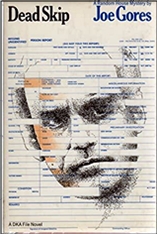
While holding down a variety of jobs, one of them a stint as a San Francisco private investigator, Joe Gores published numerous (and generally hard-boiled) short stories in the 1950s and 1960s. One of these, “Sweet Vengeance” (Manhunt, July 1964) became the basis for his first novel, the violent suspense thriller, A Time of Predators (1969). Dead Skip is the first of three novels in the DKA File series (which also includes a dozen or so short stories) — a series Ellery Queen called “authentic as a fist in your face.”
DKA stands for Daniel Kearny Associates, a San Francisco investigative firm modeled on the real agency for which Gores once worked. (It was Anthony Boucher who first suggested Gores utilize his Pl background as the basis for a fictional series.)
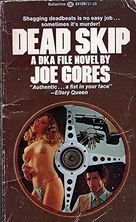
DKA operates out of on old Victorian that used to be a specialty whorehouse, and specializes in the repossessing of cars whose owners have defaulted on loans from banks and automobile dealers. Kearny, the boss, is tough, uncompromising, but fair: his operatives, each of whom plays an important role in some if not all of the novels and stories. These include Larry Ballard (the nominal lead protagonist), Bart Heslip, Patrick Michael O’Bannon, Giselle Marc, and office manager Kathy Onoda.
Dead Skip begins quietly enough, with Bart Heslip (who happens to be black) repossessing a car in San Francisco’s Richmond district and returning it to the DKA offices, where he files his report. But when he leaves he is struck down by an unknown assailant — and the following morning the other members of DKA arc confronted with the news that Bart is in a coma in a hospital intensive-care unit, the apparent victim of an accident in a repo’d Jaguar.
Ban’s girlfriend, Corinne Jones, refuses to believe in the “accident” and convinces Ballard that Bart was the victim of violence. In spite of Kearny, who seems more concerned about the cost of the wrecked Jag than about Bart’s welfare (thus causing tension in the ranks), Ballard embarks on a search for Bart’s assailant and an explanation for the attack.
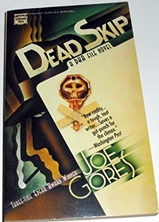
Starting with the files on Bart’s recent repo jobs, he follows a twisting trail that takes him all over San Francisco and to the East Bay: involves him with a number of unusual characters, one of them a rock musician with a group calling itself Assault and Battery; and ends in a macabre confrontation that endangers not only Ballard’s life but that of Giselle Marc, in a house high above the former haven of the flower children, the Haight-Ashbury.
The motivation for the attack on Bart is hardly new to crime fiction, and some of the villain’s other actions are likewise questionably motivated, but these minor flaws shouldn’t spoil anyone’s enjoyment of what is otherwise an excellent private-eye procedural. It is, in fact, strong stuff — realistic, powerful, “a traditional American crime novel, out of Black Mask, Hammett and Chandler” (New York Times).
Even better are the other two novels in the series- — Final Notice (1973) and Gone, No Forwarding (1978).
———
Reprinted with permission from 1001 Midnights, edited by Bill Pronzini & Marcia Muller and published by The Battered Silicon Dispatch Box, 2007. Copyright © 1986, 2007 by the Pronzini-Muller Family Trust.
March 22nd, 2026 at 9:08 am
Is this the Gores book where he and Donald Westlake wrote the same scene of a DKA op meeting Parker, Gores from the DKA perspective and Westlake from the Parker perspective? I recall the Parker book was PLUNDER SQUAD.
March 22nd, 2026 at 1:14 pm
Fred:
Yep. From my recollection it was DK himself, and they recognized one another, knowing enough to leave each alone.
March 22nd, 2026 at 1:23 pm
And for more information:
https://violentworldofparker.com/2011/08/17/parker-progress-report-a-review-of-dead-skip-by-joe-gores-and-plunder-squad-by-richard-stark/
March 29th, 2026 at 3:47 am
This was my intro to DKA, and made me a lifetime Gore’s fan. Powerful, realistic, but often as not with a streak of black humor running through it.