Wed 8 Apr 2026
Back to the Wells, Part 5: The First Men in the Moon by Matthew R. Bradley
Posted by Steve under UncategorizedNo Comments
The First Men in the Moon
by Matthew R. Bradley
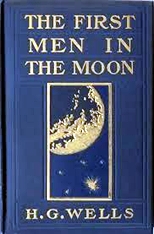
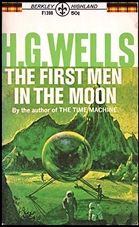
Both Jules Verne and H.G. Wells are sometimes known as “the father of science fiction,” and authored early depictions of lunar travel. Verne got off the ground first, so to speak, with De la Terre à la Lune (From the Earth to the Moon; 1865)—dismally filmed in 1958 by Byron Haskin, who did a far better job with Wells on The War of the Worlds (1953)—and its sequel, Autour de la Lune (Around the Moon, 1869). Created when humankind was on the cusp of actually reaching the moon, Paul Lehr’s evocative cover for the 1967 Berkley Highland edition of Wells’s The First Men in the Moon (1901), in various shades of green, depicts figures in modern space suits surrounding a spherical ship upon a tripod.
Narrator Bedford relates meeting Cavor at Lympne in Kent while trying to write a play in a solitary rented bungalow by Romney marsh, seeking to pay off a creditor from his latest failed business venture. As a layman, he has a limited understanding of eccentric Cavor’s efforts “to manufacture [a] possible substance opaque to gravitation out of a complicated alloy of metals and…helium,” which occurs by accident on October 14, 1899, after Gibbs and his other assistants leave the furnace untended. Cavor hits upon the idea of creating a glass-lined steel polyhedron (which Bedford, afire with Cavorite’s financial possibilities, compares to Verne), guided by Cavorite roller blinds via attraction to other heavy bodies.
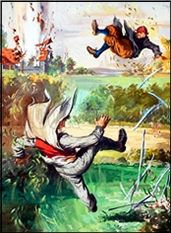
In late March, they set out on the quarter-million-mile voyage to the moon, equipped with air-purifier and electric heater, canned food, oxygen cylinders, and Shakespeare’s works, chairs obviated by weightlessness. Using attraction to the sun, they brake to their bumpy landing in a huge crater, discovering a lunar atmosphere, and life in the form of seeds that open before their eyes to drink in the sunrise, take root, and flower. Mastering the skill of “lunar locomotion” in one-sixth of Earth’s gravity, they lose sight of the sphere, and hear rhythmic noises suggesting underground machinery, confirmed as a flat surface some 200 yards in diameter slides open, à la the volcanic “lake” from You Only Live Twice (1976).
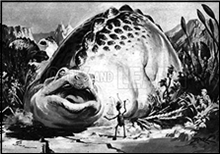
In addition to a red fungus that satisfies their hunger but inebriates them, they find fauna: 200-foot-long, sluglike mooncalves, and the 5-foot-tall, insectoid Selenites herding them, who soon capture the men. Literalizing the title, they are imprisoned deep in the hollow moon, spotting a vast mechanism whose purpose they can only guess, and angrily lashing out after being prodded by a spiked goad, Bedford finds that his hand—wrapped in one of their easily snapped chains—goes right through a “flimsy [Selenite, who] squelched and splashed.” Breaking free into stronger light they realize the chains are gold and, climbing towards the surface, battle their pursuers in a cavern where the mooncalves are butchered.
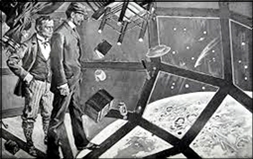
Emerging through the open “lid” into sunlight, they affix a handkerchief to a tall spike of vegetation as a reference point and separate to locate the sphere; having done so, Bedford spies Cavor’s cricket cap and a hastily penciled note indicating that, with an injured knee, recapture is imminent. As snow starts to fall and the lid shuts, Bedford knows he will die in the frigid lunar night, giving him no choice but to return to the sphere, with a chain and two crowbars made of gold, and take off. After a bizarre identity crisis he splashes down, drifting aground at Littlestone—improbably near Lympne—where four bathers carry the gold to the hotel, yet before it can be salvaged, a meddling lad is carried off in the sphere.
Repairing to Amalfi with this newfound wealth, never acknowledging his part in Tommy Simmons’s disappearance, Bedford pens his account—published under the name “Wells” in The Strand Magazine (as this was)—and resumes his play until astonishing news, after two years. At an observatory on Monte Rosa, Dutch electrician Julius Wendigee picks up signals from Cavor, at liberty amid “an almost inconceivable community of these ant-like beings,” recovered from a fever and believing Bedford dead in the crater, or lost in space. From these fragments, to which he is unable to respond, Bedford assembles an “abstract” that describes the moon’s interior, with its vast Central Sea, and master, the Grand Lunar.
Later given considerable freedom, Cavor is at first confined in a hexagonal cell, guarded by Phi-oo and Tsi-puff, who study him and learn English, enabling him to grasp how the Selenites vary greatly in form in line with highly specialized duties, each “a perfect unit in a world machine” comprising the administrators, experts, and erudite. Bedford fears he was indiscreet in his audience with the huge-brained Grand Lunar, who’d considered Cavorite merely a theoretical possibility, due to an absence of helium, and is incredulous at his account of war. The last message is “the broken beginnings of two sentences.…‘I was mad to let the Grand Lunar know—…Cavorite made as follows: take—…uless.’”

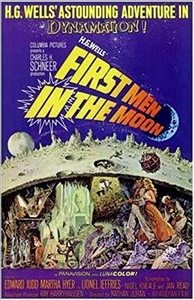
Omitting the novel’s initial article, First Men in the Moon (1964) brought together Nigel Kneale (1922-2006), who shared a script credit with Jan Read, and visual-effects creator Ray Harryhausen (1920-2013). The latter’s name is better known than those of most of his directors, including Nathan Juran on 20 Million Miles to Earth (1957), The Seventh Voyage of Sinbad (1958), and First Men. After studying sculpture and anatomy in high school and night film classes at USC, he joined the armed forces in the Signal Corps unit as an assistant cameraman, also producing on his own the animated short How to Bridge a Gorge, shown to Frank Capra, who had him transferred to his Special Service Division.
Before World War II, Harryhausen worked on George Pal’s Puppetoons animated shorts, and after it, he was contacted by his idol, King Kong (1933) animator Willis H. O’Brien, who had told him to study more anatomy when they met in 1939. Harryhausen ended up doing most of the animation on Mighty Joe Young (1949) as “Obie’s” assistant before his solo debut, Eugène Lourié’s The Beast from 20,000 Fathoms (1953), ostensibly based on the tale (aka “The Fog Horn”; The Saturday Evening Post, June 23, 1951) by his lifelong friend Ray Bradbury. It Came from Beneath the Sea (1955) began Harryhausen’s historic quarter-century association with the producer Charles H. Schneer and Columbia Pictures.
Their work encompassed straight SF (Earth vs. the Flying Saucers, 1956), adaptations of classics by Jonathan Swift (The Three Worlds of Gulliver, 1960) and Verne (Mysterious Island, 1961), Greek mythology (Don Chaffey’s Jason and the Argonauts, 1963 [also co-scripted by Read]; Clash of the Titans, 1981), dinosaurs (The Valley of Gwangi, 1969), and additional Arabian Nights fantasy (The Golden Voyage of Sinbad, 1973; Sinbad and the Eye of the Tiger, 1977). Sans Schneer, Harryhausen also worked for Hammer Films on Chaffey’s One Million Years B.C. (1966). In 1992, Bradbury presented him with the Gordon E. Sawyer Academy Award for his technical contributions to the film industry.
Neale is best remembered for his BBC serials featuring Professor Bernard Quatermass, Britain’s “must-see TV” of the day: The Quatermass Experiment (1953), Quatermass II (1955), and Quatermass and the Pit (1958). Other television work included Nineteen Eighty-Four (1954), with a star-making turn by Peter Cushing, and The Creature (1955), which like the Quatermass serials became a Hammer feature, The Abominable Snowman [of the Himalayas] (1957). Kneale also scripted Look Back in Anger (1959) and The Entertainer (1960), based on John Osborne’s plays; a naval yarn, H.M.S. Defiant (aka Damn the Defiant!, 1962); and Hammer’s The Witches (aka The Devil’s Own, 1966).
When I interviewed Harryhausen for Filmfax in 1994, he noted that Juran, Chaffey, and Lourié “were all art directors before they decided to become directors, and of course it made it easier to work with them, because they knew that there were technical problems that I had to solve and not them. Because…these type of pictures that we made were not director’s pictures, as they call them in the European sense of the word. The director sometimes comes in after the picture is all laid out and even started in production. That’s not to belittle the director’s contribution by any means, but it’s just the nature of the way we had to work in order to make these pictures for a certain type of economical sum.”
While with 20th Century-Fox, Juran shared an Academy Award for Best Art Direction-Interior Decoration, Black-and-White, for How Green Was My Valley (1941), as well as a nomination for The Razor’s Edge (1946). As a director, he is best recalled for the genre films that included The Black Castle (1952) and The Deadly Mantis (1957); embarrassed, he signed The Brain from Planet Arous (1957) and Attack of the 50 Foot Woman (1958) with his middle name, as Nathan Hertz. Jack the Giant Killer (1962) reunited Juran with the producer and star of Sinbad…but not with Harryhausen, who “was never asked. They faked it. It was practically a remake of Seventh Voyage in a different period,” he told me.
After four consecutive Harryhausen scores by the legendary Bernard Herrmann, the more economical Laurie Johnson, known for his jazzy 1965 theme for the series The Avengers, rose to the occasion with a magisterial main title. Said Harryhausen, “These are visual type films, and…you go way back to…King Kong…and Max Steiner’s score was 50% of the success of it. An impressive score for [films such as ours] needs a very imaginative and brilliant composer…[The] music in a picture that depends on stunning visual images is enormously important, and I think some of the Hollywood composers are so underrated, how they’re able to boost a picture and make it bigger than life just by the right score.”
Also the associate producer, he acknowledged that Kneale and Read had to alter First Men to accommodate the Dynamation process (credited as “the miracle of the screen”), “very much so. We adhered very closely to [the] description of the space sphere, and…tried to stick to Wells as close as possible. But many times…you have to manipulate situations in order to build to a climax.” Rather than choose between a modern or period setting—as producer George Pal did in War and The Time Machine (1960), respectively—they had both. In the present era, Col. Rice (Sean Kelly), Sgt. Andrew Martin (Gordon Robinson), Cosmonaut Nevsky (John Murray Scott), and Stuart (Norman Bird) arrive aboard U.N. 1.
A surprise awaits: a Union Jack, and a note claiming the moon in Queen Victoria’s name in 1899, written on the back of a writ summoning Katherine Callender (Martha Hyer), for illegal transfer of title deed, to court in Dymchurch, Kent. Registrar Miles Malleson tells a U.N. Space Agency investigation team—Richard Challis (Hugh McDermott), Margaret Hoy (Betty McDowall), Glushkov (Laurence Herder), and Dr. Tok (Marne Maitland)—that Kate has been dead for 10 years. But husband Arnold Bedford (Edward Judd) is in a nearby nursing home, whence he has been sending fruitless warnings to NASA and other agencies, and in great consternation, he explains how he came to leave them on the moon.
With President John F. Kennedy’s vow to put a man there by the end of the decade nearly fulfilled, and real science about to overtake SF, lifelong Wells fan Kneale conceived of a framing sequence, finally ending Schneer’s resistance to Harryhausen’s dream of a screen version, due to concerns about a period setting. Although interpolating Kate as Bedford’s fiancée, who arriving at Cherry Cottage finds that he has made no progress in writing The Eternal Triangle, the flashbacks follow the book fairly closely. The roof-raising accident caused by the inattention of Gibbs (Erik Chitty) and his colleagues inadvertently confirms to Joseph Cavor (Lionel Jeffries) that his invention has sufficient power to lift the sphere.
Read’s studio-mandated rewrite added both humor—which befit Jeffries’s comic persona but was blamed by Harryhausen for the disappointing box-office take—and an obligatory love interest; Kneale told his biographer, Andy Murray, that he left the project because of Schneer’s own uncredited script-tinkering. As played by Judd, cast due to his role in the SF film The Day the Earth Caught Fire (1961) and under contract to Columbia, Bedford is deceitful. Claiming to own the cottage, he signs it over to Kate, allegedly to shield the income from his creditors, so that she can sell it to Cavor, protecting his isolation, on the condition that the money is then invested in Cavorite, in which he senses an opportunity.
Hence the writ, delivered by the Bailiff’s Man (an uncredited Peter Finch), which Kate is angrily protesting as the sphere is about to take off, forcing Beford to yank her inside for safety; here, they are equipped with an elephant gun and, for use on the lunar surface now known to be airless, diving suits…but only two, so she is left in the airtight compartment. After an initial recon, the men find that the Selenites have dragged the sphere into the air-filled caverns, and they X-ray Kate, courtesy of a repurposed skeleton from Jason. As in Wells, when not needed, Selenite workers are drugged, which Cavor calls “a unique way of dealing with unemployment…entirely reasonable,” but prompts a warning from Kate.
Shot in Panavision (unique in the Harryhausen oeuvre) and “LunaCOLOR” by longtime collaborator Wilkie Cooper, the film is visually sumptuous, from the lovingly re-created sphere, with its wise addition of railway bumpers to cushion its landing, to the animated Selenites and mooncow, which adds drama by pursuing the men through the tunnels. The coughing Cavor, after his injudicious revelations, stops Bedford from shooting the Grand Lunar, and remains to foster understanding while the others flee in the sphere, lost at sea. The U.N. crew finds the city deserted before it collapses, apparently wiped out by germs brought from Earth, and Bedford says, “Poor Cavor….He did have such a terrible cold.”
Kneale cribbed this device, which echoes Cavor’s fever in the novel, from The War of the Worlds (1898), resolving the likelihood that actual astronauts arriving on the moon would not find Selenites. Accounts differ as to whether his younger brother, artist and sculptor Bryan Kneale, designed these or merely constructed them from Harryhausen’s designs, but those in the fight scenes and long shots match poorly with the animated ones. “I quite agree. I shuddered when I had to use children in Selenite suits—which I once vowed I would never do—but being practical I was forced to, otherwise I might still be animating the many lunarians up to the present day!,” Harryhausen told me when I asked about this.
Partly inspired by Verne, Wells’s “scientific romance” was in turn acknowledged by C.S. Lewis, best known as the author of the Chronicles of Narnia, as an influence—although with a very different philosophy—on his Space Trilogy: Out of the Silent Planet (1938), Perelandra (1943), and That Hideous Strength (1945). Released a year after First Men, Georges Méliès’s seminal French SF film Le Voyage dans la Lune (A Trip to the Moon; 1902) combines elements of Verne and Wells, respectively the cannon-propelled capsule and Selenites. There was also an eponymous Wells adaptation in 1919, now considered lost, while the story was adapted by the BBC on both radio (1981) and television (2010).
Up next: The Food of the Gods
Edition cited/works consulted:
Bradley, Matthew R., “Ray Harryhausen Now and Then: An Interview with the Dean of
Dynamation,” Filmfax #52 (Sept./Oct. 1995).
Brosnan, John, Future Tense: The Cinema of Science Fiction (New York: St. Martin’s, 1978).
Gunn, James, editor, The New Encyclopedia of Science Fiction (New York: Viking, 1988).
Hardy, Phil, editor, The Overlook Film Encyclopedia: Science Fiction (Woodstock, NY:
Overlook, 1995).
Internet Movie Database (IMDb)
Internet Speculative Fiction Database (ISFDb)
Jensen, Paul M., The Men Who Made the Monsters (New York: Twayne, 1996).
Murray, Andy, Into the Unknown: The Fantastic Life of Nigel Kneale (London: Headpress,
2006).
Wells, H.G., The First Men in the Moon (New York: Berkley Highland, 1967).
Wikipedia
Online source:
https://m.ok.ru/video/654704773872
Portions of this article originally appeared on Bradley on Film.