Wed 15 Apr 2026
by Bill Pronzini
JOE GORES – Hammett. Putnam’s, hardcover, 1975. Ballantine, paperback, 1976.
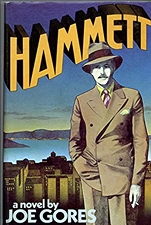
Gores is a lifelong aficionado and student of the works of Dashiell Hammett, and Hammett’s influence is clearly evident in Gores’s own fiction. Hammett is his personal monument to the man he believes was the greatest of all crime writers — part thriller, part fictionalized history, part biography set in the San Francisco of 1928, “a corrupt city. owned by its politicians, its cops, its district attorney. A city where anything is for sale.”
When an old friend from his Pinkerton days. Vic Atkinson, is murdered after Hammett refuses to help him, the former op-turned-Black Mask writer once again finds himself in the role of detective and man hunter. But as the dust-jacket blurb says, “During his search through the teeming alleys of Chinatown, through the cathouses and speakeasies and gambling helJs of the city, Hammett discovers that the years of writing have dulled his hunter’s instincts, have made him fear death — and that failure to resharpen his long-unused skills as a private detective could end … his life.”
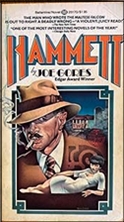
The blurb goes on to say, “Gores’ dialogue crackles and sparks with the wry, tough humor of the twenties. His characters are thinly disguised portraits of the men and women who shook and shaped this most fascinating of American cities.
His plot, drawn from actual events in San Francisco’s corrupt political past. casts harsh light on a stark and bloody era.” All of which is true enough, at least up to a point. Hammett is considered by some to be Gores’ best book, and in many ways it is. But it also has its share of flaws, among them some overly melodramatic scenes and a disinclination on Gores’ part to even mention Hammett’s left-wing politics.
All things considered, it is certainly a good novel — one that should be read by anyone interested in Hammett, San Francisco circa 1928, and/or fast-action mysteries of the Black Mask school — but it is not the great novel it has occasionally been called.
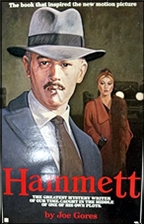
The 1982 film version produced by Francis Ford Coppola, on the other hand, is pure claptrap. Frederick Forrest is fine as Hammett, and the script by Ross Thomas is faithful to the novel, but the direction (by Wim Wenders) is so arty and stylized that all the grittiness and power is lost. Some of the scenes, in fact, are so bad they’re almost painful to watch.
Gores’ other non-series novels, A Time for Predators (which received an Edgar for Best First Novel of 1969) and Interfaces (1974) are also excellent. The latter is one of the toughest, most brutal novels published since the days of Black Mask — so hard-boiled that some readers. women especially, find it upsetting, But its power is undeniable; and its surprise ending is both plausible and certain to come as a shock to most readers.
———
Reprinted with permission from 1001 Midnights, edited by Bill Pronzini & Marcia Muller and published by The Battered Silicon Dispatch Box, 2007. Copyright © 1986, 2007 by the Pronzini-Muller Family Trust.
April 17th, 2026 at 8:14 pm
Gores also wrote a good prequel to The Maltese Falcon (Max Allan Collins has recently penned the first direct sequel). HAMMETT, though it does whitewash its protagonist politics, is still well written and worth reading, and though I don’t think it is Gores best by a long shot, it may be the best novel you could get out of Hammett’s life and still include a legitimate mystery plot worthy of the man.
April 17th, 2026 at 10:33 pm
I thought the Joe Gores book was pretty good and rode an interesting wave. All over now.
April 17th, 2026 at 10:50 pm
Hate to disagree, maybe just a bit, and given that it was 50 years ago and I was very young at the time, but I thought HAMMETT didn’t have the zip I was looking for. I don’t remember finishing it. Maybe if I tried again now …
April 17th, 2026 at 10:56 pm
I read Gore’s book at the time of its release and thought it was well constructed and obviously part of a wave. All gone now.
April 18th, 2026 at 9:25 pm
If I’m kinder to the book than you or Barry it is only becauseI read it as a novel first rather than a Mystery. As a Mystery it clearly lacks zip, and I suspect shows Gores was a bit overwhelmed by his respect for Hammett to be quite as honest or savage as was needed either in showing Hammett warts and all or in constructing a plot worthy of him.
He either needed to go full pulp or full biographical novel and instead tread too carefully. A great Hammett novel is still waiting to be written and should probably focus on his role in the Fatty Arbuckle case that Hammett himself hinted went deeper and involved a full-blown legal circus that likely partially inspired THE DAIN CURSE as LA and San Francisco both maneuvered to embarrass the other with Arbuckle caught in the middle.
April 19th, 2026 at 10:53 am
David nails it. Nothing more to add other than my second comment above exists only because my first comment did not appear, and I got a shade paranoid about that.