Wed 15 Jul 2026
SF Stories I’m Reading: ARTHUR C. CLARKE “Out of the Sun.”
Posted by Steve under Uncategorized[2] Comments
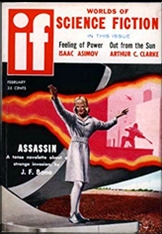
ARTHUR C. CLARKE “Out of the Sun.” First published in If, February 1958. Collected in The Other Side of the Sky (Harcourt, Brace & Co., hardcover, 1958). Reprinted in The Mammoth Book of Mindblowing SF, edited by Mike Ashley (among several other anthologies).
This is the lead story in the latter book, and it’s a good one (both the story and the anthology). It’s told by a research scientist studying the sun from the ideal vantage point of the planet Mercury. Although he is not the only person on the station where he is working, none of the others make a physical appearance. He tells his own story, and in fact, I do not believe there is a word of dialogue to be found within it.
The story begins in earnest when he spots a black spot moving across the surface of the sun before it is ejected off into space, aimed straight at the station where he is standing. I say “black spot” figuratively, as it (perhaps formed solely of invisible gas) cannot be seen by the naked eye – only by the instruments he is using. As he watches, he begins to wonder: could the object actually be alive? And if so, can it possibly survive, now well outside its home environment?
The story is short, and I’ve already described the essence of the plot itself, except for the last few sentences — which are well worth waiting for. The author, Artur C. Clarke, was an excellent writer who was also a man with a mind based on scientific reasoning. In a few words he could produce a million mind-boggling ideas. Although perhaps not the best of his tales, and it may be just a minor one, but it’s also a story you may find yourself thinking about for a quite a while after you read it.
I enjoyed this one.
July 16th, 2026 at 8:45 am
I started reading IF in the 1960s. Occasionally, I’d pick up an issue from the 1950s in a used bookstore. A surprising number of Name Writers–like Arthur C. Clarke–wrote for them.
July 16th, 2026 at 9:23 pm
I don’t remember when I started reading IF on a regular basis (the first was ASTOUNDING, the Feb 1959 issue, about a year after this one came out).
I bought this issue later on, as a used copy. For some reason I remember the cover vividly but the stories in it, not at all.
I always enjoyed the magazine. It was in the second tier of SF magazines, after ASTOUNDING, GALAXY and F&SF, but its level of story telling certainly matched what I was looking for in SF at the time.