Sun 26 Jul 2026
A 1001 Midnights Review: GRAHAM GREENE – The Third Man.
Posted by Steve under UncategorizedNo Comments
by Marcia Muller
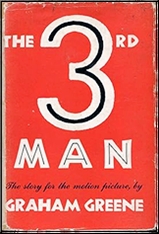
GRAHAM GREENE – The Third Man. Viking, US, hardcover, 1950. Reprinted many times.
Rollo Martins, a somewhat drunken writer of westerns, has come to Vienna at the request of his old school friend, Harry Lime. Lime has suggested he might write a piece on the postwar international refugee problem and pay his way to the divided city. But when Martins arrives, Lime is dead, having been run over by a car in front of his building, and Martins is barely in time for his funeral. There he meets Colonel Calloway of the British occupational police force; Calloway is interested in Lime, and in Martins’ association with him.
Although he has little money, Martins manages to stay on in Vienna by cadging funds from a variety of people who seem extraordinarily concerned with his welfare. And soon questions about Harry Lime begin to plague him: Who was his friend, really? A harmless adult version of the boy Martins knew at school — a young rogue who played all the angles? Or a vicious racketeer, the worst Vienna has ever seen? Why did Lime really want Martins to come to Vienna? Was Lime’s death merely an accident. or was it very deliberately staged? And who was the third man at the scene when he died-the third man who disappeared shortly after?
Martins becomes more and more convinced that Lime’s death was no accident, and he crosses the various zones of the war-tom city searching for the mysterious third man. Set against the backdrop of postwar Vienna, and told alternately from Colonel Calloway’s and Martins’ viewpoints, this is an intriguing and suspenseful novel that contains a number of surprises.
The Third Man was the basis for a gem of a film of the same title, made in 1949, directed by Carol Reed, and featuring Joseph Cotten, Orson Welles, and Trevor Howard.
Other equally absorbing thrillers by Greene include Orient Express (1933); This Gun for Hire (1936), made into a tense 1942 film starring Alan Ladd in his first major role; Brighton Rock (1956); The Quiet American (1956); Our Man in Havana (1958), the screen version of which showcases Alec Guinness in one of his best roles; and The Honorary Consul (1973).
———
Reprinted with permission from 1001 Midnights, edited by Bill Pronzini & Marcia Muller and published by The Battered Silicon Dispatch Box, 2007. Copyright © 1986, 2007 by the Pronzini-Muller Family Trust.