Mon 24 Aug 2026
D. C. BROD – Error in Judgment. PI Quint McCauley #2. Walker, hardcover, 1990. Diamond, paperback; 1st printing thus, September 1991.

[The asking price for the later edition as posted above is $4.50.] As you’ve probably noticed, paperbacks are making quantum jumps in terms of prices. I’m not sure where the upper limit is, in terms of public resistance to bigger and bigger chunks of available spending money, but so far nothing seems to be keeping the cost of reading material from jumping onward and upward, from one month to the next, or so it seems. (Compare the price of this book with the one that went before, from the same publisher. [Murder at Teatime, by Stefanie Metteson, $3,95, published March 1991.] Compare it with the price of paperbacks at the time you’re reading this, several months from now.)
But as for the question, “Is this book worth $4.50?,” I’d hesitate a little, but I’m going to say yes. I enjoyed it (and enjoyed it more than I thought I was going to, after the first couple of chapters). It’s a good-sized book, 258 pages of smallish print, and if you enjoy PI stories, I think you’ll be getting your money’s worth.
On the other hand, a general rule of thumb is that you should be careful of PI books written by authors with initials for a first name. The “D” stands for Deborah, and by and large, women still don’t write hard-boiled PI novels. (But neither did Rex Stout. All I’m saying is be careful.)
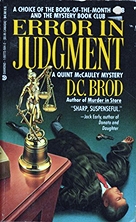
Brod’s detective hero is Quint McCauley, a struggling private investigator new to the small town of Foxport, somewhere outside of Chicago. He’s already made the mistake of crossing one of the town’s leading legal lights, and jobs are getting hard to come by. The one that he has now, on a contingency basis, is that of trying to determine whether or not a judge’s death was really a suicide. A clause in an insurance policy means a difference of a million dollars, payable to the widow.
The judge, by the way, was under indictment in an bribery case, but Quint still wonders why the case was closed so quickly by the police department. (He is also on the outs with the chief of police, you might be interested in knowing, ever since he tried to pick up the man’s wife in a bar some time earlier.)
Quint does have the advantage over the police, as far as the case is concerned, in that he was the one to have discovered the body. He was also the one who found (and went off with) the pictures he found stashed away in a filing cabinet. He shouldn’t have, and that’s where the title comes from.
It’s a complex case, in other words. The difficulty I found with it, in the early going, is that the writing is talky and flat, and McCauley, who tells the story, sounds whiney and apologetic, almost to the point of exasperation. Points of the story where he should be angry, he says he’s angry, but he doesn’t seem angry and he doesn’t act angry. (Maybe he’s more cold-blooded than I thought he was.)
If you’ve decided to read it, though, bear with it, and you’ll eventually find the plot has enough twists, major and minor, to make it worth the effort. This is a mixed review, in other words.
The Quint McCauley series —
1. Murder in Store (1989)
2. Error in Judgement (1990)
3. Masquerade in Blue (1991); apa Framed in Blue
4. Brothers in Blood (1990)
5. Paid in Full (2000)
August 30th, 2026 at 2:39 am
There were always some tough women PI writers, M.V. Heberden writing as Charles Leonard was tough as nails, but this sounds a little medium boiled for my taste.
August 30th, 2026 at 4:32 pm
Medium-boiled, yes, tending maybe toward the cozy end of scale. Not necessarily a bad place to be, but I may be remembering it wrongly. It was a long time ago.