Tue 25 Aug 2026
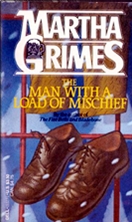
A 1001 Midnights Review: MARTHA GRIMES – The Man with a Load of Mischief.
Posted by Steve under Uncategorized[2] Comments
by Ellen Nehr
MARTHA GRIMES – The Man with a Load of Mischief. Richard Jury #1. Little, Brown, hardcover, 1981. Dell, paperback, 1990. Many other later reprint editions.

An English village called Long Piddleton, an earl who prefers to be called Mr. Plant, his slightly dolly aunt (an American by birth who hasn’t assimilated the British point of view even after thirty years), assorted villagers, pubs with ancient names and modem nicknames, and Inspector Richard Jury of Scotland Yard — all of these combine with an admixture of gruesome murders and eccentric antics in The Man with a load of Mischief .
Jury, along with his hypochondriac sergeant, arrives to investigate two unidentified murdered men whose bodies were found on consecutive nights at different Long Pid pubs. Melrose Plant, who teaches a course a year in French romantic poetry and who has given up his title, assists Jury in the investigation, but is impeded by his aunt (who has countered Plant’s renunciation by assuming the title “Lady Audrey”).
Among the suspects when yet another murder is discovered near yet another pub are a variety of Long Pid’s inhabitants, who have moved there for reasons that require several chapters to explain. The combination of Jury’s painstaking police work and Plant’s background know ledge of local skeletons helps identify the victims and finally provides the killer’s motives and identity.
Jury is a warm and clever man, and the friendship that develops between him and Plant is just the beginning of a relationship that carries over into future novels, among them The Anodyne Necklace (1982), The Dirty Duck (1984), and Help the Poor Smuggler (1985).
Grimes, an American professor of English, has perfectly captured the atmosphere of the small English village, as well as created indelible and endearing characters.
———
Reprinted with permission from 1001 Midnights, edited by Bill Pronzini & Marcia Muller and published by The Battered Silicon Dispatch Box, 2007. Copyright © 1986, 2007 by the Pronzini-Muller Family Trust.
August 26th, 2026 at 6:01 pm
I made a serious mistake with this series. I didn’t start with the first one, but one written a bit further down. The characters were locked into their roles fairly solidly by that time, and I didn’t know any of them. Long time readers did, and I think Grimes was coasting then, before I jumped in.
She wrote 26 of the Jury books, the most recent last year, when she was 92. t just came out in paperback a couple of months ago.
August 30th, 2026 at 2:35 am
I was a big fan, and then suddenly it felt as if Grimes was just dogpaddling along and I ran out of steam and never knew if she got back to form or just stayed where she was.