Sun 15 Nov 2026
The Mystery Fiction of Author THURMAN WARRINER (aka SIMON TROY) by Jamie Sturgeon.
Posted by Steve under UncategorizedNo Comments
by Jamie Sturgeon.
Thurman Warriner is an English mystery writer whose first novel Method in His Murder was published in 1950. His crime novels under his own name and as Simon Troy, have been discussed on several blogs, including this one. However, you might be wondering if it should be ‘was an English mystery writer’.
Well, there is a mystery about Warriner; although 1974 is widely cited as the year of his death, no supporting evidence has been found. The date does not appear in the General Register Office Death Index for England and Wales, nor in records on Ancestry, FindMyPast, Scotland’s People, or FamilySearch. A query on RootsChat also failed to uncover its source.
The first two editions of Twentieth Century Crime & Mystery Writers (1982 and 1985) describe Warriner only as “British”, while the third edition (1995) merely states that he had died. Even crime-fiction bibliographer Al Hubin no longer recalls where he obtained the 1974 date for his authoritative Crime Fiction Bibliography.
It is known he was born in Sheffield, in Yorkshire, in 1904. He is on the 1939 Register taken in the United Kingdom on 29th September, living in Sheffield, his occupation given as ‘Journalist & Author’, with his date of birth recorded as 6 March 1904. Living with him is Kathleen M. Bush, born in 1914, occupation a children’s governess. Warriner & Bush married in 1941, they had one son ‘Johnny’, born in late 1944.
So, what else is known about Thurman Warriner, particularly his writing career? Warriner’s first novel Method in His Murder was published in the United Kingdom by Hodder & Stoughton in the summer of 1950. The book has three main characters who went on to appear in all but one of the subsequent Warriner books: an elderly gentleman Mr Charles Ambo, private enquiry agent John Scotter, and Archdeacon Toft.
The British edition has nothing about the author on the dust-jacket or in the book. However, when the American edition was published in October 1950, the dust-jacket has a short biography of him with a photograph, which shows him smoking a pipe – the same photograph is used on three later Warriner Hodder books and the 1961 Penguin paperback of The Doors of Sleep.
THURMAN WARRINER who has written innumerable short stories for English magazines, makes his first appearance in this country with this, his first novel. (*) For six war-time years he was engaged in airplane production; in less troubled times, he had a brief but spirited encounter with the stage. A good Englishman, he likes living in the country (his home is near Sheffield), walking, climbing, cycling, and gardening. Music, book collecting, and the study of ecclesiastical architecture are his special passions.
(*) The only American edition of a Thurman Warriner book.
Three of Warriner’s later Hodder books have an author biography which is a variant of the above information:
Thurman Warriner had a brief theatrical career in his early youth and has also been a poultry farmer and a cinema technician. During the war he worked in an aircraft factory.
In latter years he threw wisdom to the winds and gave up his job to devote himself to full-time writing, on the strength of fifty short stories published in pre-war years. He never expected Mr Ambo to appear again after the first book (he writes), but now he’s like an old friend. In his detective stories Mr Warriner is interested not so much in police methods and court procedure as in the way life contrives to make saints and murderers out of the same basic material.
His chief ambition used to be, he says, “£2,000 a year tax free,” but is now “to write a really good book some day.”
I also found a piece about the author in the May 4 1957 issue of John Bull magazine, to accompany the first part of their three-part serialisation of ‘The Golden Lantern’:
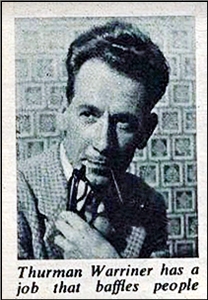
Living in Chesterfield, (*) Thurman Warriner is a long way from the sea that he loves so much. But creeks and estuaries, fishing villages and yachting centres, are all familiar to him. Warriner is an inveterate walker and, in the past year, he has tramped with his twelve-year-old son Johnny along most of the Devon coast. Warriner also likes boats, but he has no illusions about his seamanship. “I don’t sail,” he says. “I go marine motoring.”
Except for the war years, Warriner has been writing continuously since 1936 and now has ten novels and more than two hundred short stories to his credit. Currently his output is two novels a year and two stories a month. Many of the people he meets in Chesterfield still can’t quite get used to his profession. When he tells them that he is a writer they are apt to reply: “Ah yes, but what do you do for a living?”
Warriner, who is in his forties, (**) can afford to be philosophical about it. “After all, this year I’m celebrating my professional coming-of-age.”
(*) in Derbyshire (**) he was actually 53.
From the dust-jacket of his final book The Penthouse Emperor, a novel published by Robert Hale in 1971 as by John Kersey:
John Kersey is a pseudonym of a prolific author with over twenty novels and more than four hundred short stories to his credit. At present he lives in Derbyshire and earns his living as a professional writer. Hobbies include music and walking.
In 1952, the first of twelve books he wrote as Simon Troy, Road to Rhuine, was published in the U.K. by Collins Crime Club. The dust-jacket has a different photograph of Warriner, smoking a pipe of course, wearing a rather natty overcoat and a pair of gloves; in the blurb it says Simon Troy shows a feeling for character and atmosphere which gives his first crime novel a rare distinction.
No mention anywhere that Simon Troy is Thurman Warriner. No author biography in any of the subsequent U.K. editions of the Simon Troy books which were all published by Victor Gollancz.
There is however a mini-biography on the dust-jacket of the 1962 American edition of his fifth Simon Troy book Second Cousin Removed, which repeats some of the above, but adds that he says he got his education ‘scratchily, in any such junior and grammar schools as happened to be adjacent to the places where at the time I lived.’ Also, that ‘his hobbies include photography, gardening, and music from Bach to Brubeck’.
A post from 2019 in the Facebook Group Old Chesterfield Pics asks if anybody ‘remembers a novelist called Thurman Warriner?’ but the only information of interest added in the comments, is an address, and mention of him walking in a local park with an English Setter dog, always with a pipe in his hand.
So how many stories did Thurman Warriner actually write? Was it more than four hundred as it states on the dust-jacket of his last book? When his first novel was published in the USA he described it as ‘more concerned with evil than crime, with motive than murder’, and said that it was the first writing of this nature he had done, out of more than a hundred short stories in the past few years.
So, if there are ‘more than a hundred’, they are not crime fiction, and many, if not most, would surely have been written under a pseudonym, or perhaps published anonymously. The biography on the Hodder books says he wrote ‘fifty short stories pre-war’ and in John Bull it states his writing career began in 1936. However, only one pre-war story is known: ‘Back Stage’ in the April 1938 issue of the prestigious magazine The Grand.
His first known post-war story is ‘The Look’ published in 1949 in the Evening Standard August 23, the byline was Thomas Warriner (when it was reprinted in the Yorkshire Evening Post November 26, the author’s name was T. Warriner). Less than a fortnight later his next story ‘The Worm’s Turn’ appeared in the Evening Standard on September 3 under the author’s correct name.
From January 1950, Warriner became a regular contributor to John Bull magazine. He also contributed to Britannia & Eve magazine, the first being ‘Dictator’s End’ in May 1950, there are four more stories and they are well worth tracking down; they are not police stories but do have elements of crime and/or suspense.
In July 1950, The Derbyshire Times reported that Thurman Warriner of Cromwell House, Ridgeway (between Sheffield & Chesterfield), ‘who is becoming increasingly well known as a short story writer, has had his first full-length novel published this month’.
Over the next ten years Thurman Warriner contributed nineteen stories to John Bull both under his own name and as Simon Troy, and one serial ‘The Golden Lantern’, though not all the stories feature a crime. Inspector Bracegirdle, a policeman in a north country town called Holtrigg, based on Chesterfield I believe, appears in ten of them.
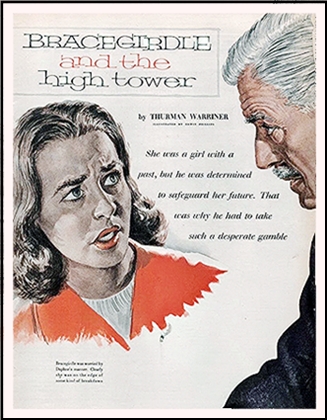
These are his best short stories, though ‘Detective Fiction, the Collector’s Guide’ (Cooper & Pike) omits the Bracegirdle stories from its Thurman Warriner article bibliography as it disingenuously states ‘all known stories show him tackling social issues rather than crime’.
Not only does he get involved in ‘social issues’ he deals with such matters of crime as capturing an escaped prisoner, stopping some teenage vandalism, breaking the alibi of a murderer, finding a lost child, tracking down a missing V.I.P., and solving the case of why the murder victim’s body was moved.
The very first Bracegirdle story ‘The Miracle of Hell Nick’ sets the tone for the series; the inspector faces a moral dilemma when he finds a body whilst potholing off duty. Bracegirdle does what he thinks is correct even if it should go wrong and he loses his job.
Lionel Davidson, the fiction editor of John Bull from May 1951, stated in an article in The Writer in 1952 that he wanted ‘fully developed stories as opposed to sketches’ with a range ‘from between 2000 and 4500 words, and in that space things must happen. That means good action’. Certainly, Thurman Warriner supplied this in the John Bull stories, especially those with Bracegirdle. His four short stories in the Evening Standard & Evening News are slight; that length of story was not the author’s forte, only one of them is crime fiction.
Warriner’s only contribution to John Bull’s successor Today, was the story ‘The Four Footed Tide’ in January 1961, an over-the-top story about some escaped laboratory animals that devastate the countryside after reproducing exponentially and eating anything and everything organic. He had a short story published in the last issue of Suspense in April 1961, ‘Edge of Terror’.
Then, there were five stories in Argosy, the magazine that ‘swallowed’ Suspense. The Argosy stories are a little disappointing and are not crime or suspense fiction except ‘Pursuit’ which has a similar setting and two main characters as the author’s only Suspense story. It is a tale of a manhunt and revenge that is spoiled by an illustration which gives away part of the plot.
The penultimate Argosy story ‘Last Adventure’ subtitled ‘A Christmas Fable for the Space Age’ is set on planet ‘Kantur 3’ several centuries in the future; it is not clear what ‘message’ the author is trying to give. There are also two Simon Troy short stories in Ellery Queen’s Mystery Magazine. ‘Once a Policeman’ in October 1969, and his final short story ‘The Liquidation File’, in August 1970.
It has an introduction by Ellery Queen who say it ‘strongly reminded’ them of a Roy Vickers Department of Dead Ends story and ask the author to ‘try his hand at a series of contemporary “inverted detective’’ stories’. Sadly ‘The Liquidation File’ has an underwhelming ending with a twist that is easily foreseen.
So, what happened to Thurman Warriner? Why did he give up writing? Why did he stop writing novels under his own name after 1960, and continue only under the pseudonyms Simon Troy and John Kersey? And where and when did he die? If we assume, even without any evidence, that he died in 1974, perhaps it was in the Channel Islands which we know he visited and where he set two of the Troy books. Or in France the setting for his last Simon Troy book Blind Man’s Garden, published in 1970.
Another question I have been unable to answer is where are the vast majority of the four hundred short stories he said he wrote from 1936-1971? We may never know the answer to any of these questions.
Warriner had a troubled marriage, separating from his wife, possibly before his first novel was published. The 1954 story ‘Bracegirdle’s Christmas’, written I am sure from personal experience, concerns a divorced couple and the ex-wife’s custody of their son. It has a bitter portrait of the ex-wife though the story does have a happy ending. Only in the last Troy book is there a dedication to his wife, one that is both affectionate and pointed: For Kathleen, at last. With apologies for writing about so many unpleasant human beings instead of the animals she would no doubt prefer.
Thurman Warriner shone as a crime writer for just over twenty years and then disappeared as quickly as he arrived. He left behind a distinctive body of work, and the mystery of his writing career and death. His twenty books as Thurman Warriner and Simon Troy are unjustly neglected and deserve a new readership; only four have ever been paperbacked in English, the aforementioned 1961 Penguin edition of The Doors of Sleep, and as Simon Troy a 1966 Brown Watson paperback of Don’t Play With the Rough Boys, and two American Harper Perennial editions, Swift to Its Close in 1981, and Road to Rhuine in 1982.
I am sure that a new reprinting of his books and the best of his short stories would inspire a renewed interest in his work.
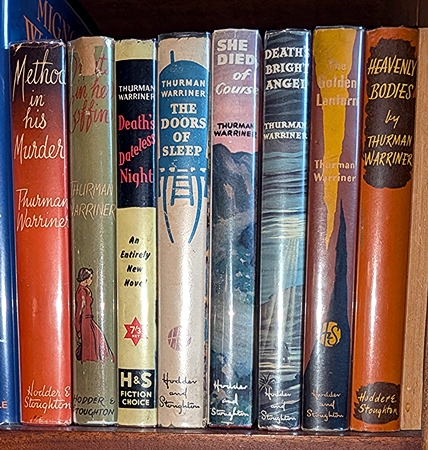
THURMAN WARRINER bibliography —
All the novels feature Mr Charles Ambo, John Scotter, and Archdeacon Toft except The Golden Lantern. All only published in the United Kingdom except the first listed.
Method in His Murder — Hodder & Stoughton 1950, Macmillan 1950
Ducats in Her Coffin —- Hodder & Stoughton 1951
Death’s Dateless Night — Hodder & Stoughton 1952
The Doors of Sleep — Hodder & Stoughton 1955
Death’s Bright Angel — Hodder & Stoughton 1956
She Died, of Course — Hodder & Stoughton 1958 – also features Inspector Charles Smith from the Simon Troy books
The Golden Lantern — Hodder & Stoughton 1958 – non-series
Heavenly Bodies — Hodder & Stoughton 1960
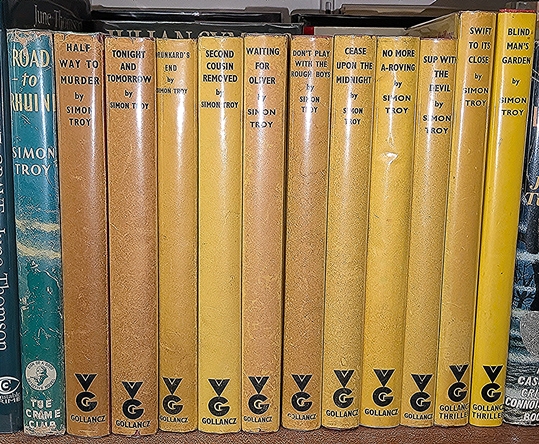
SIMON TROY Bibliography —
All feature Inspector Charles Smith (‘The Maigret of the West Country’) except Half Way to Murder. All first published in the United Kingdom, with American editions as noted.
Road to Rhuine — Collins Crime Club, 1952, Dodd, 1952
Half-Way to Murder — Gollancz, 1955
Tonight and Tomorrow — Gollancz 1957
Drunkard’s End — Gollancz 1960, Walker, 1961
Second Cousin Removed — Gollancz 1961, Macmillan 1962
Waiting for Oliver — Gollancz 1962, Macmillan 1963
Don’t Play with the Rough Boys — Gollancz 1963, Macmillan 1964
Cease Upon the Midnight — Gollancz 1964, Macmillan 1965
No More A-Roving — Gollancz 1965
Sup with the Devil — Gollancz 1967
Swift to Its Close — Gollancz 1969, Stein 1969
Blind Man’s Garden — Gollancz 1970
JOHN KERSEY Bibliography —
Night of the Wolf — Cassell 1968
The Penthouse Emperor — Robert Hale 1971 — not crime fiction
Short stories by Thurman Warriner, and under the pseudonym Simon Troy. All only published in the United Kingdom except the two Simon Troy stories in Ellery Queen’s Mystery Magazine. # = not crime fiction.
• Back Stage — The Grand Magazine – April 1938
• The Look – Evening Standard Aug 23 1949 as by Thomas Warriner, Yorkshire Evening Post – November 26 1949 (as T. Warriner) #
• The Worm’s Turn – Evening Standard – September 3 1949 #
• The Careless Snow Man — John Bull – January 14 1950 #
• Master of Progress — John Bull – April 1 1950 #
• Dictator’s End — Britannia and Eve – May 1950
• The Dark Night (Inspector Bracegirdle) — John Bull – October 7 1950
• The Last Word — Britannia and Eve – March 1951
• Sixty Years On (Inspector Bracegirdle) — John Bull – April 7 1951
• Double Deal — Britannia and Eve – May 1951
* The Miracle of Hell Nick [Inspector Bracegirdle] — John Bull – June 30 1951
• Love on Tour — John Bull – February 23 1952 #
• No Police Action (Inspector Bracegirdle) — John Bull – March 8 1952
• Five Minutes in a Lifetime – Evening News – September 16 1952 #
• Tomorrow at Noon — Britannia and Eve – February 1953
• Wanted – Evening Standard – July 27 1953
• Cover Up the Crime — John Bull – August 14 1954, as by Simon Troy
• Away to the Woods — Britannia and Eve – November 1954
• The Gunman’s Girl (Inspector Bracegirdle) — John Bull – December 11 1954
• Bracegirdle’s Christmas [Inspector Bracegirdle] — John Bull – December 25 1954
• The Golden Lantern (serial) – John Bull – May 4, May 11, May 18 1957
• Money in the Bank — John Bull – June 15 1957
• A Girl Called Susie — John Bull – August 24 1957 #
• Bracegirdle and the Book of Rules [Inspector Bracegirdle] — John Bull – May 17 1958
• The Rosebud Line — John Bull – October 4 1958 #
• Hour of Darkness — John Bull and Illustrated – October 25 1958
• Bracegirdle and the Teenagers [Inspector Bracegirdle] — John Bull Illustrated – April 4 1959
• Bracegirdle and the Brothers [Inspector Bracegirdle] — John Bull Everybody’s Weekly – September 19 1959
• Bracegirdle and the High Tower [Inspector Bracegirdle] — John Bull Everybody’s Weekly – December 12 1959
• Murder Will Out — John Bull Everybody’s Weekly – January 9 1960, as by Simon Troy
• The Four Footed Tide – Today – January 21 1961 #
• Edge of Terror — Suspense (UK) – April 1961
• Moment of Error — Argosy (UK) – March 1965 # (marginal crime)
• Pursuit — Argosy (UK) – December 1967
• VIP — Argosy (UK) – October 1968 #
• Last Adventure — Argosy (UK) – January 1969 #
• Once a Policeman — Ellery Queen’s Mystery Magazine – October 1969, as by Simon Troy
• Days Before Christmas — Argosy (UK) January 1970 #
• The Liquidation File — Ellery Queen’s Mystery Magazine – August 1970, as by Simon Troy.