Bibliographies, Lists & Checklists


MASTERPIECES OF MYSTERY

A Bibliographical Account
Presented by Victor A. Berch


   There seems to have been a few compilations of mystery stories under this title, but presented below is the earliest I could find. The stories appeared in the Sunday Constitution Magazine of the Atlanta Constitution and what makes them unusual is that they were condensations of the original tales by Arthur B(enjamin) Reeve of Craig Kennedy fame.

   Some of the readers of Mystery*File may have online access to the Atlanta Constitution, but for those who do not, your local library should be able to borrow the microfilms of the issues involved.

   The list is arranged by story number, story title and date of publication. So here goes:

1. The Murders in the Rue Morgue, by Edgar Allan Poe [not noted as a
Masterpiece of Mystery]-June 10, 1928
2. File No. One-Thirteen, by Emile Gaboriau [also not noted as a Masterpiece
of Mystery] June 17, 1928
3. The Sign of the Four, by Sir Arthur Conan Doyle. June 24, 1928
4. The Outcasts of Paris, by Eugene Francois Vidocq. July 1, 1928
5. Zadig, by Voltaire. July 8, 1928
6. The Adventure of the Hansom Cab, by Robert Louis Stevenson. July 15, 1928
7. Inspector Bucket, by Charles Dickens. July 22, 1928
8. Sergeant Cuff, by Wilkie Collins. July 29, 1928
9. The Story of the Three Burglars, by Frank R. Stockton. Aug. 5, 1928
10. The Horla, by Guy de Maupassant. Aug. 12, 1928
11. The Biter Bit, by Wilkie Collins. Aug. 19, 1928
12. The Doomdorf Mystery, by Melville Davison Post.. Aug. 26, 1928
13. A Scandal in Bohemia, by Sir Arthur Conan Doyle. Sep. 2, 1928
14. The Purloined Letter, by Edgar Allen Poe. Sep. 9, 1928
15. The Safety Match, by Anton Chekhov. Sep. 16, 1928
16. Some Scotland Yard Cases, by Sir Robert Anderson,. Sep. 23, 1928
17. Gentlemen and Players, by E. W. Horning. Sep. 30, 1928
18. The Riddle of the Rope of Fear, by Mary E. and Thomas W. Hanshew,
Oct. 7, 1928.
19. The Sign of the Shadow, by Maurice Le Blanc. Oct. 14, 1928
20. The Murder at the Jex Farm, by Oswald Crawford. Oct. 21, 1928
21. The Border, by Henry C. Rowland. Oct. 28, 1928
22. The Man Who Was Lost, by Jacques Futrelle. Nov. 4, 1928
23. The Mystery of the Steel Door, by Broughton Brandenberg. Nov. 11, 1928
24. The Mystery of the Seven Minutes, by Louis Joseph Vance. Nov. 18, 1928
25. The Lost Room, by Fitz-James O’Brien. Nov. 25,1928
26. The Woman in the Case, by Arthur Train. Dec. 2, 1928
27. The Yellow Cat, by Wilbur Daniel Steele. Dec. 9, 1928
28. The Oblong Box, by Edgar Allan Poe. Dec. 16, 1928
29. A Suspicious Character, by William Hamilton Osborne. Dec. 23, 1928
30 The Mystery of the Steel Room, by Thomas W. Hanshew. Dec. 30, 1928
31. The Great K & A Train Robbery, by Paul Leicester Ford. Jan. 6, 1929
32. The Mystery at 89—-St., New York, by George S. McWatters. Jan. 13, 1929
33. The Adventure of the Toadstools, by Sax Rohmer. Jan. 20, 1929
34. The Fenchurch Street Mystery, by Baroness Orczy. Jan. 27, 1929
35. The Case of Mrs. Magnus, by Burton. F. Stevenson. Feb. 3, 1929
36. Cowardice Court, by George B. McCutcheon. Feb. 10, 1929
37. Cheap, by Marjorie. L. C. Pickthall. Feb. 17, 1929
38. The Great Valdez Sapphire, by Anonymous. Feb. 24, 1929
39. The Episode of the Black Casquette, by Joseph Ernest. Mar. 3, 1929
40. The Listener, by Algernon Blackwood. Mar. 10, 1929
41. The Mysterious card, by Cleveland Moffett. Mar. 17, 1929
42. A Study in Scarlet, by A. Conan Doyle. Mar. 24, 1929
43 [not used]
44. The Lost Duchess, by Anonymous. Mar. 31, 1929
45. The Pipe, by Anonymous. Apr. 7, 1929
46. The Hand on the Latch, by Mary Cholmondely. Apr. 14, 1929
47. [not used}
48. The Beast with Five Fingers, by William F. Harvey. Apr. 21, 1929
49. The Mystery of Marie Roget, by Edgar Allan Poe. Apr. 28, 1929
50. The Risen Dead, by Max Pemberton. May 5, 1929
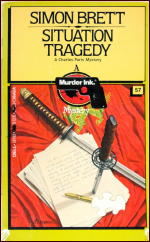
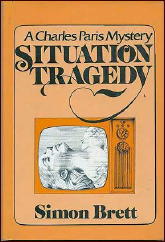
SIMON BRETT Situation Tragedy

SIMON BRETT – Situation Tragedy. Scribner’s, hardcover, 1982. First published in the UK by Victor Gollancz, hardcover, 1981. Dell/Murder Ink #57, paperback, 1986. Warner, paperback, 1990.

   In case you’ve never come across one of these mystery adventures of actor-sleuth Charles Paris before, be forewarned: there will be times when you will be convinced that if there is any detection going on it is definitely taking second place to Simon Brett’s witty, caustic commentary on the world of show business, British style.

   In this, his seventh case, Paris tackles the world of commercial television. Somewhat to his own surprise, he has a bit part in a new sitcom. It’s a continuing part, at least — but so’s the series of fatal “accidents” that begin to plague the show, and even before the first episode is ever aired.

   Also be forewarned that Charles Paris is something of a tosspot and a womanizer, but he is certainly also one not to be overly impressed with the glamour of show-biz. There are also a couple of digs at the peculiarities of some mystery collectors. (Nobody who doesn’t deserve it!)

   The ending is tragic, scarcely believable, and yet, mostly a fitting one.

Rating: B

— Reprinted from The MYSTERY FANcier, Vol. 6, No. 3, May-June 1982 (very slightly revised).This review first appeared in the Hartford Courant.

The Charles Paris series —

1. Cast in Order of Disappearance (1975)
2. So Much Blood (1976)
3. Star Trap (1977)
4. An Amateur Corpse (1978)
5. A Comedian Dies (1979)
6. The Dead Side of the Mike (1980)
7. Situation Tragedy (1981)

SIMON BRETT Situation Tragedy

8. Murder Unprompted (1982)
9. Murder in the Title (1983)
10. Not Dead, Only Resting (1984)
11. Dead Giveaway (1985)
12. What Bloody Man is That (1987)
13. A Series of Murders (1989)
14. Corporate Bodies (1991)
15. A Reconstructed Corpse (1993)
16. Sicken and So Die (1995)
17. Dead Room Farce (1997)
18. A Decent Interval (2013)

THE BACKWARD REVIEWER
William F. Deeck


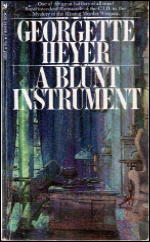
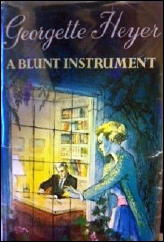
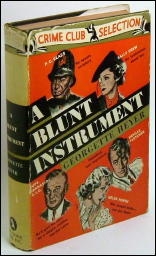
GEORGETTE HEYER Blunt INstrument

  GEORGETTE HEYER – A Blunt Instrument. E. P. Dutton, hardcover reprint, 1970. First UK edition: Hodder & Stoughton, hardcover, 1938. First US edition: Doubleday, hardcover, 1938. Also: Bantam, paperback, 1973; Berkley, paperback, 1987.

   Police Constable Glass, following his appointed rounds, discovers the bludgeoned body of Ernest Fletcher in his study. Fletcher was not a well-loved man, but his only major fault appears to have been womanizing.

   Superintendent Hannasyde and Sergeant Hemingway begin an investigation. No weapon is found on the scene, a woman’s footprints are in the garden, and apparently Fletcher had had a busy evening with people both known and unknown visiting him. After comparing the stories of the various participants, Hannasyde and Hemingway nearly conclude that Fletcher, despite the reality of his corpse, could not have been killed. There just wasn’t time for it.

GEORGETTE HEYER Blunt INstrument

   To add to their problems, P.C. G!ass, who aids in the investigation, is an inveterate quoter of the Bible, usually from the Old Testament and mostly of the unhappier sort.

   Who, how, and why do manage to get sorted out. The who and how I had, most uncommon for me, figured out; the why is not explained until the end. If Heyer didn’t fool me, she probably won’t fool anyone else, either.

   But don’t let that stop you from reading this one. It’s a good investigation, and there are some quite amusing characters in the monocled young lady mystery writer and Fletcher’s nephew, Neville, who would like to be thought of as a ne’er-do-well. Plus, Hannasyde and Hemingway are engaging investigators.

— From The MYSTERY FANcier, Vol. 10, No. 1, Winter 1988.


       The Supt. Hannasyde & Sgt. Hemingway series —

Death in the Stocks, Hodder, 1935
Behold, Here’s Poison!, Hodder, 1936
They Found Him Dead, Hodder, 1937
A Blunt Instrument, Hodder, 1938

GEORGETTE HEYER Blunt INstrument

       The Inspector Hemingway series

No Wind of Blame. Hodder 1939
Envious Casca. Hodder 1941
Duplicate Death. Heinemann 1951

   For more on Georgette Heyer and her detective fiction, the best place to start would be her page on the Golden Age of Detection Wiki here.

THE ARMCHAIR REVIEWER
Allen J. Hubin


DONALD E. WESTLAKE – Drowned Hopes. Mysterious Press, hardcover, 1990; paperback, 1991.

DONALD WESTLAKE Drowned Hopes

   While it seems to me that Donald E. Westlake’s Dortmunder series began at its highest point with The Hot Rock in 1970, succeeding volumes have certainly been amusing. And now, with the seventh, Drowned Hopes, you can also add long. Four hundred and twenty-two pages long, in fact.

   Tom Jimson turns up one day in John Dortmunder’s apartment. Rather surprisingly, since Jimson, one of nature’s nastiest creatures, was sentenced to seven consecutive life terms. But prison budgets in New York being what they are, here’s Tom, looking for help in retrieving $700,000 in armored car loot buried twenty years before.

   On land which the state, in its wisdom, has turned into a reservoir, so the money is under three feet of earth and fifty feet of water. If John won’t help, Tom will simply dynamite the dam, killing a few thousand people, and retrieve the money from the reappearing turf.

   It’s a matter of some indifference to Tom how the money is recovered, but John is of finer mettle and begins to plan furiously. There are several noteworthy things about Dortmunder’s plans: they are carefully, thoughtfully conceived, the details are painstakingly worked out, and they usually fail in spectacular ways.

   Pleasant Drowned Hopes is, with chuckles and some poignancy, though it’s a little attenuated and gifted with the season’s least imaginative title.

— Reprinted from The MYSTERY FANcier,
       Vol. 12, No. 4, Fall 1990.


      The John Dortmunder series —

1. The Hot Rock (1970)
2. Bank Shot (1972)
3. Jimmy the Kid (1974)
4. Nobody’s Perfect (1977)
5. Why Me? (1983)
6. Good Behaviour (1987)
7. Drowned Hopes (1990)
8. Don’t Ask (1993)
9. What’s the Worst That Could Happen? (1996)
10. Bad News (2001)
11. The Road to Ruin (2004)
12. Watch Your Back! (2005)
13. What’s So Funny? (2007)
14. Get Real (2009)

Thieves’ Dozen (ss collection; 2004)

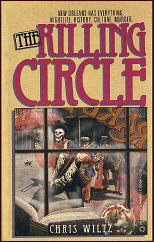
CHRIS WILTZ Killing Circle

CHRIS WILTZ – The Killing Circle. Macmillan, hardcover, 1981. Pinnacle, paperback, 1985.

   I like private detective stories. Ordinarily, the first in what promises to be a new private eye series is a matter for rejoicing. Add a plot that begins with a set of missing books, rare editions of William Blake, and the vividly moody back-ground of New Orleans, and what we get this time is, well, a book that just doesn’t live up to its potential.

   The detective is named Neal Rafferty, and his biggest problem in life is that his father doesn’t understand him, and his love life is in trouble too. He’s quit the police force under fire, and they don’t like him too well either.

   The plot is nicely twisted, although heavily tangled at times in massive coincidence. Rafferty meets a girl he can respond to, of course. The problem here is that the converse does not seem to be wholly true.

   What lets us down is the writing. The art of subtlety seems beyond Wiltz’s capabilities. Most of the story she tells is stiff, formal, perfunctory and placid.

Rating: C minus.

— Reprinted from The MYSTERY FANcier, Vol. 6, No. 3, May-June 1982 (truncated and slightly revised).


[UPDATE] 12-17-13.   I ended this review in its first appearance rather smugly with a PostScript commenting on the fact that all the while reading this book I was under the impression (false) that Chris Wiltz was male. Further comment in this regard unnecessary. A re-do on this one might be in order.

       The Neal Rafferty series —

1. The Killing Circle (1981)
2. A Diamond Before You Die (1987)
3. The Emerald Lizard (1991)
4. Glass House (1994)

   Chris Wiltz has written one other work of crime fiction, that being Shoot The Money (2012), described by one source as a “racy gumbo of suspense, comedy, and ‘sisters-in-crime.'”

THE ARMCHAIR REVIEWER
Allen J. Hubin


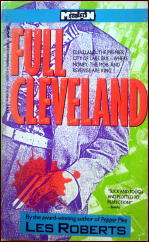
LES ROBERTS – Full Cleveland. St. Martin’s, hardcover, 1989; paperback, 1990.

LES ROBERTS

   Full Cleveland, the second of Les Roberts’ novels about private investigator Milan Jacovich, doesn’t have the high appeal for me that the first (Pepper Pike) did, but it’s agreeable enough.

   Jacovich, a former cop like most PI’s, operates in Cleveland and mourns his lost family (his wife divorced him, and his sons, particularly the older, are drifting away). He consoles himself with no-commitment sex and here accepts what seems a simple and tranquil assignment: track down a downscale swindler who ripped off a bunch of would-be advertisers in his won’t-be magazine.

   But complications soon arise. Milan’s client, a lakeside hotel, invested an incredible amount for an ad, and said hotel proves to have mob connections whom Milan has unhappily met before. Said connections provide Jacovich with a most unwelcome assistant. And why should businesses so little in need of publicity have invested in advertising space?

— Reprinted from The MYSTERY FANcier,
       Vol. 12, No. 4, Fall 1990.


     The Milan Jacovich series —

1. Pepper Pike (1988)

LES ROBERTS

2. Full Cleveland (1989)
3. Deep Shaker (1991)
4. The Cleveland Connection (1993)
5. The Lake Effect (1994)

LES ROBERTS

6. The Duke Of Cleveland (1995)
7. Collision Bend (1996)
8. The Cleveland Local (1997)
9. A Shoot In Cleveland (1998)
10. The Best Kept Secret (1999)
11. The Indian Sign (2000)

LES ROBERTS

12. The Dutch (2001)
13. The Irish Sports Pages (2002)
14. King of the Holly Hop (2008)
15. The Cleveland Creep (2011)
16. Whiskey Island (2012)
17. Win, Place, or Die (2013) (with Dan S Kennedy)

Note: Between 1987 and 1994, Les Roberts also wrote six mysteries featuring an LA-based PI named Saxon. More recently he has has published two standalone crime novels and one collection of short fiction, The Scent of Spiced Oranges (2002).

THE BACKWARD REVIEWER
William F. Deeck


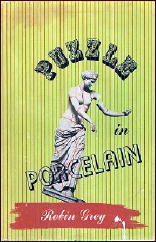
ELIZABETH GRESHAM – Puzzle in Porcelain. Duell Sloan & Pearce, 1945. Bart House #29, paperback, June 1946. Curtis, paperback, no date [1973]. See also below.

ELIZABETH GRESHAM pUZZLE SERIES

   Tom Pottle comes to Hunter Lewis, a tinkerer or handyman, to get a statue of Psyche repaired. Pottle had bent over in his garden and something hissed by him and struck the porcelain statue doing a fair amount of damage. A young man, something of a natural, who lives in the woods and cares for animals of all kinds is blamed for the shattering of the statue.

   Pott!e is a cad, a scoundrel, a bounder, a parvenu, a philanderer, and, much worse, a Northerner who has settled near Richmond, Virginia, and has social and power ambitions. When Lewis goes to see the remains of the statue the next day, he discovers that Pott!e has been found dead at his doorstep, the victim of a rattlesnake bite, Lewis notes some oddities in the death and gets the local police interested.

   When the young man who lives in the woods dies shortly thereafter — suicide maybe — the police are convinced that Pott!e was really bitten by a snake, probably handled by the young man. Lewis is unconvinced, and he and Jenny Gilette, a young lady hopelessly, or so it would seem, in love with him, continue to seek out the real story.

   Gilette is the first person narrator of the proceedings and makes for a good Watson. She and Lewis are an interesting and enjoyable pair. The novel is mostly fair play, with the clues, though not the motive, necessary to figure it out along with Lewis.

   There is something of a mystery about Elizabeth Gresham. Puzzle in Porcelain was published in 1945 as by Robin Grey. Another novel under that name was published in 1947, and then came a long silence, broken finally in 1972, 25 years later, with the publication of Puzzle in Paisley and the republication in paperback of her first two novels, this time under her real name.

   Paisley is a gothic-type novel, which nonetheless features Jenny Gilette and, to a small extent, Hunter Lewis. Like Porcelain, it has no specific period setting; both could have taken place at any point, except for the Second World War years, from the ’20s to the ’50s and maybe even ’60s.

— From The MYSTERY FANcier, Vol. 10, No. 1, Winter 1988.


The Jenny Gilette & Hunter Lewis series

    As by Robin Grey:

Puzzle in Porcelain (n.) Duell 1945
Puzzle in Pewter (n.) Duell 1947

    As by Elizabeth Gresham:

Puzzle in Paisley (n.) Curtis 1972
Puzzle in Parchment (n.) Curtis 1973

ELIZABETH GRESHAM pUZZLE SERIES

Puzzle in Parquet (n.) Curtis 1973

ELIZABETH GRESHAM pUZZLE SERIES

Puzzle in Patchwork (n.) Curtis 1973

   The author has five other entries in Hubin’s Crime Fiction IV, one indicated as marginally criminous, all from the late 1970s when she was in her seventies, and from the titles, probably romantic suspense novels (Gothics), at their height of popularity at the time.

THE BACKWARD REVIEWER
William F. Deeck


ROBERT GEORGE DEAN On Ice

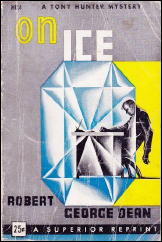
ROBERT GEORGE DEAN – On Ice. Charles Scribner’s Sons, hardcover, 1942. Superior Reprint M654, paperback, 1945.

   Bill Griffith, private eye, had been tailing a man who had some diamonds to sell for a refugee. Now he is tailing the same man, who is picking up the money for the diamonds. Unfortunately, the man with the money is found sitting at his desk with no money and no life, his throat having been slit.

   Fearing that he might be suspected of involvement in the murder, since he is broke and is working for an almost bankrupt agency, Griffith asks his friend and former co-worker at the Imperator Schmidt Agency, Tony Hunter — one of Robert George Dean’s continuing characters — to he!p him out of this jam.

   A great deal happens in a short time. Hunter’s dog thinks she is going to have puppies; the dead man’s fiancee, for whom everyone is searching for various reasons, turns out to have predeceased her betrothed, and by the same murder method; the refugee who owns the diamonds acts strangely, and Hunter finds various females attractive.

   The detection here is good, the clues fair, the characters fairly interesting. I thought I knew who did it, but I was wrong. Not a great or a memorable mystery, but one that ought not be passed up if you fortuitously come across it at a reasonable price.

— From The MYSTERY FANcier, Vol. 10, No. 1, Winter 1988.


    The Tony Hunter series —

Murder Makes a Merry Widow (n.) Doubleday 1938.
A Murder of Convenience (n.) Doubleday 1938.
A Murder by Marriage (n.) Scribner 1940.
Murder Through the Looking Glass (n.) Doubleday 1940.
Murder in Mink (n.) Scribner 1941.
Layoff (n.) Scribner 1942.
On Ice (n.) Scribner 1942.
The Body Was Quite Cold (n.) Dutton 1951.
The Case of Joshua Locke (n.) Dutton 1951.
Affair at Lover’s Leap (n.) Doubleday 1953.

   Author Robert George Dean also wrote four mysteries under his own name featuring series character Pat Thompson, about whom I know nothing, and one stand-alone. As “George Griswold” he wrote four early 1950s espionage novels (I believe) with a mysterious Mr. Groode appearing or mentioned in all four, but the leading characters (with two appearances each) in reality being Jim Furlong and William Pepper.

THE ARMCHAIR REVIEWER
Allen J. Hubin


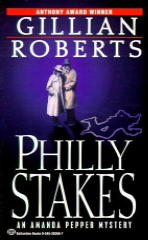
GILLIAN ROBERTS Philly Stakes

GILLIAN ROBERTS – Philly Stakes. Scribners, hardcover, 1989. Fawcett, paperback, 1990.

    Philly Stakes is the second (after Caught Dead in Philadelphia) novel about Philadelphia private schoolteacher Amanda Pepper by Gillian Roberts (the criminous pseudonym of mainstream novelist Judith Greber).

    Amanda teaches a particularly challenging array of early teen-agers, and, in groping for a way to make Dickens real, conceives of a Christmas party. Her notion is that the children will feed the poor, but the father of one child, a wealthy businessman, turns it to his own ends. At first.

    It begins as a publicity-laden event with said businessman playing Santa Claus. It ends with his playing unmourned corpse, and three people confessing to the act. The case really isn’t assigned to detective C. K. Mackenzie, Amanda’s rather good friend, but it seems to be his anyway. It certainly isn’t assigned to Amanda, but there she is, squarely in the muddle of it.

    Quite pleasant, this tale, smoothly narrated and with an extremely well-hidden killer.

— Reprinted from The MYSTERY FANcier,
       Vol. 12, No. 4, Fall 1990.


        The Amanda Pepper series —

1. Caught Dead in Philadelphia (1987)
2. Philly Stakes (1989)
3. I’d Rather Be in Philadelphia (1992)
4. With Friends Like These… (1993)
5. How I Spent My Summer Vacation (1994)
6. In The Dead of Summer (1995)
7. The Mummers’ Curse (1996)
8. The Bluest Blood (1998)
9. Adam and Evil (1999)
10. Helen Hath No Fury (2000)
11. Claire and Present Danger (2003)
12. Till the End of Tom (2004)
13. A Hole in Juan (2006)
14. All’s Well That Ends (2007)

THE ARMCHAIR REVIEWER
Allen J. Hubin


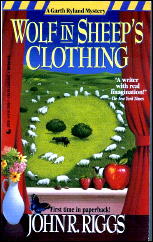
JOHN R. RIGGS Wolf in Sheep's Clothing

JOHN R. RIGGS – Wolf in Sheep’s Clothing. Dembner Books, hardcover, 1989. Jove, paperback reprint, 1993.

   Wolf in Sheep’s Clothing is the first of John R. Riggs’ five novels about Garth Ryland I’ve read, and on this evidence I’ve missed four previous treats.

   Ryland publishes a weekly newspaper in the small Wisconsin town of Oakalla. Here he’s concerned about Diana, whom he loved and lost to English professor Devin LeMay. She and LeMay went to a cabin somewhere in northern Minnesota and both are overdue to return.

   His anxiety mounting, Garth checks out LeMay’s home (vacant, but with one most peculiar room, and watched over by a lovesick neighbor) and the one-time local resident who owns that Minnesota cabin. These trails lead to fearsome territories.

   Solid suspense, atmosphere thick enough to cut and package, vivid characters. Memorable stuff.

— Reprinted from The MYSTERY FANcier,
       Vol. 12, No. 4, Fall 1990.


       The Garth Ryland series —

1. The Last Laugh (1984)
2. Let Sleeping Dogs Lie (1986)
3. The Glory Hound (1987)
4. Haunt of the Nightingale (1988)
5. Wolf in Sheep’s Clothing (1989)
6. One Man’s Poison (1991)
7. Dead Letter (1992)
8. A Dragon Lives Forever (1992)
9. Cold Hearts and Gentle People (1994)
10. Killing Frost (1995)
11. Snow on the Roses (1996)
12. He Who Waits (1997)
13. The Lost Scout (1998)
14. Nothin’ Short of Dyin’ (2011)
15. After the Petals Go (2012)

Editorial Comment:   For a local newspaper story on John R. Riggs and his resumption of the Garth Ryland series after a lapse of 12 years, go here.

« Previous PageNext Page »