Bibliographies, Lists & Checklists


THE BACKWARD REVIEWER
William F. Deeck


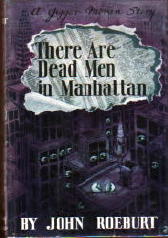
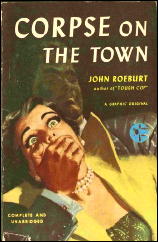
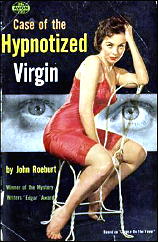
JOHN ROEBURT – Corpse on the Town. Graphic #27, paperback original, 1950. Revised edition: The Case of the Hypnotized Virgin. Avon #730, pb, 1956. Reprinted: Belmont/Tower,1972.

JOHN ROEBURT Jigger Moran

   About to check in to his terminal in New York City, cab driver J. Howard Moran, better known as Jigger, agrees to take a trunk to the Railway Express Office. An unknown someone meanwhile has informed the police that the trunk in Jigger’s cab contains a corpse. Which it does, the body of a young woman whose face is battered beyond recognition.

   Apparently Jigger. a disbarred attorney in Illinois and a private eye without a license, has investigated other crimes before, though this is his first recorded case. He and his reluctant assistant, Red, “free-lance journalist and improvident writer of plays, features, fiction, columns,” try to determine the woman’s identity and find her killer.

   As the police follow Jigger closely with the thought that if they can’t convict him maybe he will be able to pin it on someone else, Jigger manages to come up with the answer.

JOHN ROEBURT Jigger Moran

   For his novel Tough Cop, Roeburt won an Edgar, or so the publisher of this novel claims. I have not been able to identify either the category or the year. This one is no prize winner, but it has its amusing moments.

– From The MYSTERY FANcier, Vol. 13, No. 3, Summer 1992.


Bibliographic Data:   It is perhaps no surprise that Bill was unable to discover the category for which John Roeburt won an Edgar, as the publisher’s claim is not true, as he surmised might have been the case.

   It may be as obscure as an MWA award can get, and was apparently not for Tough Cop at all. It came in 1949, and it was for Best Radio Drama, the actual title of which I have not discovered, even with the resources available to me on the Internet. It was, however, for one of the episodes of the Inner Sanctum series. (I do not believe that it was for the entire series, but perhaps I am wrong about that.)

    Bill erred in saying that Corpse on the Town was Jigger Moran’s first recorded case. Not true; it was his third and last. The first two were published in hardcover; only Corpse was a paperback original:

       The Jigger Moran series —     [Taken from the Revised Crime Fiction IV, by Allen J. Hubin.]

    Jigger Moran (n.) Greenberg, hc, 1944.
    There Are Dead Men in Manhattan (n.) Mystery House, hc, 1946.

JOHN ROEBURT Jigger Moran

    Corpse on the Town (n.) Graphic, pbo, 1950.

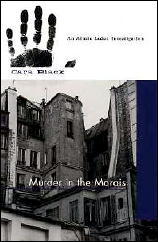
CARA BLACK – Murder in the Marais. Soho Crime; trade paperback, October 2000. Hardcover edition: Soho Press, 1998.

   The publication date for the hardcover edition of this book is generally accepted to be 1998, but I’m a little puzzled about it. In the paperback edition I have, the copyright date is given as 1999. And the book was an Anthony (and Macavity) nominee for Best First Mystery in 2000, so … I’m confused.

   A small question of little importance, perhaps. What does matter is that since the success of this, her first book, Cara Black (who is not the young tennis player from Zimbabwe, whose name also comes up if you try Googling her) has written several more in the series, to whit:

       2. Murder in Belleville. Soho Press, 2000; trade paperback: April 2002.
       3. Murder in the Sentier. Soho Press, 2002; trade paperback: April 2003.
       4. Murder in the Bastille. Soho Press, 2003; trade paperback: April 2004.
       5. Murder in Clichy. Soho Press, 2005; trade paperback: March 2006.
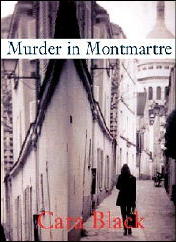
       6. Murder in Montmartre. Soho Press, March 2006.

CARA BLACK Soho

   These are all cases of murder and intrigue in one form or another for Parisian private eye Aimée Leduc, a specialist in computer penetration, and her partner, René Friant, a “handsome dwarf with green eyes and a goatee.” Either the author or her character has struck quite a chord with her readers, as witness the almost yearly addition to the saga, and all in multiple printings. The books themselves are handsomely made as well, solid and somehow daring you not to pick them up.

   In Marais, the first of the six above, Aimée is hired by an aged French Nazi-hunter to take a digitalized photo (converted from computer code) to an elderly woman still living in the Jewish section of Paris. Aimée arrives too late, finding Lili Stein murdered soon before her arrival; and her employer, Soli Hecht, is hospitalized soon thereafter in what is called a horrrific pedestrian accident. (We know better.)

   In France and apparently Paris in particular, life has gone on since World War II, but the days of Nazi control are never far from the memory of many of its inhabitants, both victims and collaborators. It is one sad story such as this in which Aimée finds herself up to her neck.

   Aimée herself reminded me of Emma Peel and a not-so-voluptuous Honey West, mixed in with a dash of Sydney Bristow (of TV’s Alias) with her penchant for disguise and undercover work, slinking across Parisian rooftops in high-heeled pumps. And a form-fitting tight black skirt. (I can picture that.)

CARA BLACK Soho

   Her partner René does not have much of a role in this one, content to opening password-locked computer accounts with an ease and nonchalance that makes it seem all too easy, with his one big scene consisting of being hung by his suspenders by one of the villains on a peg on the wall. It would seem churlish to suggest that passwords are not discovered as easily as they are in this book, but perhaps the author was just trying to keep the pace of the book moving, which is constant, fierce and filled with action upon demand.

   A large portion of Aimeé’s background is described in broad outlines, but some of her past is only hinted at. The part that is hidden may be part of what it is that has had readers coming back for more. That, and of course, the independent and free spirit that is Aimée herself, living as she wants, and being attracted to and sleeping with whomever she wants.

   Life in Paris is always an attraction to people in the United States, and whether her depiction is authentic or not, Cara Black makes the city come to life, the non-touristy part, made even more real by the inclusion of more than occasional phrases in French, in my mind just the right dosage. (Some of the reviewers of this book online have taken issue with the authenticity, which I noted but did not care to know about. If it was an illusion, I did not want the illusion broken. So I am pointing this out but stepping back, and with double grains of salt, I shall allow you to be the judge.)
CARA BLACK Soho

   I am disappointed in myself for having to tell you some of my other impressions. The book is not meant for speed-reading. The prose, while not clumsy, is often as disjointed as the plot, jumping here and there and including good scenes when a good scene is called for, whether it is sometimes that particular scene or sometimes not.

   Here is one example of the author’s carelessness in the details. On page 217, the dying Soli Hecht’s last words are related as having been “Don’t … let … him …,” then “Lo … ” On page 251, the man’s last utterance, as Aimée is puzzling over the case to that point, she remembers as “Ka … za.”

   Faulty details like this are deadly in a detective story, even if both versions could have been true. To my knowledge the point was never addressed, just another indication that in today’s world of detective fiction, atmosphere and eye-catching characters can often carry the day, even if the puzzle of the plot is present but is shunted aside as if it almost really doesn’t matter.

   But here’s what is really funny, not in the sense of “ha-ha” funny, unless the joke is on me, but funny in the sense of “I can’t explain it either.” I enjoyed the book, and if you were to ask me if I am going to read another of Aimée’s adventures, the answer would definitely be yes.

— January 2006


           The Aimée Leduc series, continued —

   Perhaps I should not make promises in print that I have not kept, or at least not yet. There have been four more books in the series since I wrote this review, either published or forthcoming. I’d be remiss if I didn’t include them here.

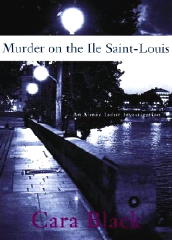
        7. Murder on the Ile Saint-Louis (2007)

CARA BLACK Soho

        8. Murder in the Rue de Paradis (2008)
        9. Murder in the Latin Quarter (2009)
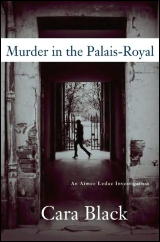
       10. Murder in the Palais Royal (2010)

CARA BLACK Soho

   But while I’ve purchased most if not all of these, I have not read another, and that is really remiss of me. I shall endeavor to do something about it.
A REVIEW BY MARYELL CLEARY:
   

ANTHONY OLIVER – The Pew Group. Doubleday/Crime Club, hardcover, 1981. Paperback reprint: Fawcett Crest, 1985. UK edition: William Heinemann, hc, 1980.

ANTHONY OLIVER

   Here’s a first novel that kept me laughing all the way to the last page!

   It’s set in an English village, but after that any resemblance to the good old conventional English murder mystery ceases. No one, least of all Doreen, is going to call her tripping her dull, antique dealer husband at the top of the stairs murder.

   But his death sets off a marvelous train of events: Doreen’s mother arrives from Cardiff, funeral unbaked meat under her arm. Joseph O’Shea, itinerant picker, tries to sell an undistinguished piece of pottery to a gay antique dealer; unsuccessful there, he goes on to Doreen’s, where he’s more successful in more than one way. The pottery turns out to be “The Pew Group,” a fantastically valuable piece, but as the assembled party partakes of baked meats after Rupert’s funeral, “The Pew Group” disappears.

   Inspector Webber, born in Flaxfield, returned there after a failed marriage and a lackluster career, finds new life in his old home town, as almost everyone involved does. Most of the characters are slightly bent, most of them are enjoying sex lives that aren’t exactly conventional and sometimes not even legal.

   All of them want “The Pew Group.” Who gets it and how we find out at the end, after a thoroughly delightful roam in the British country gloamin’.

– Reprinted from The Poisoned Pen, Vol. 6, No. 4, Fall 1986


    Bibliographic data:    [Taken from the Revised Crime Fiction IV, by Allen J. Hubin.]

OLIVER, ANTHONY.    SC: Lizzie Thomas & Insp. John Webber, in all titles.

       The Pew Group (n.) Heinemann 1980.
       The Property of a Lady (n.) Heinemann 1983.
       The Elberg Collection (n.) Heinemann 1985.

ANTHONY OLIVER

       Cover-Up (n.) Heinemann 1987.

Note: Coming soon to this blog will be Maryell’s review of The Property of a Lady.

THE BACKWARD REVIEWER
William F. Deeck


BARBARA FROST – The Corpse Died Twice. Coward McCann, hardcover, 1951. No paperback edition.

BARBARA FROST Marka de Lancey

   Though suffering from a severe hangover, Jerome Carrigan doesn’t feel he deserves the obituary published in a New York City newspaper. He calls upon Marka de Lancey, attorney at law, to investigate it and also asks her to check on an insurance policy he is considering purchasing. She doesn’t have time for the latter since Carrigan is found dead in a Turkish bath at Coney Island under suspicious circumstances.

   This is de Lancey’s second murder investigation with Lieut. Jeff McCrae of Manhattan Homicide. It is a moderately amiable non-fair-play novel.

– From The MYSTERY FANcier, Vol. 13, No. 3, Summer 1992.


Bio-Bibliographic Data: According to Al Hubin in the Revised Crime Fiction IV, Barbara Frost (married name Barbara Frost Shively) was a publicity manager for J. B. Lippincott Co., an obvious rival to Coward McCann, who was the publisher of her four mystery novels.

   Bill is correct in saying that this is Marka de Lancey’s second appearance. He did not mention that there was a third, however, nor that Ms. Frost’s first crime novel was not a series entry. One source on the Internet suggests that the police lieutenant’s name was spelled “Macrae.” It is not presently known if he appeared with Marka de Lancey’s in all three of her cases.

FROST, BARBARA.   1903-1985.   Note: Marka de Lancey appeared in books two through four:

        The Unwelcome Corpse (n.) Coward 1947.
        The Corpse Said No (n.) Coward 1949.
        The Corpse Died Twice (n.) Coward 1951.
        Innocent Bystander (n.) Coward 1955.

BARBARA FROST Marka de Lancey


Editorial Inquiry: Marka de Lancey’s first appearance was in 1949, making her perhaps one of the earliest female attorneys to appear in crime fiction. Who may have preceded her in this category?

[UPDATE] 02-08-10.   See comment #3. It isn’t a definitive answer, but if Jon Breen doesn’t know of any other female attorney who was a lead character in a mystery novel and who came before Marka de Lancey, then my money’s on the fact that there weren’t any.

A REVIEW BY MARYELL CLEARY:
   

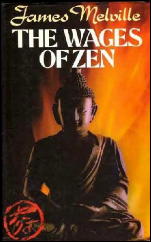
JAMES MELVILLE – The Wages of Zen. Martin Secker & Warburg, Ltd., UK. hardcover, 1979. Methuen, US, hc, 1981. Reprint paperback: Ballantine/Fawcett Crest, paperback, 1985.

JAMES MELVILLE Otani

   In this first novel, Melville gives us a very human and very Japanese superintendent of police, Tetsuo Otani, in a case involving foreign students at a small Zen temple. Its priest, Okamoto, is a mysterious person who leads his students in za-zen by day and entertains prostitutes by night.

   The students are a mixed bag: male, female, old, young, Irish, English, American, Danish, hippie, conservative. Otani is called in first when it seems that drugs are being used or sold; next there is a murder.

   In the course of the investigation we are introduced to Otani’s wife, Hanae, and their happy home life, and to his associates in the police and even an Ambassador. The depiction of everyday Japanese life is interesting, and Otani’s thought processes as he attempts to deal with these foreigners and their strange ways are enlightening. Seeing our Western ways through Eastern eyes is quite an experience.

   An enjoyable book.

– Reprinted from The Poisoned Pen, Vol. 6, No. 4, Fall 1986


The Superintendent Tetsuo Otani series  [Taken from the Revised Crime Fiction IV, by Allen J. Hubin] —

       The Wages of Zen (n.) Secker 1979
       The Chrysanthemum Chain (n.) Secker 1980
       A Sort of Samurai (n.) Secker 1981

JAMES MELVILLE Otani

       The Ninth Netsuke (n.) Secker 1982

JAMES MELVILLE Otani

       Sayonara, Sweet Amaryllis (n.) Secker 1983
       Death of a Daimyo (n.) Secker 1984
       The Death Ceremony (n.) Secker 1985
       Go Gently, Gaijin (n.) Secker 1986
       Kimono for a Corpse (n.) Secker 1987
       The Reluctant Ronin (n.) Headline 1988
       A Haiku for Hanae (n.) Headline 1989

JAMES MELVILLE Otani

       The Bogus Buddha (n.) Headline 1990
       The Body Wore Brocade (n.) Little Brown 1992

Excerpted from an online obituary at Zenit.org:

RALPH McINERNY

       Ralph McInerny Dies at Age 80

SOUTH BEND, Indiana, JAN. 29, 2010 – Prominent Catholic author, professor and cultural commentator Ralph McInerny died today at the age of 80.

Ralph McInerny was a professor of philosophy and the Michael P. Grace Professor of Medieval Studies at the University of Notre Dame

He was an acknowledged expert on the writings of St. Thomas Aquinas, and a prolific author. He penned over two dozen scholarly books, many more scholarly essays, and over 80 novels.

He wrote the popular book series Father Dowling Mysteries, which became a successful television program starring Tom Bosley and Tracy Nelson.

          …

   Here’s a list of his Father Dowling books. There isn’t much doubt that in our world of mystery fiction, these are the ones he’ll be remembered for the longest:

     The Father Dowling series

1. Her Death of Cold (1977)

RALPH McINERNY

2. Bishop as Pawn (1978)

RALPH McINERNY

3. The Seventh Station (1977)
4. Lying Three (1979)
5. The Second Vespers (1980)
6. Thicker Than Water (1981)
7. A Loss of Patients (1982)
8. The Grass Widow (1983)
9. Getting a Way with Murder (1984)

RALPH McINERNY

10. Rest in Pieces (1985)
11. The Basket Case (1987)
12. Abracadaver(1989)
13. Four on the Floor (1989)
14. Judas Priest (1991)
15. Desert Sinner (1992)
16. Seed of Doubt (1993)

RALPH McINERNY

17. A Cardinal Offense (1994)
18. The Tears of Things (1996)
19. Grave Undertakings (2000)
20. Triple Pursuit (2001)
21. Prodigal Father (2002)
22. Last Things (2003)
23. Requiem for a Realtor (2004)
24. Blood Ties (2005)

RALPH McINERNY

25. The Prudence of Flesh (2006)
26. The Widow’s Mate (2007)
27. Ash Wednesday (2008)
28. The Wisdom of Father Dowling (2009)
29. Stained Glass (2009)

RALPH McINERNY

   As Monica Quill, he wrote 10 books in a series of equally light mysteries solved by Sister Mary Teresa, and under his own name: six books about lawyer Andrew Broom, 13 mysteries with the University of Notre Dame as the background if not an active participant itself, two books with Egidio Manfredi as the leading player, and most recently (2009) two books in his Rosary Chronicle series. Not to mention another long list of standalone novels and story collections, and three anthologies edited, including Murder Most Catholic (2002) with Martin H Greenberg.

FATHER DOWLING

   The television series Father Dowling Mysteries of the TV series (and add Mary Wicke to Tom Bosley and Tracy Nelson as one of the continuing stars) was first aired as an NBC made-for-TV movie in 1987 and its weekly run did not begin until 1989. After one season the show moved from NBC to ABC, where it lasted another two season.

   Tom Bosley played Father Dowling, while Tracy Nelson played his assistant in solving crimes, Sister Stephanie ‘Steve’ Oskowski. Also appearing in all 44 episodes was Mary Wicke as Father Dowling’s always fussing housekeeper, Marie.

   The series has not yet been released on commercial DVDs — and why not?

BRAD LATHEM – The Hook #1: The Gilded Canary. Warner, paperback original; 1st printing, September 1981.

BRAD LATHAM The Gilded Canary (Hook #1)

   Warner has been publishing books in several of its various new “Men of Action” series for some time now, and for mystery fans, here is the first appearance of the one that might seem the most promising. “The Hook” is Bill Lockwood, a 1930’s private eye who is as tough with his fists as he is energetic in bed.

   There seems to be little else to say. Lockwood’s case, as he investigates the theft of some jewelry from a rich girl singer named Muffy Dearborn, is nothing less than a flimsy excuse for him to jump in and out of a bed or two and beat up a few hoodlums in between with his patented left hook.

   There are a few good moments — once in a while I got a fleeting impression that there was some intelligent thought put into the writing of this mediocre excuse for a book — but they quickly pass.

   On the other hand, the result is probably exactly what Warner had in mind when they commissioned it.

– From The MYSTERY FANcier, Vol. 6, No. 2, March/April 1982
        (slightly revised)


[UPDATE] 01-28-10.   Whew. I seldom put down a book as solidly as this, and this review took me a bit by surprise when it turned up next to be put online. I thought of tempering the tone down a notch or two, but this is what my reaction was some 28 years ago, and (without re-reading the book) I decided at length that I ought to stand by it.

   There were, in all, five in the series. Here, taken from the Revised Crime Fiction IV, by Allen J. Hubin, is a complete list:

          LATHAM, BRAD. Pseudonym of David J. Schow.

    1. The Gilded Canary (n.) Warner, pbo, Sept 1981.
    2. Sight Unseen (n.) Warner, pbo, Sept 1981.
    3. Hate Is Thicker Than Blood (n.) Warner, pbo, Dec 1981.
    4. The Death of Lorenzo Jones (n.) Warner, pbo, 1982.
    5. Corpses in the Cellar (n.) Warner, pbo, June 1982.

THE BACKWARD REVIEWER
William F. Deeck


MEDORA FIELD – Blood on Her Shoe. The Macmillan Co., hardcover, 1942. Paperback reprint: Popular Library #201, no date stated [1949].

MEDORA FIELD Blood on Her Shoe

   Despite the fact that her cousin, assumedly a levelheaded chap, calls to tell her not to come to St. Simon’s Island, Georgia, though with no explanation, Ann Carroll goes anyhow.

   Despite the fact she would rather not be there, she attends a ghost-seeking session at a graveyard, where murder occurs.

   Despite the murderer being still at large and she possessing, or so it is presumed, information that might identify the murderer, she visits a lonely farm house alone at dead of night.

   Despite nearly dying from that dunderheadedness, she goes later to the graveyard by herself to gather evidence.

   At the end of the novel, the young man she is in love with has been arrested for being AWOL and has assaulted the M.P.’s. This novel isn’t a matter of had-I-but-known. She does know, and she deserves all she gets, including her future husband.

– From The MYSTERY FANcier, Vol. 13, No. 3, Summer 1992.


       Bibliographic Data:    [Taken from the Revised Crime Fiction IV, by Allen J. Hubin.]

FIELD, MEDORA. Working byline of Medora Field Perkerson, 1892-1960. Born in Georgia; newspaper columnist in Atlanta as “Marie Rose.”

    Who Killed Aunt Maggie? Macmillan, hc, 1939. Film: Republic, 1940.
    Blood on Her Shoe. Macmillan, hc, 1942. Film: Republic, 1944, as The Girl Who Dared (with Lorna Gray, Peter Cookson).

REVIEWED BY WALTER ALBERT:         


MICHAEL GRUBER – Night of the Jaguar. Harper, paperback reprint, March 2007. Originally published in hardcover by William Morrow, March 2006. Trade paperback: Harper, November 2009.

MICHAEL GRUBER Jimmy Paz

   Jimmy Paz, formerly a crackerjack Miami homicide detective, works in his mother’s restaurant, but still consults, on occasion, for the police.

   Now, as a series of horrific murders begin to eliminate the shady members of a cartel that is planning to level a Colombian forest for the highly desirable lumber it contains, he’s drawn into the investigation, which seems to target an improbable giant jaguar as the killer.

   Jimmy’s mother is considered by the native community to have special powers that her son has inherited, a sensitivity to psychic forces that invade his dreams and those of his young daughter, a development that makes the case a very personal one for Jimmy Paz.

   There’s an environmental group with connections to the Colombian timber region, a Colombian shaman, and some very scary drug lords, with even scarier associates they bring in to settle with whoever or whatever is reducing their number very quickly.

   Gruber tends to overwrite, but, just when you think one of his too bright and too articulate characters is never going to shut up, the plot lunges ahead again with some slambang action that almost makes you forget the oases of boredom that crop up from time to time.

   This is the third in a series. I may read the first one, but if it’s as wordy as this one, I’ll probably close the book on the series.

    The Jimmy Paz Series —

        1. Tropic of Night (2003)

MICHAEL GRUBER Jimmy Paz

        2. Valley of Bones (2005)
        3. Night of the Jaguar (2006)

    Note: Subsequent books by Michael Gruber have not involved Jimmy Paz.

JEREMIAH HEALY – Yesterday’s News. Harper, hardcover, July 1989. Reprint paperback: Pocket; 1st printing, September 1990.

JEREMIAH HEALY Yesterday's News

   A lot of people think highly of Boston-based PI John Francis Cuddy, and I wish I were one of them. I find both him and his cases rather bland, although I’m always hopeful whenever I decide to try another of them.

   This one falls into the same category, unfortunately, and it’s difficult to say exactly why. He’s hired by a female newspaper reporter to help her uncover a leak that led to the death of one of her sources — she’s working on a story involving corruption in the small seaport town of Nasharbor.

   She’s dead before he can get there. Suicide, the local police say. Cuddy knows better.

   Thus, a good beginning, a good picturesque locale, and the story seems only to inch on from there. Cuddy goes through the usual motions, gets a break on page 219, follows it up, and solves the case. And once he makes a deal — which he doesn’t call a deal– the whole affair is over, to everybody’s satisfaction, but mine.

   And there in a nutshell, I think maybe I answered my own question.

– This review first appeared in Deadly Pleasures, Vol. 1, No. 2, Summer 1993 (slightly revised).


[UPDATE.] 01-19-10.   I wish I could tell you that I read another one in the series and really enjoyed it, but I can’t. It’s my fault, though, since (as far as I can recall) I haven’t read another in the series, and I ought to.

       The John Francis Cuddy Series:

1. Blunt Darts (1984)

JEREMIAH HEALY

2. The Staked Goat (1986)
3. So Like Sleep (1987)
4. Swan Dive (1988)
5. Yesterday’s News (1989)
6. Right To Die (1991)
7. Shallow Graves (1992)
8. Foursome (1993)

JEREMIAH HEALY

9. Act Of God (1994)
10. Rescue (1995)

JEREMIAH HEALY

11. Invasion Of Privacy (1996)
12. The Only Good Lawyer (1998)
13. Spiral (1999)
14. The Concise Cuddy [Collection] (1998)
15. Cuddy Plus One [Collection] (2003)

JEREMIAH HEALY


« Previous PageNext Page »