Inquiries


Hi Steve

Can you tell me whether your MR. CLACKWORTHY volume from Wildside contains any tales not collected in the two Chelsea House volumes of the 20’s? I have one of them but not the other.

Best wishes for 2007.

Doug Greene
>>>

This may be more than the rest of the world wants to know, but after I wrote a review of the first Mr. Clackworthy collection, word got around, and I somehow became known as the expert on the character, who was created by Christopher B. Booth and who first appeared in a long series of stories for Detective Story Magazine. Little did anyone know that the stories in Mr. Clackworthy (Chelsea House, 1925) were all that I knew about the fellow, a gentleman con man who preyed on unscrupulous bankers, stockbrokers and other chiselers, thereby striking a certain chord in the hearts of thousands of readers in the Depression era. The stories were quite popular.
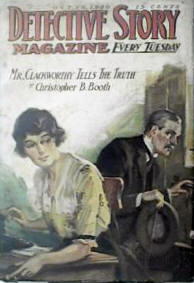
Mr. C

But the limited knowledge that I had certainly did not prevent me from being asked to provide the introduction to the recent Wildside collection of Clackworthy adventures — nor prevent me from accepting for that matter, either.

Which of course obliged me to not completely fake it. Even after the Wildside book was published, I continued to hunt around to find as much information as I could come up with. I have the first and third of the three volumes below, but not the second. The stories in the first of the two Chelsea House books are not identified by name. It’s what’s called a fix-up novel: a collection of stories combined into what is called a novel, but is, simply speaking, a collection of stories combined into a novel, some related to each other, others not.

I suspect, but do not know for sure, that the second Chelsea House collection is structured the same way. For the titles of the stories in both books, I am indebted to Gordon W. Huber’s Chelsea House: A Bibliography (June 2001), with the relevant data sent on to me by Don Davidson. For the first book, I matched the story lines with the titles that Gordon listed, his data coming directly from the Street and Smith files located at Syracuse University. (Street and Smith was the publisher of Detective Story Magazine, among tons of other pulp magazines and dime novels over the first half of the past century.)


THE MR. CLACKWORTHY STORY COLLECTIONS:

All of the stories below originally appeared in Detective Story Magazine. There has been no attempt to ascertain which Mr. Clackworthy stories have so far not been collected.

In the first collection, there is one more story than I can match up with a title. Two of the titles have been established by guesswork only, as indicated, and even so, all of the matching should be considered questionable.


MR. CLACKWORTHY
Chelsea House, hardcover, 1925.

Chapters 1-3. The Million Dollar Air Bag. March 9, 1920

Chapters 4-7. Blasted Reputations. March 23, 1920

Chapters 8-10. Painful Extraction. April 27, 1920

Chapters 11-13. The Comeback. May 11, 1920

Chapters 14-20?? Mr. Clackworthy Stakes a Friend. September 28, 1920

Chapters 21-24. Mr. Clackworthy Tells the Truth. October 19, 1920 (a)

Chapters 25-26. [unknown story title]

Chapters 27-28?? A Modern Lazarus. March 30, 1920

Chapters 29-32. Mr. Clackworthy Digs a Hole. July 16, 1921

(a) Contained in the Wildside collection below.


In the second collection, the following titles have been identified. They may not appear in this order in the book, which I have not seen.

MR. CLACKWORTHY, CON MAN
Chelsea House, hardcover, 1927.

Mr. Clackworthy Forgets His Tonic. January 14, 1922

When Mr. Clackworthy Needed a Bracer. January 21, 1922

Mr. Clackworthy and the Auto Rim. January 28, 1922

Mr. Clackworthy Sells a Gold Brick. March 25, 1922

Clackworthy Coddles a Contract. June 3, 1922

Mr. Clackworthy Pays His Income Tax. June 9, 1923

Mr. Clackworthy Takes a Dip in Rye. June 30, 1923

Mr. Clackworthy Tips a Teapot. April 19, 1924


In this latest collection, there seems to be only one overlap with either of the earlier ones.

THE ADVENTURES OF MR. CLACKWORTHY
Wildside Press. Hardcover & Trade Paperback, 2006.

Mr. Clackworthy Tells the Truth. October 19, 1920 (a)

Mr. Clackworthy Within the Law. August 13, 1921

Mr. Clackworthy’s Pipe Dream. March 11, 1922

Mr. Clackworthy Turns Chemist. December 17, 1921

Mr. Clackworthy Digs a Hole. July 16, 1921 (b)

Mr. Clackworthy Revives a Town. September 24, 1921

Mr. Clackworthy Sells Short. February 26, 1921 (b)

Mr. Clackworthy’s Pot of Gold. October 7, 1922.

(a) Appeared in the first Chelsea House collection. The story is also available online.

(b) The dates are in error as given on the copyright page. The ones given here are correct.

In my recent post on C. B. Dignam, I pointed out that it was not even known whether Dignam was male or female. Going on from there, I asked for a list of female mystery writers who hid their gender by using initials in their byline or by deliberately choosing a “male-sounding” pen name.

Commenting on that post, Bill Crider suggested Paul Kruger as a relatively recent example. On the Golden Age of Detection yahoo group, Nick Fuller posted the following:

E. X. Ferrars is the obvious one; she deliberately went for initials which sounded masculine. Then there’re E. C. R. Lorac, G. M. Mitchell (as the American publishers called the author of Speedy Death), and P. D. James.

Several women authors also used male pseudonyms: Maxwell March (Margery Allingham), Anthony Gilbert (Lucy Malleson), Malcolm Torrie and Stephen Hockaby (Mitchell) and Gordon Daviot (Josephine Tey / Elizabeth Mackintosh). On the other hand, H. R. F. Keating used the ambiguous (and Christie-inspired?) pseudonym of Evelyn Hervey for his historical detective stories about a Victorian governess.

Thanks, Nick. I think you’ve come up with all that I’ve thought of myself, along with a couple more, although I cannot find anything to suggest that Speedy Death was ever published as by G. M. Mitchell. Can you confirm this?

Strangely enough, you failed to mention an author you discussed in an earlier posting on another subject — Guy Cullingford, pseudonym of Constance Lindsay Dowdy, according to one website.

This comes as a surprise to me. I did not know that Cullingford was female until now, or if I did, I’d forgotten it. In Crime Fiction IV, Al Hubin says that Cullingford was a pen name of C. Lindsay Taylor, which upon further investigation is a shortened version of (Alice) C(onstance) LINDSAY TAYLOR (1907-2000). Dowdy must have been her married name?

     [UPDATE 01/03/07. Al Hubin did some investigatory work and discovered that Dowdy was her maiden name. See comment 3 below.]

In any case, she wrote one book as by C. Lindsay Taylor (Murder with Relish, Skeffington, 1948) and ten as by Cullingford between 1952 and 1991. Only five of them seem to have been published in the US.

The question I posed was of female mystery authors writing as men. I confess that vice-versa hadn’t occurred to me. There must be others besides Keating as Hervey, but other than cases involving male authors who wrote gothic romances under female names, as many did in the 1960s and 70s, this is a question I’ll have to think about some more.

The next posting on the same Yahoo group was from Jeffrey Marks, who confirmed exactly what I suspected. There’s a totally obvious candidate for inclusion that hadn’t even occurred to me:

Don’t forget Craig Rice, who actually used part of her real name ((Georgiana Ann Randolph Craig)), but then also used Michael Venning as well.

And assuredly there are more, but have we named all of the obvious ones so far? Probably not.

Getting back to C. B. Dignam briefly, who unknowingly brought this whole matter on, Google is *fast*. The day after my original post, I thought to double-check to see if there was anything on-line about him or her, and the only relevant blog or website that came up was … mine.

[UPDATE] 03-29-10. An email note from Sheila Mitchell, who was married to H. R. F. Keating, is both relevant and interesting. She says:

“This related to pseudonyms that women have used but you also instance that Harry wrote his Miss Unwin Victorian books under the ambiguous pseudonym of Evelyn Hervey and suggested that this may have some connection with Agatha Christie. Should you be interested it has no connection at all with Christie. He chose Hervey because that was a family name and Evelyn as you rightly say because of its ambiguity. Also interesting that publishers refuse to allow established authors their ambiguity and almost always reveal that of course this is so-and-so writing under the pseudonym X.”

What follows arose from an inquiry by Paul Di Filippo on the FictionMags Yahoo group, based on a mystery novel found in a recent catalog from Peter Stern —

— Another Lesser-Known Writer in the crime field, one C. B. Dignam, commands top-dollar ($300) for his/her 1926 novel BLACK VELVET.

I am unable to google anything on Dignam. Anyone know info about this forgotten writer?

● Another member of the group, Denny Lien, a librarian at the University of Minnesota came up with the following information —

— Hubin lists only this and one other detective novel by the author, does not expand the pseudonyms or give dates etc., so presumably unknown and perhaps pseudonymous..

No holdings for the book in WorldCat. COPAC shows it at the British Library and the National Library of Scotland:

Main Author: Dignam, C. B.
Title Details: Black Velvet. A novel.
Publisher: London : John Hamilton, [1926.]
Physical desc.: pp. 287. ; 8o.
Note: Part of “The Sundial Mystery Library.”

and gives the same holdings for his/her only other novel:

Main Author: Dignam, C. B.
Title Details: The Sons of Seven.
Publisher: London : John Hamilton, 1928.
Physical desc.: pp. 357. ; 8o.
Note: Part of “The Sundial Mystery Library.”

I assume the “Sundial Mystery Library” was likely a lending library specialist or some such, resulting in few surviving copies.

● I sent both query and response to Al Hubin, who had this to add —

— I once owned copies of both Dignam’s books, but have no further information. According to freebmd.org, Dignam was a fairly common British surname, so it could be an author’s real name. But that list has no one with the initials C. B., though it’s possible that one of the listed persons with a first name beginning with C had a middle name which wasn’t given (or that one of a few entries without first/middle names and just given as “male” or “female” could be our author). I’ll inquire of others in case they know anything about C. B.

● But at the moment, this is where the matter stands. From their titles, both books sound like “thrillers” to me. I cannot think of very many female mystery writers who felt the need to disguise their sex by using initials or a “male-sounding” pseudonym, so my feeling is that C. B. Dignam was male.

And yet, Mary Violet Heberden, to point out a single counterexample (and all I need is one), and for whatever reason, felt the need to write her more than thirty spy/private eye novels in the 1940s and 50s as either M. V. Heberden or Charles L. Leonard. (The link will lead you to my review of Sinister Shelter, which Heberden wrote under the latter name, a private eye novel which has Paul Kilgerrin doing some post-war work in South America for the US government.)

In any case, here is another question: How many other female mystery writers can you think of who have disguised themselves in print as male? Leave a comment, if you would, or email me directly.

And FYI: There are currently three copies of BLACK VELVET for sale on the Internet, ranging in price from $14.00 to $53.50, including postage.

I received the following inquiry yesterday by email:

Dear Steve,

You are doing a terrific job. Thank you very much.

There are a couple of books/stories I want to know about:

1) I read a book by Erle Stanley Gardner about 25 years ago havi ng a character by the name of Terry Clane. I have not been able to locate that book nor any other with the character. In the book, Terry Clane uses a Chinese meditation technique to solve problems. Can you help me?

2) Has Alfred Hitchcock himself written any mysteries?

Keep up the good work.

— Shashi Dharan


Dear Shashi

Thank you for your kind words about Mystery*File. The original site has been on hiatus since September, and (*fanfare*) this is the first posting in its new format.

If you haven’t visited it yet, another site I have been spending some time on is www.crimefictioniv.com. I hope you’ll take a look when you have a chance.

To answer your questions, the two books by Erle Stanley Gardner in which Terry Clane appeared are Murder Up My Sleeve (1937), and The Case of the Backward Mule (1946). Both can be easily obtained, I’m sure, from the usual sources on the Internet (www.biblio.com, ABE, Amazon, and so on).

I wasn’t previously aware of Terry Clane’s Chinese meditation techique in solving crimes, so I looked him up on Google, where I found a link to Murder Up My Sleeve in The George Kelley Paperback Collection. You’ll find him described there as: Clane, formerly a lawyer and currently a “mysterious adventurer,” has recently returned from an extended stay in China where he studied at a Chinese monastery and collected a large number of Chinese curios, including a sleeve gun. The book came out in 1937, so I imagine that The Shadow got to China before Terry Clane did.

If you’re interested, you can find an extremely complete bibliography for Gardner at http://www.grooviespad.com/esg/works/Bibliography.asp

The only book attributed to Alfred Hitchcock personally is Rope (Dell, paperback, mapback edition, 1948), a novelization of his movie of the same name, but it was actually ghost-written by Don Ward. I strongly doubt that Hitchcock had much involvement with the various anthologies produced under his byline, and probably never with Alfred Hitchcock’s Mystery Magazine.

For a partial list of the anthologies, a sales list at http://www.alfredsplace.com/mysterybooks.htm provides cover images and the contributors for each.

I hope this helps!

Steve

« Previous Page