Silent films


REVIEWED BY JOHN APOSTOLOU:         


DRESSED TO KILL. Fox Film Corporation, 1928. Irving Cummings, director; Edmund Lowe, Mary Astor, Ben Bard, Robert Perry, Joe Brown, Tom Dugan, John Kelly, Robert Emmet O’Connor, Ed Brady, Charles Morton. Shown at Cinecon 41, September 2005.

   This silent movie bears no relationship to any of the three films released between 1941 and 1980 that have the same title. This Dressed to Kill is what we used to call “a cops & robbers movie.” The stars are Edmund Lowe and Mary Astor (whom we all remember for her role in The Maltese Falcon).
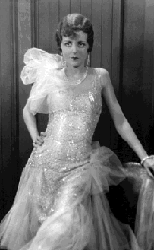
DRESSED TO KILL Mary Astor

   Lowe’s character is the boss of a gang that specializes in big heists, and Astor plays an attractive young woman who becomes his girlfriend. On the night of a robbery, the gang dresses in formal clothes, pretending to be a group of wealthy gentlemen going out on the town.

   When they arrive at the site of the robbery, they change into their regular duds, and when making their getaway they again put on their formal clothes. I suppose this explains the meaning of the title.

   A mystery element enters the plot when Astor’s character becomes Lowe’s girlfriend (read mistress). We wonder why such a smart young lady would get involved with gangsters. Is she working for the police? Or is she just a pretty gal who’s seeking a fast, glamourous life?

   Dressed to Kill is well directed by Irving Cummings. Lowe and Astor give good performances. The photography has a noirish look, and the sets and costumes nicely represent the art deco era. Although not a masterpiece, certainly not in the same class as von Sternberg’s 1927 Underworld, the film is very entertaining and would certainly please silent movie buffs.
REVIEWED BY WALTER ALBERT:         


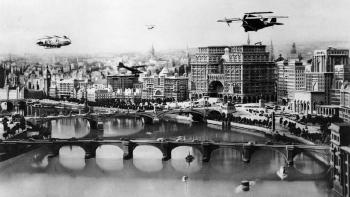
HIGH TREASON. GB/Tiffany, 1929; Maurice Elvey, director; Benita Hume, Jameson Thomas, Humberston Wright, Basil Gill, James Carew, Judd Green, Milton Rosmer, Henry Vibart, Irene Rooke, Renee Ray. Shown at Cinecon 41, September 2005.

   This was a science fiction film previously unknown to me and to, I suspect, a majority of the audience. Although it was filmed in both sound and silent versions, the sound track had decomposed, and only the silent version appears to survive.

HIGH TREASON (1929).

   Set in the mid-20th century, some twenty years after the date of the film’s release, it chronicles an explosive situation in which subversive capitalists and terrorists, working behind the scenes, are attempting to set off a war between the two major international powers represented by North America and Britain and continental governments.

   (The writer of the program notes seems to think Britain and the US are a co-joined superpower even though the film makes it clear that Washington and London are the leaders of their respective alliances.)

   This was released two years after the seminal German science fiction film, Metropolis. High Treason has none of the visionary power of Lang’s film but its simplistic view of the future city (airplanes landing on roofs, and TV) is somewhat compensated for by a plot which culminates with the murder of the leader who’s pushing for war by the world’s leading pacifistic in an attempt to derail the race toward disaster.

   It’s certainly superior to the rather silly American SF film Just Imagine (1930) but it will not be until 1936 that Britain, with the release of Things to Come, will produce an important science fiction film.

REVIEWED BY WALTER ALBERT:         


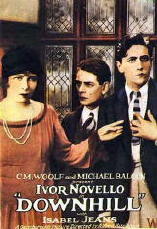
DOWNHILL. US title: When Boys Leave Home. Gainsborough, 1927; Alfred Hitchcock, director; Claude McDonnell, cinematographer; Ivor Novello, Ben Webster, Robin Irvine, Sybil Rhoda, Isabel Jeans, Ian Hunter. Shown at Cinecon 41, September 2005.

DOWNHILL - When Boys Leave Home

   Ivor Novello stars in a film adaptation of his own play, and is once again directed by Hitchcock, whose previous film was The Lodger in which Novello played the prime suspect.

   Although Novello is best known as a consummate stage performer and composer of popular songs, the screen persona I’ve seen in at least three films shows a darker, risk-taking side.

   In Downhill, he’s a popular public school student, from a wealthy family, who takes the blame for a friend’s indiscretion with a barmaid and slides downhill after his father throws him out.

   The film shows the influence of German expressionism on Hitchcock, with some striking photography in an extended dance-hall sequence that, although it takes place in Paris, recalls images of decadent Berlin settings in the 1920s.

REVIEWED BY WALTER ALBERT:         


THE SPOILERS (1914)

THE SPOILERS.  Selig Polyscope Co., 1914; Colin Campbell, director; William Farnum, Tom Santschi, Kathlyn Williams, Wheeler Oakman. Shown at Cinecon 41, September 2005.

   The first filming of Rex Beach’s Alaskan adventure novel, with a fifth version released in 1955. A knockdown fist fight is the high point of the film, with the fight between John Wayne and Randolph Scott in a 1942 version still fondly remembered by filmgoers of my generation.

   In this first silent version, William Farnum (a big man with a pummeling technique) goes at it with Tom Santschi. The fight is filmed in a small interior set that doesn’t give the actors much room to maneuver but heightens the scene’s excitement. The print was a bit light but this doesn’t detract significantly from the atmospheric staging.

THE SPOILERS (1914)

   Sets seem (at times) makeshift, although this gives a realistic look to the Alaskan frontier setting at a time when towns went up almost overnight as goldhunters poured into the region.

   Tempers flare frequently, the corporate and political villains haven’t a decent bone in their bodies, and the screen seems at times to explode from the vitality of the almost primitive action and emotions.

   A vibrant example of early feature length filmmaking that’s no lost masterpiece but still a very entertaining take on a historical period.

REVIEWED BY WALTER ALBERT:         


PEGGY LEADS THE WAY Mary Miles Minter

PEGGY LEADS THE WAY. American Film Company-Mutual, 1917; Lloyd Ingraham, director; Mary Miles Minter, Andrew Arbuckle, Carl Stockdale, Alan Forrest, Emma Kluge, Margaret Shelby, George Ahern, Frank C. Thompson, William Spencer. Shown at Cinecon 41, September 2005.

   Lightning struck a third time, bringing to light a film starring Mary Miles Minter, few of whose films have survived and whose career was, in effect, ended by the unsolved murder of director William Desmond Taylor, with the scandal arising from rumors of her relationship with Taylor tarnishing her screen image.

PEGGY LEADS THE WAY Mary Miles Minter

   I had never seen one of her films and I was completely charmed by her bright, take-charge performance. She returns home after studying in the East to find her father’s country store struggling in the wake of government regulations and the entire community’s livelihood and existence threatened by the dastardly actions of a heartless developer.

   Fortunately, he has a son who’s as charmed by Mary as I was. He takes the side of the locals, and with Mary orchestrating the revolt, helped by a fortuitous storm, happiness and prosperity are restored to the small community.

THE DANGER SIGNAL. Columbia, 1925; Erie C. Kenton, director; Jane Novak (shown below), Dorothy Revier, Robert Edeson, Gaston Glass. Shown at Cinecon 41, September 2005.

THE DANGER SIGNAL (1925).

   An incomplete print of this film only turned up in 2002 and even with careful piecing-together and restoration, shows signs of nitrate decomposition and narrative gaps. However, what remains (and is, in fact, only about 900′ short of the original footage listed in the American Film Institute Catalog) proved to be one of the highlights of the weekend.

   It’s the melodramatic story of a an unwed mother who gives up one of her twin sons to a successful father, signing away all rights without telling him there were two boys. Years later, she’s running a small dress shop while the son she raised is working for the railroad his father owns, with his brother being groomed to succeed his father.

THE DANGER SIGNAL (1925).

   The one son is poor but honest and a genuinely sterling character, while his brother is a lazy good-for-nothing. The plot finds the good son falling in love with his brother’s girlfriend, a love that’s returned. The plot has echoes of classic drama (both French and English/American), with a good dollop of novelistic high-jinks that climax in a thrilling runaway train chase that had the audience literally cheering.

   The resolution reunites all the long-separated parties, rewards the good and provides a way toward redemption for the wayward.

   A moral tale whose charm, coupled with first-rate acting, directing, and scripting, carried the day.

REVIEWED BY WALTER ALBERT:         


THE CANADIAN

THE CANADIAN. Famous Players-Lasky, 1926. William Beaudine, director; adapted by Arthur Stringer from W. Somerset Maugham’s play, The Land of Promise; Alvin Wyckoff, cinematographer; Thomas Meighan, Mona Palma, Wyndham Standing, Dale Fuller, Charles Winninger, Billy Butts. Shown at Cinecon 41, September 2005.

   For me, this was the revelation of the convention, an outstanding silent film, with superb photography by Wyckoff, dead-on performances by every member of the cast, with Mona Palma lighting up the screen as the English woman, brought up in modest but cultivated circumstances, who goes to live with her brother on a remote Canadian farm in a desolate landscape.

   To escape the indignities she feels she’s enduring from his wife and the rough farmhands she marries his foreman who’s shown her some kindness, a decision that she quickly regrets.

THE CANADIAN

   Every performance is true to the character, seemingly natural and unaffected, the soul reflected in characterizations where there’s not an excessive gesture. The subtitles are almost superfluous, the drama playing out in the visuals, with moments that are almost unbearable in their intensity. It’s this kind of experience that makes attending film conventions an adventure with a potential for transcendence.

   (Fellow attendee Jim Goodrich’s comment on this sentence was “Wow!” Could he be suggesting that I was tripping here?)

[EDITORIAL COMMENT.] The photo of Mona Palma is probably not related to the film, but after reading Walter’s review, I knew you’d like to have an idea of what she looked like at the time. Born in 1897, Mona Palma made only seven movies, all between 1923 and 1927, three of them as Mimi Palmeri. She died in 1989.

THE CANADIAN

   Thomas Meighan is the tall fellow dominating the scene above, which was taken from the movie, and of course that’s him again in the publicity still on the right. His career was quite a bit longer than his co-star’s, consisting as it did of 82 movies between 1914 and 1934. Until talkies came along, he was quite a popular star.

   To make this post a little more crime-related, Meigan’s first movie was Dandy Donovan, the Gentleman Cracksman, in which he played the title role, and his first sound film was The Argyle Case (1929) in which he again played the leading character, this time homicide investigator Alex Kayton.

— Steve

« Previous Page