Silent films


REVIEWED BY WALTER ALBERT:         


SHARP SHOOTERS. Fox, 1928. George O’Brien, Lois Moran, Noah Young, Tom Dugan, William Demarest, Gwen Lee, Josef Swickard. Director: John G. Blystone. Shown at Cinecon 40, Hollywood CA, September 2004.

SHARP SHOOTERS (1928)

   A modest effort in which George O’Brien dallies with a French dance-hall girl (Moran) before he leaves her, protesting eternal love, with his comrades Young and Dugan for their next port in the states.

   When Moran finds him, he’s already dallying with another dilly and not too pleased to see her. Young and Dugan, exercising what passes for a moral example, maneuver him into an unwanted marriage.

   Then, as you might suspect, anger turns to something much warmer, and the film ends on a very happy note. Demarest is the cad who tries to separate the two.

   A nice, undemanding entertainment for the start of the first full day of screenings.

REVIEWED BY WALTER ALBERT:         


THE WEDDING MARCH. Paramount; 1928. George Fawcett, Maude George, Erich von Stroheim, George Nichols, ZaSu Pitts, Fay Wray. Erich von Stroheim, director; screenplay by von Stroheim and Harry Carr. Photography by Hal Mohr, Buster Sorensen, and Ben Reynolds; art direction by Richard Day and von Stroheim. Shown at Cinevent 41, Columbus OH, May 2009.
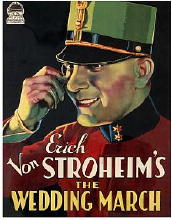
THE WEDDING March 1928

   After the cost overruns of The Wedding March and withdrawal of funding before von Stroheim was able to complete Part II as he had planned it, he essentially ended his directing career with Queen Kelly (1929, also incomplete). But what a tribute to his extraordinary skill the first part of The Wedding March is!

   Von Stroheim was, of course, popularly known as The Man You Love to Hate, but his role as Prince Nicki von Wildeliebe-Rauffenburg is almost sympathetic. He’s expected to marry properly (that is, a rich wife) but he falls in love with crippled musician Mitzi Schrammell (Fay Wray), much to his (and her) parents’ dismay.

   He woos the besmitten Mitzi in a flowered bower where she finally succumbs to his charms, then summarily abandons her when he goes along with his parents’ ambitions (to replenish the family coffers, constantly depleted by the family’s spendthrift ways) and, at the film’s climax, marries Cecelia Schweisser (ZaSu Pitts), the daughter of a wealthy merchant.
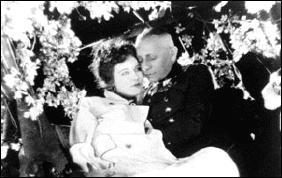
THE WEDDING March 1928

   The magic of the film (aside from the fine performances) is in von Stroheim’s detailed portrait of an ancient aristocracy largely going to lavish seed, hedonistic and opportunistic, interested only in perpetuating its indolent way of life.

   Prince Nicki seems to show some promise of breaking with his class, but if he is to marry a commoner, she must pay for the privilege of marrying him.

   Nicki and Mitzi first meet at an elaborate outdoor ceremony where the equestrian Prince is parading with his company in a reel that’s filmed in beautiful two-strip color. If only the quality of the print were as good for the black-and-white sequences that make up most of the cinematography. By the last reel, the print is almost unwatchable, washed out, grainy, with the intertitles unreadable.

   One of the Cinevent attendees I was talking to blamed the poor quality on the fact that the print screened was 16mm. My friend Charlie Shibuk has seen a good print of the film and told me that William Everson found his 16mm print to be of quite acceptable quality. It would seem that better prints are available, and I wonder if anyone screened this print before scheduling it.
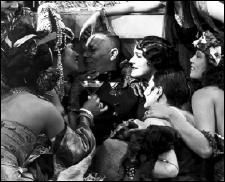
THE WEDDING March 1928

   In addition, the writer of the program notes claims that although von Stroheim began to film part II, the film was taken away from him and given to Josef von Sternberg, who put together a poor version. He further claims that Henri Langlois, of the French Cinematheque, allowed his print to deteriorate.

   Charlie has told me that the writer was wrong on both counts. Von Stroheim did, in fact, edit a version of Part II (at the end of which Nicki tries to atone for his rejection of Mitzi), and the French print was destroyed in a fire. So it would seem that the von Stroheim legend endures, a mixture of fanciful fiction and fact.

EDITORIAL COMMENT.   For a three-minute glimpse of the wedding march itself — in color — see this YouTube clip.

REVIEWED BY WALTER ALBERT:         


LUCKY STAR. Fox Film Corp., 1929. Charles Farrell, Janet Gaynor, Guinn “Big Boy” Williams, Paul Fix, Hedwig Reicher, Gloria Grey, Hector V. Sarno. Scenario by Sonja Levien; photography by Chester Lyons and William Cooper Smith; art direction by Harry Oliver. (Originally part talkie, but the soundtrack has been lost.) Director: Frank Borzage. Shown at Cinevent 41, Columbus OH, May 2009.

LUCKY STAR Janet Gaynor

    This was one of the films severely compromised by print quality. On its original release, the New York Times reviewer described a film in which “many of the scenes highly resemble etchings — dim portraits of aged shingle houses, with their shutters hanging askew,” and in which muted tones “play a large part.”

    Although the print quality left most of these details to the viewer’s imagination, it was apparent that the sets were expressionistic, often angled so that the architecture appeared slightly askew, off-center.

    It was clearly a studio (or a stage) set, a grim landscape with the houses widely separated and sparsely populated, a setting appropriate to the film’s minimalist drama, with the look of some remote European village rather than the American town it is supposed to represent.

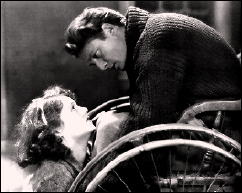
    Timothy Osborn (Charles Farrell) and Martin Wrenn (Guinn Williams) go off to war together and while Wrenn returns to pick up his life where he had left off, Osborn comes back as a cripple who lives by himself in a cottage where he takes on odd jobs to support himself.

LUCKY STAR Janet Gaynor

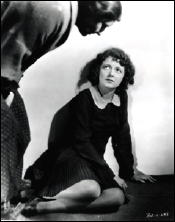
    Mary Tucker (Janet Gaynor) is the young girl they left behind, now a young woman to whom both men are attracted. Wrenn’s body may be untouched by the war, but his spirit is dark and violent, while Osborn’s bright spirit is undamaged by his experiences.

    Mary’s mother, in a telling performance by Hedwig Reicher, wants a better life for her daughter and forbids her to visit Osborn, supporting the suit of Wrenn, who plans to take her away but whose intentions are anything but honorable.

    This seems a much smaller film than Borzage’s earlier 7th Heaven and Street Angel, but the director’s handling of his actors is so sure that he makes the !miracles of the spirit he favors in his films believable and touching, even when the darkened print sabotages his intentions.

REVIEWED BY WALTER ALBERT:         


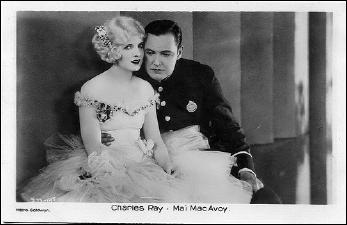
THE FIRE BRIGADE. MGM, 1926. May McAvoy, Charles Ray, Holmes Herbert, Tom O”Brien, Eugenie Besserer, Warner P. Richmond, Bert Woodruff. Director: William Nigh. Shown at Cinevent 41, Columbus OH, May 2009.

THE FIRE BRIGADE 1926

    I don’t know what the cast of FX’s Rescue Me would think of this fire-fighter drama, but I liked it just fine.

    Terry O’Neill (Charles Ray) is the youngest of three brothers in a family whose profession as firefighters goes back several generations. When one of Tom’s older brothers is killed in a fire that got out of control because of shoddy construction, the stage is set for a drama in which corrupt politicians and builders think nothing of constructing an orphanage that’s a potential firetrap.

    Mix in Terry’s developing relationship with Helen Corwin (Mac McAvoy), daughter of James Corwin, the crooked builder (Holmes Herbert), and you have all the ingredients for an edge-of-your-seat, burning building conclusion.

    And I want to add that the scene in which the young hero races the horse-drawn firewagon to the burning building caught my imagination in a way that the high powered technical marvels available to the contemporary firefighter never quite do.

REVIEWED BY WALTER ALBERT:         


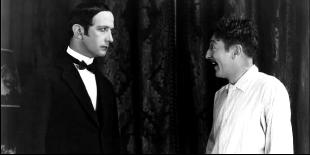
A GENTLEMAN OF PARIS. Paramount Famous Lasky Corp., 1927. Adolphe Menjou, Shirley O’Hara, Arlette Marchal, Ivy Harris, Nicholas Soussanin. Screenplay by Chandler Sprague from the story “Bellamy the Magnificent” by Roy Horniman; titles by Herman Mankiewicz; photography by Hal Rosson. Director: Harry d’Abbadie d’Arrast. Shown at Cinevent 41, Columbus OH, May 2009.

   The cinematography by the noted Hal Rosson was compromised by the dark print that made some of the intertitles difficult to read.

A GENTLEMAN OF PARIS Menjou

   This was also to be a problem with at least two other films, one of which was so severely damaged that the last reel was almost unwatchable. (More on this later.)

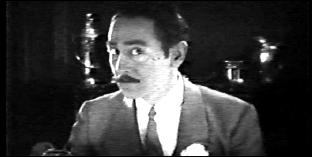
   Adolphe Menjou is the dapper Marquis de Marignan whose complicated love life is managed with great skill by the apparently unflappable Joseph Talineau (Nicholas Soussanin), his butler and general manager of his household.

   The arrival of the Marquis’ fiancee, Yvonne Dufour, taxes even Joseph’s talents, but all seems to be under control until Joseph learns that his wife (their marriage seems to be one largely of convenience from her point of view) is one of his employer’s conquests.

   Stunned by the discovery, Joseph decides to destroy the Marquis by engineering a card game that appears to demonstrate that the Marquis is a cheat, a crime worse, in the eyes of society, than cheating with a friend’s wife. What begins as a frothy comedy of manners turns so dark that the only recourse for a gentleman is to take his own life.

A GENTLEMAN OF PARIS Menjou

   The sudden reversal that undermines Joseph’s plan and restores comedic balance may satisfy some conventional sense of wanting a restoration of the “natural” order but it throws the film off balance.

   Tragedy threatens and the momentary crossing of the boundary that separates comedy and tragedy in classical French theater may prove disconcerting to more than one spectator, especially since the resolution seems so hollow.

   The director had worked with Chaplin on A Woman of Paris in which Menjou plays a similar role as a gentleman about town, his stock in trade as an actor in the silent era, and this film, even viewed in a dark print, is an effective exercise in style.

   D’Abbadie d’Arast’s Hollywood career was apparently damaged by his reputation for being difficult and going over budget (reminding one of von Stroheim). He ended his career in 1933 with the direction of Topaze, which boasts fine performances by a cast headed by John Barrymore and Myrna Loy, closing his career with a film that played to his strengths as a director.

REVIEWED BY WALTER ALBERT:         


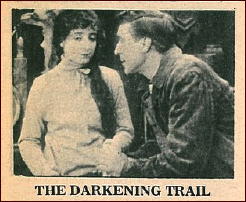
THE DARKENING TRAIL. Mutual Film Corp. 1915. William S. Hart, Enid Markey, George Fisher, Nona Thomas, Louise Glaum. William S. Hart, director; Thomas H. Ince, producer; written by C. Gardner Sullivan. Shown at Cinevent 41, Columbus OH, May 2009.

THE DARKENING TRAIL William S. Hart

    William S. Hart, in his third feature film, plays Yukon Ed, hopelessly in love with Ruby McGraw (Enid Markey), owner of the local saloon, who has refused his offer of marriage dozens of times.

    When Jack Sturgess (George Fisher), fleeing from his father’s wrath after he has wronged and abandoned a woman he refuses to marry, arrives in the small Alaskan town, Ruby, seeing in him the knight in shining armor she’s been waiting for, takes up with him.

    Yukon Ed, willing to give the newcomer a chance, but ever watchful for any wrong done to Ruby, is there when Ruby, gravely ill, is waiting for the doctor who will never come because Jack, after promising to bring him, detours for a dalliance with a dancehall girl.

    The intertitle “Requiem of the Rain” announces the grim conclusion and captures the dark poetry of this striking film.

REVIEWED BY WALTER ALBERT:         


DANTE’S INFERNO. Fox Film Corporation Production, 1924. Lawson Butt, Howard Gaye, Ralph Lewis, Pauline Starke, Josef Swickard, Gloria Grey. Written by Edmund Goulding and Cyrus Wood; cinematography by Joseph August. Director: Henry Otto. Shown at Cinevent 41, Columbus OH, May 2009.

DANTE'S INFERNO 1924

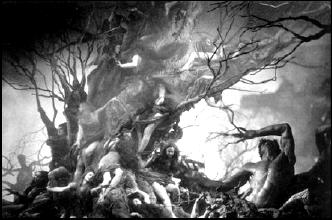
   This is one of those moral dramas that were so popular in the silent film era, which seemed to take special delight in appealing to audiences’ interest in the artistically tasteful depiction of sexual excess, this time portrayed in a tour through Dante’s Inferno with the poet guided by his Roman predecessor, Virgil.

   The really interesting part of the film, the guided tour that shows the horrified Dante the sufferings of the damned (with a great deal of what appears to be actual or very well simulated nudity), is embedded in a modern morality play, whose simple treatment of good and evil needn’t detain us here.

   As for the programmers at Cinevent, I suspect they scheduled the film rather less for its artistic merit than as a lead-in to Josef van Sternberg’s The Shanghai Gesture, a modern take on the eternal question of good and evil that may be less classically graphic but is a much more powerful treatment of the subject.

Editorial Comments: Be watching for Walter’s review of The Shanghai Gesture. It’ll show up here soon.

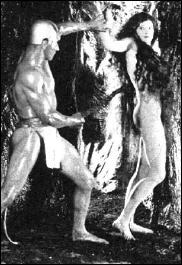
   And while it isn’t certain that the photo below is from the 1924 silent version of Dante’s Inferno, there is a long sequence in the 1935 film with Spencer Tracy and Claire Trevor which used stock footage from the earlier one. Since that may be where this rather horrific scene came from, I’ll include it on a provisional basis, and delete it later if it shouldn’t be here at all:

            DANTE'S INFERNO 1924

REVIEWED BY WALTER ALBERT:         


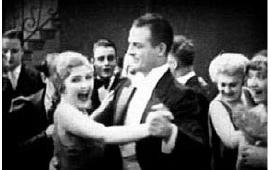
SKINNER’S DRESS SUIT. Universal, 1926; Reginald Denny, Laura La Plante, Ben Hendricks, Jr., E. J. Ratcliffe, Arthur Lake, Hedda Hopper. Director: William A. Seiter. Shown at Cinevent 41, Columbus OH, May 2009.

SKINNER'S DRESS SUIT

   Skinner and Honey (Denny and La Plante) are a young married couple, with Skinner’s office job bringing in a salary that’s not up to Honey’s expectations of her husband’s worth. Egged on by his ambitious wife, Skinner finally works himself up to asking his boss for a raise.

   Although the request is refused, Skinner finds himself incapable of confessing the failure to his wife, who immediately assumes he has the raise and starts spending down their savings on the expectation of the increased income.

   Denny and La Plante gave such charming performances that it was difficult for me to find his wimpiness and her pushy nature distasteful. As their financial difficulties mount, an invitation to a fancy party proves to be their salvation, a plot turn fueled by their skill at the Charleston that leads to a dancing sequence that lifts this expertly directed and played comedy to new levels of effervescence.

REVIEWED BY WALTER ALBERT:         


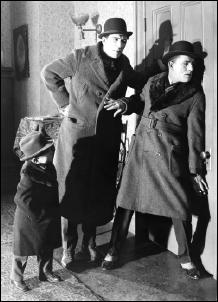
THE UNHOLY THREE. MGM, 1925. Lon Chaney, Mae Busch, Matt Moore, Victor McLaglen, Harry Earles, Matthew Betz. Based on the novel by Clarence Aaron ‘Tod’ Robbins; director: Todd Browning. Shown at Cinevent 19, Columbus OH, May 1987.

THE UNHOLY THREE (1925) Lon Chaney

   There was, perhaps, one film at the convention in which acting, script; and direction combined in an often unforgettable combination: Todd Browning’s The Unholy Three, starring Lon Chaney, Victor MacLaglen, and, memorably, the fine midget actor, Harry Earles. This is the 1925 silent version.

   Chaney plays a side-show ventriloquist (Professor Echo) who engineers a scam in which he, strongman Hercules (McLaglen), and Tweedledee (Earles) gain entry to homes of the rich who are clients of a pet store where the trio’s foil, Mae Busch, works. Chaney, disguised as Busch’s grandmother, and Earles as a year-old baby, make service calls to treat “ailing” parrots who, once they have left the store, cannot talk.

   Earles is a malevolent presence who fully justifies W.C. Fields’ wariness toward children, and McLaglen, at moments, in makeup and hulking movements bears a striking resemblance to Karloff’s Frankenstein monster.

   Eventually, a sentimental ending weakens the somber power of the best scenes, but this is still a striking film, with a vein of nastiness that gives it an acerbic edge sixty years after its production.

– Reprinted from The MYSTERY FANcier, Vol. 9, No. 3, May/June 1987.

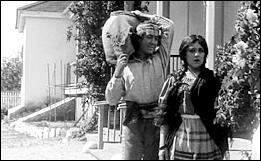
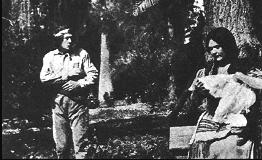
RAMONA. Biograph, 1910. Mary Pickford, Henry B. Walthall, Francis J. Grandon, Kate Bruce, W. Chrystie Miller. Based on the novel by Helen Hunt Jackson. Director: D.W. Griffith.

RAMONA Mary Pickford

   If cutting Crime and Punishment down to a 90 minute movie was a considerable feat, as discussed briefly here, a few posts back, then how about a 200 to 300 page novel that’s trimmed down to a very quick 17 minutes?

    It can’t be done, but it was, and the result is about as good (or bad) as you might expect.

   Starting with the positive, the photography is quite remarkable. But there are no dialogue cards, only brief statements of what the next scene is to display, and in the two reels, there’s only enough time to get the gist of things, no more.

RAMONA Mary Pickford

   Subtitled “The Story of the White Man’s Injustice to the Indian,” a Spanish girl in California (Mary Pickford) marries an Indian (Henry B. Walthall), they have a child, and as the subtitle suggests, they do not live happily ever after. The gun-toting white settlers who keep moving the small family on do not come off at all well in this movie.

   This movie is to be watched for its historical significance, and — unless you tell me otherwise — for little other reason. Thankfully it still exists to be watched today, nearly 100 years later.

« Previous PageNext Page »