Science Fiction & Fantasy


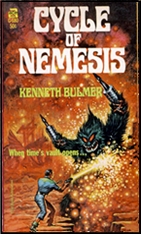
KENNETH BULMER – Cycle of Nemesis. Ace G-680, paperback original, 1967. Cover art: Kelly Freas.

   After 7000 years, Khamushki the Undying is able to break the seven locks on the Time Vault in which has been imprisoned. The compete destruction of Earth for the second time is threatened, and it is up to our group pf five (plus one robot named Charlie) to prevent it. K the U has control over both time and space but the weakening of his guardians aid in his defeat for another 7000 years.

   The terror of mythology comes to life as science. Ridiculous. About as bad as a Fantastic Adventures story from the thirties. Even Bulmer cannot adequately motivate the continuity of he project, though he tries hard, every two or three pages. Probably too hard. Acceptance [of the basic story line] might otherwise come easier. Most people [caught up in a situation such as this] would become quietly drunk if not insane.

   The beginning is promising, at least, but by halfway through, reading is a struggle.

Rating: *½

– January 1968


JACK VANCE “Phalid’s Fate.” Novelette. First appeared in Thrilling Wonder Stories, December 1946. First collected in The Dark Side of the Moon (Underwood-Miller, hardcover, 1986).

   As a strike against the enemy in the ongoing Earth-Phalid war, Ryan Wratch agrees to have his mind transferred to that of a Phalid that has been captured. Ryan’s own body had been all but destroyed in a Phalid attack, his brothers having been killed in the same incident. The Phalids are insect-like creatures with long black carapaces, oddly jointed legs, and rubbery tentacles with mottled gray undersides, hardly human looking at all.

   The plan is to have Ryan rescued in space by the Phalid, then taken to their hitherto unknown home planet, where he can act against them from the inside. The plan succeeds exceedingly well, and if you don’t realize that there has to be a beautiful female captive that also needs rescuing, you haven’t read all that many space opera stories like this one.

   And that is exactly what this story is. Out-and-out space opera. And I enjoyed it immensely. This was only the third published story in Vance’s long career, and it’s hardly representative of the kinds of story he became famous for. You can tell that he was a writer, though, even at this early stage, or that he was going to be one, especially in passages in which he is describing the Phalids’ home planet, in what I’m going to refer to as what became his well-established baroque style.

JACK VANCE – The Palace of Love. Demon Princes #3. Serialized in Galaxy SF, December 1996 through February 1967. Berkley X1454, paperback, October 1967. Cover by Richard Powers. Daw UE1442, paperback, February 1979.

   Keith Gerson managed to obtain a fortune for use in his life’s single purpose – revenge against his parents’ murderer. The hunt for the third is this story. The trail of Violo Falushe leads him to a mad poet Navarth; Drusilla, his ward; and then to the notorious Palace of Love. Falushe is killed and the love of Drusilla turned down.

   The first installment [of the serial version] is the best; at the beginning, trips to far-flung planets are a necessary part of Gerson’s hunt and are reminiscent of Delany in descriptive wonder. As the search narrows down, so does the tale itself slow down, to the pace of the final walk to the palace. The symbolism of that place escapes me, but there must be something more to it other than boredom.

Rating: ***½

–December 1967

GALAXY SCIENCE FICTION – February, 1967. Edited by Frederik Pohl. Cover by Jack Gaughan. Overall rating: 3 stars.

HAYDEN HOWARD “Our Man in Peking.” Novella. Esks #6. Dr. West is sent by the CIA to China, where Esks have been welcomed and have multiplied to overwhelming numbers. His purpose is unknown, implanted hypnotically in his subconscious, but once they meet, he discovers he has telepathic control over Mao III. Mental torment can be worrisome. Some story was omitted since he was left frozen in a Canadian prison in the December issue; details should be in order. ***½

UPDATE: I no longer recall anything about this series, but Howard wrote a book titled The Eskimo Invasion (Ballantine, paperback, 1967) which is described on ISFDb as a “fix-up” of some or all of the Esk stories, of which there were seven. A review on Amazon says: “An Eskimo community finds an alien space probe which quickly hybridizes the locals with alien DNA, leading to a new species called ‘Esks.’ The Esks are so lovable that no one is able to say no to them. And from there, it goes straight to crazytown.” As for my unhappiness about a gap between the story in the December issue and this one, there was no story in between.

PHILIP K. DICK “Return Match.” A raid on an outspacer’s gambling casino yields a pinball machine that builds its own defenses; and the best defense… Not to be put down easily. (5)

WALLACE WEST “The Last Filibuster.” What might happen if legislators and other leaders were forced to do the fighting also. (3)

RICHARD WILSON “They Hilariated When I Hyperspaced for Earth.” Novelette. Young Harmish of Auxor seeks the help of UN Sechen Nboto to initiate progress in his homeworld, but returns with the number man. Amusing at times. (3)

UPDATE: The interior artwork for this story was by Vaughn Bodé, which seems quite appropriate for what I called an amusing tale.

CHRISTOPHER ANVIL “The Trojan Bombardment.” Warfare based on giving enemy what his wants rather than what he needs has one longrun drawback. (2)

THOMAS M. DISCH & JOHN T. SLADEK “The Discovery of the Nullitron.” Pseudo-scientific report. (1)

R. A. LAFFERTY “Thus We Frustrate Charlemagne.” With the aid of a computer, scientists change the presence by altering the past. Idea not very new. (1)

UPDATE: My rating for this one is surprising. Lafferty was generally a favorite of mine.

JACK VANCE “The Palace of Love.” Serial, part 3 of 3. Look for my full review soon.

–December 1967

JOHN ANTHONY “The Hypnoglyth.” First published in The Magazine of Fantasy and Science Fiction, July 1953. Reprinted in Portals of Tomorrow, edited by August Derleth (Rinehart, hardcover, 1954), and A Decade of Fantasy and Science Fiction, edited by Robert P. Mills (Doubleday, hardcover, 1960).

   A word first, if you will, about August Derleth’s Portals of Tomorrow anthology. I never realized it before, but having recently decided to read a long-owned copy, it’s clear that its original intent was that it was to be the first of a “Best of the Year” series of anthologies, this one covering SF for the year 1953. If the subtitle doesn’t give it away: “The Best Tales of Science Fiction and Other Fantasy,” then Derleth’s introduction does, without quite saying so but obvious by reading between the words. Perhaps the publisher had a change of heart somewhere along the way.

   And so, what I’ve also decided to do is to read my way through the book and report back on each of the stories as I do. The year 1953 was maybe six years before I started reading the SF magazines from the local newsstand, so I wouldn’t have had the chance to read them while the ink was still fresh on them. These will be my opinions today, not from back then, often based on seeing them for the first time, not from later collections or anthologies.

   And at first glance, “The Hypoglyth” is a strange choice to begin a book with. Neither the title or author was at all familiar to me. Not even learning that “John Anthony” was the pen name of John Ciardi helped at all. But Derleth was right. This one’s a small gem of storytelling.

   There are only two characters in the tale. One is a returned space traveler  telling a friend about his adventures on a primitive planet he has just visited. To that end, he hands his companion a strange woodlike artifact which is not wood, but which has a small hollow on one side. As the space traveler goes on with his story, the other cannot help but use his thumb to continually stroke the hollow. It is as if he is being hypnotized by it, but if so, to what end?

   I wish I could tell you more, or even hint at more, but I can’t. Suffice it to say that if you play close attention to what the one man tells the other about life on the planet, everything is there to fall into place at the sweetly foreshadowed ending. Emphasis on sweetly, as say a Stanley Ellin story in another genre altogether.

MICHAEL BISHOP “Allegra’s Hand.” Novelette. First appeared in Asimov’s SF, June 1996. Collected in At the City Limits of Fate (Edgewood Press, hardcover, 1996).

   I called this a science fiction story, and it is that, but it’s far from a space or planets story. A young girl new to her school catches the head counselor there, as well as a host of bullies. It’s not difficult to see why. She wears a glove on her left hand, a long-sleeved one that goes up her arm to almost her elbow.

   Why? What is she hiding? Why won’t she tell anyone? She is clearly intelligent, perhaps more than her years. But taunted one day too far, she punches the boy bullying her in the stomach with the hand in the glove, leaving a huge circular bruise. I won’t tell you her secret, as the mystery is a major factor in the first half of the story, one her counselor (female, and a first person narrator) works to unravel.

   Which she eventually does, gaining Allegra’s trust at last, slowly and carefully. It is quite an affliction, shall we say, that Allegra has to face. Luckily she has her father on her side, and she doesn’t have to face her future alone, not for a while yet.

   It’s in essence a quiet, melancholy story and I think a memorable one. But as Mrs. Hewit tells a colleague, “Beth, I go bump against more hopeless, intractable cases than Allegra’s almost very week. None more unusual, I grant that, but many sadder and a few even harder to envision tuning out acceptably.”

   As for me, I agree. It won’t be easy, but I think Allegra is a survivor.

   Michael Bishop has been writing SF since 1970, and his work has won or has been nominated for any number of awards. Even so, his stories are not flashy, and I don’t believe they’ve ever gained the attention they should have.

WORLDS OF TOMORROW – February, 1967.  Edited by Frederik Pohl. Cover by [Gray] Morrow.  Overall rating: 3½ stars.

SAMUEL R. DELANY “The Star-Pit.” Short novel. The golden are those people psychologically capable of traveling beyond the limits of the galaxy, exploring new worlds, having adventures that ordinary people dream of and hate them for. Vyme, working at ship-repair at the edge of the galaxy, is trapped there. But the golden, exploited for their ability, are trapped, too, in another way. The best treatment of this theme ever written. Characterization is truly tremendous; there are no minor roles in this story. The future of the human race on a believable galactic scale. (5)

KEITH LAUMER “The Planet Wreckers” Novelette. An Earthman gets caught up in the efforts to stop an alien movie company from destroying the US while filming a galactic effort. Meant to be funny, but not very convincing. (3)

KENNETH BULMER “Station HR972.” No story, but a brutal picture of our highway system if this goes on. (3)

RICHARD C. MEREDITH “The Fifth Columbiad.” Short novel. Twelve descendants of Earth capture an enemy spaceship as part of a revenge lasting over 700 years. Action story, with sex arising in inconsistent ways; not too interesting. (2)

— December 1967

IF SCIENCE FICTION. February 1967. Editor: Frederick Pohl. Cover art: [Paul E.] Wenzel. Overall rating: 3 stars.

LARRY NIVEN “The Soft Weapon.” [Known Space series #14.] Novella. Two humans and a puppeteer have stolen from them a strange weapon from the past. Corresponding to each setting the weapon takes on a new shape and purpose. Much too long [43 pages]; not until the second half does there seem to be any story at all. (2)

   [Collected in Neutron Star (Ballantine, paperback original, 1968), and Playgrounds of the Mind (Tor, 1991).]

BRUCE McALLISTER “Gods of the Dark and Light.” A contrast between religions as settlers invade an isolated planet, and what religions become. (4)

   [Although this story has never been reprinted or collected, Bruce McAllister has written a long list of short fiction, and as of last year was still adding to that list.]

KEITH LAUMER “Forest in the Sky.” [Retief.] Novelette. On a planet where the inhabitants are forced to live in he sky to avoid the ferocity of their children on the ground, Retief again saves the diplomatic staff from the Grocci. Quite funny. (3)

   [First collected in Retief: Ambassador to Space (Doubleday, 1969 / Berkley, 1970.) The long running series of Retief adventures were a big hit back in the day.]

ALGIS BUDRYS “The Iron Thorn.” Serial, part 2 of 4. To be reviewed in its entirety at a later date.

ROBERT RAY “Confession.” A priest in North Australia receives an alien with a message of deep religious significance. Overdone. (2)

   [This was the author’s only published science fiction story.]

RICHARD WILSON “The Evil Ones.” Novelette. A murderer committed to a rest-home redeems himself by aiding aliens to repair their ship and leave Earth. Sentimental at the end, but effective. (4)

   [First collected in The Story Writer and Other Stories (Ramble House, 2011.) Wilson wrote only two novels, but was well known for a long list of short fiction.]

MATHER H. WALKER “The Dangers of Deepspace.” Glamorous space reality isn’t. (3)

   [The second “one shot wonder” in this issue.]

C. C. MacAPP “A Beachhead for Gree.” [Gree series.] Novelette. The battle against the Gree continues, this time on a planet of pacifists. From page 149: “It appears … you are as fanatical as those you fight.” A good point, but the evil of Gree overcomes. (3)

   [Never reprinted or collected. The last of nine stories about the long fought battle against the Gree.]

–December 1967

THEODORE STURGEON. “Agnes, Accent and Access.” Short story. First published in Galaxy SF, October 1973. Reprinted in The Best from Galaxy, Volume II, edited anonymously by Ejler Jakobsson. Collected in Case and the Dreamer, Volume XIII: The Complete Stories of Theodore Sturgeon (North Atlantic Books, 2010).

   This is the second of three short stories in this issue of Galaxy that I’ve been reading, ignoring the two long serial installments by James White and Arthur C. Clarke that take up a full two-thirds of the magazine. As far as ISFDb knows, the story has appeared in only two other places, which seems strange to me, as it’s a good one.

   When a company who stock in trade is the information retrieval business, it seems strange that they have to hire an outside consultant when problems arrive internally: requests from departments of the firm are being replied to with very incorrect responses. His way of investigating: to sit outside the president’s office ostensibly waiting for an appointment but in reality watching the very efficient secretary, named Agnes, working at her desk throughout the day.

   This story was written in 1973, long before Siri and Alexa came along, but if science fiction could ever have been said to predict the future, and the describe the problems that come along with it, this is a story that fits the bill to perfection. Adding even more to the enjoyment of the tale is the fact that Theodore Sturgeon was a flows along.

   Examples. This one line sentence, a mere throwaway in fact, sums up a fact that you might not of thought of yourself, but once read, you say, “Of course.”

   If the eardrum ever becomes taboo, high fashion will find a way to give you a glimpse of it.

   Or how about this longer passage, describing only the office itself where the consultant is waiting and observing:

   Suave was the word; the room was suave. The lighting was gentle and varied, tasteful and flattering. Sound went where one desired it to go and was swallowed up everywhere, else. There was a sense of pleasant disorientation, for the walls and to a very subtle degree the floor were not perfectly flat and there was no special place or line where wall became ceiling. In a strange way one seemed not to be indoors at all as much as in another country. Most of the light in the room changed color, but only slightly and with the wonderful gradualness of an aurora, for one does not see the change; one must look away and look back again to be able to know it at all. Yet the light was steady and clear where it should be so – around the wide soft benches and their displays of literature (current magazines, “coffeetable” art books and, nowhere in sight but by no means out of reach, discreetly startling M&H promotions), and equally steady and warm near the two mirrors. Clever touch, that, thought Merrihew.

HARLAN ELLISON “Cold Friend.” First published in Galaxy SF, October 1973. Reprinted in The Best from Galaxy, Volume II, edited anonymously by Ejler Jakobsson. Collected in Approaching Oblivion: Road Signs on the Treadmill Toward Tomorrow (Walker, hardcover, 1974).

   A man who has died on cancer wakes up and finds that except for a chunk of land surrounding the hospital in Hanover, New Hampshire, perhaps only three blocks in radius, the rest of the world has disappeared. Electricity is still on, and food is always stocked in the stores. At the edge of his world, things dangle from underneath, cables, water linesand the like.

   He is the only one there, except at first strange barbarians from all eras from Earth’s past, who ride through then vanish over the edge. Until, finally, a young girl from Boston shows up. She is very pale and is wearing only a translucent dress. She is also very cold to the touch. She claims to have been responsible for the situation they are in, but Eugene Harrison (that’s his name), is not so sure.

   There is a little more to the story, but not a lot. (I have glossed over the finer details.) Readers who want solid endings to their reading matter may not like this one, but it’s told in such a way, — as if Eugene Harrison is telling us his story in words an ordinary person would use (or if Harlan Ellison, in proxy, was leaving an audio recording for us to listen to) — you may not mind at all either.

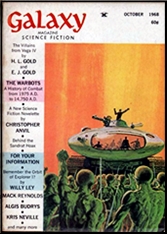
PostScript: You may be able to discern from the cover of Galaxy SF above that this was a special issue, the 23rd Anniversary issue, with quite a few name authors in it. If I’d bought this issue from the newsstand, and I probably did, I might have been disappointed. One chunk of 50 pages is the first part of a serial by James White (“The Dream Millennium”), and another chunk of almost 70 pages is the end of a serial by Arthur C. Clarke (“Rendezvous with Rama”).

   That’s 120 pages of a 180 page magazine. This leaves space for only a one page poem by Ray Bradbury, and three short stories. The other two are by Theodore Sturgeon and Ursula K. LeGuin. If you skip the serial installments, that’s not a lot of reading for 75 cents.

« Previous PageNext Page »