Science Fiction & Fantasy


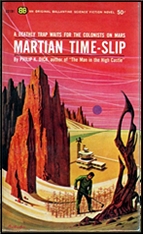
PHILIP K. DICK – Martian Time-Slip. Ballantine U2191, paperback original; 1st printing, 1964. Cover art by Ralph Brillhart. Previously serialized in Worlds of Tomorrow, August/October/December 1963 as “All We Marsmen.” [See Comment #2.] Collected in Five Novels of the 1960s & 70s (The Library of America #183, 2008).

   Mars in the early 21st century is not really an emigrant’s paradise: water and supplies from Earth are severely limited. The colonies barely self-supporting. The suicide of a black marketeer is the focus of events overwhelming a tightly-knit cast of characters, beset by their own problem of existence. “Death .. Sets a radiating process of action and emotion going…” (page 101).

   Neurosis, and schizophrenia in particular, is the main theme, personified by technician Jack Bohlen, who find himself lost in an autistic boy’s time-warped world. Individual characters are developed individually, possible only in the closed world of Mars.

   A great deal could be done in further development; for example, the society of the native Blackmen is barely touched upon. But it would add nothing to the plot, fitted together well.

Rating: ****

–November 1967

ALFRED BESTER “Galatea Galante, the Perfect Popsy.” Novella. First published in Omni, April 1979. Reprinted in The Best of Omni Science Fiction, edited by Ben Bova & Don Myrus (1980) and The Best Science Fiction of the Year #9, edited by Terry Carr (Del Rey/Ballantine, 1980). Collected in Virtual Unrealities: The Short Fiction of Alfred Bester (Vintage, 1997).

   The word “biodroid” may be as new to you as it was to me, but it didn’t me take long to figure out what one is, and Dominie Regis Manwright is the number one craftsman in the field of making them, and always to his client’s complete specifications. He’s commissioned in this highly amusing tale to create just that: a young and attractive woman, perfect in every way: intelligent but compliant, perceptive but instantly available; that is to say,  completely perfect in every way.

   But as Manwright explains to his client, such a woman would also be completely boring. What he suggests is a “wild” factor, a random ingredient that would also make her interesting. Which of course, when Galatea comes of age, it does.

   Keep in mind that this story was written when men’s magazines such as Playboy and Penthouse were at their peaks of popularity. This rollicking romp of a story may have a harder time of it being accepted for publication today, based as it is on the emphasis on the male perception of the ideal woman, much less ending up in a “Best of the Year” anthology (and the lead-off story, to boot). Maybe I’m wrong, but if I’m right, we the readers today are the losers for it.

   But it should also be noted that it was Omni (a slick magazine with connections with Penthouse, and generally assumed to be rather sophisticated) that first published it, not Analog or Asimov’s. I never bought the magazine myself, thinking that the fiction in it was always outweighed by the scientific articles in each issue, of which I had much less time for at the time.

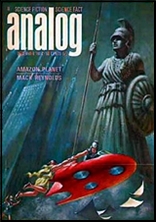
MACK REYNOLDS – Amazon Planet. United Planets #5. Serialized in Analog SF in three parts: December 1966 through February 1967. Ace, paperback, 1975.

   United Planets, with its variety of political systems, socioeconomic theories, and religions, is once again the [setting] for a lecture by Reynolds. This time Renny Bronston of Section G is sent to Amazonia to investigate the alleged suppression of the male half of the population. Amazonia is, however, a most enlightened planet, threatened with overthrow by the forces of a renegade G-agent.

   If it weren’t for the obviousness of the lecture, things might happen a little faster. Reynolds has good ideas, though, the most noteworthy being the possible use of time as monetary basis. A clever plot fits together well, except for a feeling of being just a little too forced.

Rating: 3½ stars.

–November 1967

ANALOG SCIENCE FICTION February 1967. Cover by Kelly Freas. Editor: John W. Campbell. Overall rating: 3 stars.

JOE POYER “Pioneer Trip.” The completion of the first manned flight to Mars must be weighed against a man’s life. Interesting problem, but conventional ending. (3)

JACK WODHAMS “There Is a Crooked Man.” Short novel. We are rapidly approaching the point where science and engineering can easily enable the criminal mind to outwit the law, if the particular law does indeed exist. Law enforcement becomes a hilarious problem, as Thorne Smith becomes SF, not fantasy. Not Analog’s usual stuff. (4)

J. B. MITCHEL “The Returning.” Alien takes over experimental US rocket to return home. (2)    [His only published SF story.]

MACK REYNOLDS “Amazon Planet.” Serial, part 3 of 3. Separate report forthcoming.

WINSTON P. SANDERS [POUL ANDERSON] “Elementary Mistake.” Crew sent to establish mattereaster [?] on a distant planet discovers they haven’t the necessary elements available. Too technical to make sense. (1)

–November 1967

LARRY MADDOCK – The Flying Saucer Gambit. Agent of T.E.R.R.A #1. Ace G-605, paperback original, 1966.

   The Temporal Entropy Rescue and Repair Agency sends the team of Hannibal Fortune and Webley to the year 1966 on Earth to stop Empire from using a new weapon capable of driving mankind insane. The trail leads from the plains of Kansas to the mountains of Arizona, where a last-ditch battle is fought in the cave headquarters of Empire.

   The basis of history, as expounded upon on page 56, is not that of individuals, but of social dynamics, determining a certain stability that makes temporal tampering difficult, although not impossible. It is Fortune’s job to maintain current time-lies, relative to the 26th Century, against Empire’s efforts to tyrannize the universe.

   All ends [of the story] are tidy, except for a lingering suspicion that time-travel should make warfare even easier. Or more complicated. The background seems well-researched, but the basic character of Hannibal Fortune does not yet seem settled – James Bond is a prototype, but the Bond of the books, or of the movies?

Rating: **½

–October 1967

      The Agent of T.E.R.R.A. series —

1. The Flying Saucer Gambit (1966)
2. The Golden Goddess Gambit (1967)
3. The Emerald Elephant Gambit (1967)
4. The Time Trap Gambit (1969)
   

Biblographic Update: Larry Maddock was the pen name of Jack Jardine, who wrote other SF novels and stories as Howard L. Myers. The comments following my earlier review of The Mind Monsters which he wrote under that name has quite a bit of discussion about him.

J. T. McINTOSH – Snow White and the Giants. Serialized in If SF, October-January, 1966-67. Avon S347, paperback, May 1968. Also published in the UK as Time for a Change (Michael Joseph, hardcover, 1967).

   The town of Shutel, England, is destined to be the site of the worst disaster in the world’s history. It is also the main attraction for a history class traveling from the future, but there are ulterior motives behind their visit. They hope that a dangerous mutant strain can be eliminated by altering the past. In spite of disrupted plans, success is theirs, at least temporarily.

   The first installment is quite leisurely in its pace, almost maddeningly casual, as the visitors seem to take few pains to conceal their strangeness. When the fire breaks out, the action increases abruptly and continues until the final lengthy discussion and explanation. People act correctly, as real people should, and do, in the face of something new, or confronted with disaster.

Rating: ****

-October 1967

IF SCIENCE FICTION. January 1967. Cover by Gray Morrow [as by Morrow]. Edited by Frederik Pohl.     Overall rating: 3 stars.

ALGIS BUDRYS “The Iron Thorn.” Serial, part 1 of 4. See review to be posted later.

J. F. BONE “A Hair Perhaps.” A radar technician in a captured station defeats aliens by introducing hair into their ventilation system. (2)

D. M. MELTON “The Scared Starship.” Novelette. A Mars exploration team discovers a starship cowering in a cavern and must sneak up on it to discover its secrets. (3)

ROBERT SILVERBERG “By the Seawall.” Mysterious story of man’s flight to a sea full of strange monsters. Ballardesque. (4)

ROBERT MASON “On the Shallow Seas.” Novelette. Convicts are sentenced to a prison planet and released only when they find a golden “oyster.” Amateurish. (1)

C. C. MacAPP “The Impersonators.” An inspector hunts for a criminal on a planet whose inhabitants can take on any shape. (2)

J. T. McINTOSH “Snow White and the Giants.” Serial, part four of four. See review of the complete novel soon.

-October 1967

POUL ANDERSON – The War of Two Worlds. Ace Double D-355, paperback, 1959. Novella. Published back to back with Threshold of Eternity, by John Brunner (reviewed here ). Cover by Ed Valigursky. Reprinted in The Worlds of Poul Anderson (Ace, paperback, 1974).

   Aliens forced from Sirius instigate the Earth-Mars war by taking the form of top leaders of both sides, so that after the defeat of Earth by Mars, the conquest of both planets will be easier. An ex-spaceman returns to Earth after the war and becomes the object of a countrywide hunt after he learns the truth. The aliens are exposed after they believe he and his Martian friend have been killed.

   A clever but obvious idea that ends much too easily. The best scenes are those of a conquered Earth under Martian rule. After the introduction of the aliens and their story, there is little left but the usual chase-and-hunt. Somehow should have been better.

Rating: ***

JOHN BRUNNER – Threshold of Eternity. Ace Double D-335, paperback original, 1959. Cover by Ed Emshwiller. Published back to back with The War of Two Worlds, by Poul Anderson. Previously published in New Worlds SF #66, December 1957.

   Two people of the 20th Century, a sculptor from California and a London nurse, are caught up in a space-war encompassing all of space and time. The enemy is intent on destroying the Being, located in the Solar System, and existing in four dimensions. But as time itself is no barrier to the being, dedicated to the welfare of Man, parallel time-streams can sculpted for that purpose.

   Truly large-scale action, but someone not used to sf concepts would give up early, as the true story becomes clearer only gradually. Brunner takes his concepts seriously, but this is not one of the better works on the structure of time and space. Explanatory material is presented through dialogue and actions of the characters, as they too struggle through the mysterious happenings, and hence is only partial. All scenes are neatly tied together, but the reader merely goes long for the ride.

Rating: **

–October 1967

FUTURE SCIENCE FICTION. June 1954. Cover by Ed Emshwiller [as by Emsh].     Overall rating: 3 stars.

IRVING COX, JR. “Peace on Earth.” Novelet. Aliens bring Earth love and peace, actually a test for galactic citizenship. Length adds little (2)

SAM SACKETT “Hail to the Chief.” Short novel. A processor of political science gets a chance to put his theories into practice. Unknown to the mass of American people, a group of the intellectually elite has been secretly ruling the country, and they ask Logan to join them. But he becomes disillusioned and attempts the murder of the Chief. Quite a fascinating hypothesis, with better than average character analysis. (4)

PHILIP K. DICK “Sales Pitch.” An unwanted self-selling robot attaches itself to a man and wife. Commuter rocket travel described exactly like freeway traffic? (1)

SAM MERWIN, JR. “The Intimate Invasion.” A bathroom is the location of a bridge between parallel worlds. Invasion through romance is foiled. (2)

GORDON R. DICKSON “Rescue.” A spaceman discovers lost colony, but the inhabitants do not plan on being rescued. (4)

-October 1967

« Previous PageNext Page »