Science Fiction & Fantasy


ELEANOR ARNASON “Ruins.” First published in Old Venus, edited by Gardner Dozois & George R. R. Martin (Bantam, hardcover, 2015). Reprinted in The Year’s Best Science Fiction: Thirty-Third Annual Collection, edited by Gardner Dozois (St. Martin’s Griffin, trade paperback, 2016).

   The stated goal of the anthology Old Venus is to showcase new stories based on the vision that SF writers had of the planet back in the 40s and early 50s; namely, a water-drenched planet with all kinds of exotic flora and fauna, a world where humans could live, but it would be a struggle.

   I don’t own a copy of that book, a companion edition to a similar anthology called Old Mars, but now that I’ve read this story in editor Dozois’s most recent best of the year anthology, which I’m slowly working my way through, I know I need to have it.

   In “Ruins” a young female photographer named Ash Weatherman is hired by a representative of National Geographic to put together a small guided tour of some of the more interesting locales on Venus. She agrees, finds a local crew,and off they go.

   This is all great fun. None of the sights and sounds the group comes across would out of place in an old back issue of Planet Stories, to pick a most obvious example. But all is not what it seems, neither with the people she hires as guides, or with the story itself. The crossbreeding of Terran wildlife with that on Venus was caused by a meteor glancing off Earth and hitting that other planet, or was there a second one as well?

   There are also two factions on Venus that ring strangely out of place. The CIA has a strong outpost there, with their primary protagonists being remnants of the Soviet Union, which collapsed economically by trying to keep their colony on the planet going, and this new expedition finds themselves caught up in the crossfire.

   Nor is this all that they find, hence the title. This is the kind of story, extremely well-written, that gave science fiction its grand sense of wonder in the past. It’s good to see that there are authors who can still provide us the same thrills today.

PETER SAXON – The Vampires of Finistère. The Guardians #4. Berkley X1808, paperback original; 1st US printing, April 1970. First published in the UK by Howard Baker, hardcover, 1970.

   I’m not too sure of the numbering, even though the cover of the Berkley paperback clearly says this is #4 in the series. But I also believe that this is the last of the series, and there are five of them in all. (The numbering may be Berkley’s doing. One of the books, The Curse of Rathlaw, was published first in this country by Lancer.)

   As for the author, there was no Peter Saxon. That was a house name used by many authors, including W Howard Baker, who used it as his own personal pseudonym at first, primarily for Sexton Blake novels, then used by other authors for other books and series.

   The author of Vampires is generally accepted as being Rex Dolphin, whose name and work has come up for discussion previously on this blog with a review of a tale he wrote for Weird Tales entitled “Off the Map.”

   I have read online some speculation that The Guardians may have been the first team of occult detectives, fighting among other evils in the world the following: vampirism, witchcraft, black magic, voodoo and sorcery. (I am cribbing from a list displayed on the back cover of the book at hand.)

   The members of The Guardians, based in a strangely out-of-the-way location in London, are:

Gideon Cross: Founder and most powerful member in terms of his own occult powers. He generally does not leave the team’s headquarter building. Sometimes his actual motives in their various investigations seem hazy.

Steven Kane: The leader, rugged and individualistic, a former professor anthropology with a vast knowledge of the occult.

Father John Dyball: A priest and a former wartime chaplain. Very handy when exorcisms and/or prayers are needed.

Lionel Marks: No psychic powers but a fine detective and a good man to have along when the going gets tough. A very minor participant in this adventure.

Anne Ashby: A beautiful mysterious woman with many secrets and psychic powers. A strong connection exists between herself and Gideon Cross, but none of the other members of the team are sure what it is.

   In this particular investigation, The Guardians come to the assistance of a young man whose girl friend disappeared while they were traveling in an isolated region of Brittany. Getting off a main road they leave their car and try to walk to the sea, but instead find themselves caught up in a pagan ritual harking back to ancient times.

   The first two-thirds of the book are simply terrific. Dolphin, if he indeed was the author, was a very descriptive writer, evoking both eeriness, and a sense of wonder, fear and dread in almost every passage he writes. It is easy to believe, once you fall under his spell, that there could be an isolated village on the coast of France where if anyone visits, they never come back a second time.

   Unfortunately, in terms of a team effort, this is very nearly a one-man show. For most of the book, Steven Kane is the only member who has any active role in trying to track down the missing girl. (She is a virgin, by the way. Her father forbade the trip if there were going to be any funny business going on between her and her boy friend.)

   Alas, that also means that Ann Ashby’s active presence is contained in only a few pages at the beginning. I’d like to learned more about her. The ending is perfunctory, but the getting there is quite a bit of fun. And, yes, that scene on the cover of the Berkley paperback, so evocatively portrayed by artist Jeff Jones, is actually in the book.

KAREN JOY FOWLER “Private Grave 9.” First published in McSweeney’s Mammoth Treasury of Thrilling Tales, edited by Michael Chabon (Vintage Books, 2003). Collected in What I Didn’t See and Other Stories (Small Beer Press, 2010). Reprinted (and lead story) in The Mammoth Book of the Mummy, edited by Paula Guran (Prime Books, 2017).

   This story takes place in Mesopotamia around the same time that Howard Carter was looting King Tut’s burial site over in Egypt. The unnamed narrator is there at the dig as its official photographer when two things happen: First the discovery of a body of a royal princess in a tomb also containing the remains of seven other women, quite possibly her servants.

   Secondly, and perhaps even as importantly: the arrival of a mystery writer (à la Agatha Christie) hoping to soak up some atmosphere for her next book, and looking for signs of conflict between the various members of the expedition. She finds none, not at first, but as time goes on, she does create some.

   Or do the murderous thoughts that come into his mind come from the princess, Tu-api, rather than the presence of Miss Whitfield? One of the narrator’s photos of the princess mysteriously shows a ghostly image of her face, or is it only his imagination?

   This story is extremely well written, with many fine scenes and phrases to keep the reader turning the pages. To me, however, this is a story in which something is always on the verge of happening, but that something never really does. Nor by story’s end has anything much changed, except to the narrator, who cannot seem to relate what he has found out about himself to anyone except himself.

   But as to whether his discovery translates well to the reader, well, all I can suggest is that is something that will depend on the reader. As for me, I was disappointed, but I also have to tell you there are depths here that make this a story well worth reading.

EDMOND HAMILTON “What’s It Like Out There?” Thrilling Wonder Stories, December 1952. First anthologized in The Best from Startling Stories, edited by Samuel Mines (Henry Holt, hardcover, 1953). Reprinted elsewhere many times. The first Hamilton collection in which it appeared was What’s It Like Out There and Other Stories (Ace, paperback, 1974).

   I’m working my way through the latter collection, if reading only the first story so far qualifies as “working my through” it. Although he had an extraordinarily long writing career, “What’s It Like Out There?” is probably Hamilton’s most well remembered story, and it came along toward the beginning of what I consider the last third of it.

   In his early days — the 20s and 30s — Edmond Hamilton was an out and out “space opera” kind of guy, writing stories with titles such as Crashing Suns, The Star-Stealers and The Comet-Drivers, all appearing first in Weird Tales. In the 1940s his career took a nosedive (my opinion) when he spent most of writing time dreaming up new adventures for Captain Future, again for the pulp magazines.

   Whether “What’s It Like Out There?” was his first story written for readers at an adult level, I’m not sure, but from what I’ve read, it turned heads around in SF fandom almost immediately. It’s the story of a survivor of the second expedition to Mars, who before making his way home in Ohio from the hospital where he spent a number of weeks recovering, has to stop along the way to visit the families and loved ones of his friends who didn’t make it.

   He would like to tell them the truth — that their loved ones died in vain, perishing on a cruel and uncaring planet, with their only purpose for being there being the uranium people on Earth need to continue going about their merry and equally uncaring ways — but he finds that he can’t. People on Earth still need their heroes, he discovers, no matter how little they actually care, except when of course it’s personal, and even then, as he discovers, most are happier not knowing the truth.

   There are lots of nuances in this story that the preceding paragraph does not begin to go into. Last night was the first time I’d read this story in years, and it surprised me as to how much I read into it this time that I suspect I didn’t before. More than I remembered, at any rate.

Reviewed by MIKE TOONEY:


JOE HALDEMAN – The Forever War. St. Martin’s Press, hardcover, 1970. Ballantine/Del Rey, paperback, 1976. Avon, paperback, 1991 (includes material excluded from earlier editions). AvoNova, paperback, 1997 (author’s definitive edition). Sections were originally published in Analog SF as four shorter works; “Hero”, “We Are Very Happy Here”, “This Best of All Possible Worlds”, and “End Game.” “You Can Never Go Back” was published in Amazing Stories and eventually became part of the paperback version of the novel.

   William Mandella, the child of hippie parents, gets caught up in events way beyond his control. Just before a battle he pauses to reflect:

   Then what the hell are you, we, am I answered the other side [of my mind]. A peace-loving vacuum-welding specialist cum physics teacher snatched up by the Elite Conscription Act and reprogrammed to be a killing machine. You, I have killed and liked it.

   Like all draftees, William didn’t ask for this, but now that he’s in it he knows it’s kill or be killed. Such is the way with all wars. High-flown rhetoric about “why we fight” sells newspapers, but when you get right down to it, you fight for your life and your buddies’ lives—and not necessarily in that order.

   From all reports, an alien race known as the Taurans (what they call themselves is anybody’s guess) have attacked an Earth transport without provocation and a state of war now exists. So it should be a simple matter to track the Taurans to where they live and reduce them to less than nothing with tachyon bombs, right? Not quite. It was recognized centuries ago that infantry is the queen of battle, meaning that no matter how many ships and planes and bombs you throw at them, sooner or later somebody has to occupy and hold the enemy’s terrain.

   Enter William Mandella, reluctant hero. The Forever War chronicles Mandella’s wartime experiences from raw recruit to company commander, his battles (which are never glorious), his love for Marygay (which is marked with pain and keen loss), his injuries (which include mutilation), and his reactions to the changes wrought by time on the culture he left behind—for, while he and Marygay struggle to survive, back on distant Earth, things are getting stranger . . . and stranger . . . and stranger . . . .

   The best writers—SF authors among them—are able to transport the reader to a time and place and culture that either once existed or exists only in their imagination. Haldeman succeeds by limiting us to Mandella’s perception of events; William’s wry and laconic narration convinces us of the plausibility of the advanced technology he dazzles us with even as we realize with our logical faculties how unlikely all of this is.

   There’s high-tech aplenty in The Forever War: tachyon drives allowing high-speed movement through normal space at velocities nearing the speed of light; interstellar travel through “collapsars” (collapsed stars, which have since been commonly termed “black holes,” permitting instantaneous passage through what are now called “wormholes” connecting to other collapsars); battlesuits that recycle everything, making it possible for troopers to stay in them for weeks (not really a pleasant prospect, just ask Mandella); stasis fields that dampen electronic systems, thus necessitating fighting with bows and arrows and swords (!); and acceleration pods that make it possible for the frail human body to withstand upwards of twenty-five gees — of course, you’re totally incapacitated and in a near-coma, but at least you won’t wind up looking like a bowl of salsa that’s been slammed into a wall. And let’s not forget Heaven, which William and Marygay get to without dying.

   Since the tachyon drive permits near-light-speed travel, Haldeman makes the most of Einstein’s relativity theory, hanging two important plot points on it—which we won’t reveal. But think about this: As you may recall from that physics class you might also have slept through, Saint Albert tells us that the faster you go, the slower time passes for you, while in the outside universe time passes at its normal rate.

   The spaceships in The Forever War travel from collapsar to collapsar at relativistic speeds, taking weeks, months, or even years in transit; but once they enter the collapsar they exit at the other end in the smallest fraction of a second—in one instance jumping 140,000 light-years in the blink of an eye. This implies that the folks on the ship seem to age more slowly than the people back on Earth—and that means kids like William Mandella grow older just a few years at a time while centuries are passing back home. Imagine Christopher Columbus returning to Spain this afternoon and you’ll get an inkling of what Haldeman is up to.

   The Forever War was awarded a Nebula (voted by writers and editors) and a Hugo (voted by fans) back in 1976. We believe it was as much a zeitgeist vote — most Americans were fed up with the conflict in Vietnam, a kind of “forever war” that never seemed to end — as an acknowledgement of the quality of the writing, which is nevertheless quite high for the usual “hard science fiction” novel.

   The Forever War invites comparison with Robert Heinlein’s Starship Troopers. Many believe Haldeman was writing a rebuttal to Heinlein’s book, but Haldeman is reputed to have denied it; so the jury’s still out on that.

   Joe Haldeman, a Vietnam War draftee and Purple Heart recipient, is still producing fiction.

SELECTED BY JONATHAN LEWIS:


MANLY WADE WELLMAN “Ever the Faith Endures.” First published in The Year’s Best Horror Stories: Series VI, edited by Gerald W. Page (Daw #297, paperback original; 1st printing, 1978). Collected in The Devil is Not Mocked and Other Warnings (Night Shade Books, hardcover, 2001).

   I love this type of atmospheric horror story. One in which a man goes in search of his roots in either the United Kingdom or New England and discovers some shocking family secret. That, or something far more sinister, ones in which a sense of slowly creeping dread permeates the entire story.

   Such is the case in Manly Wade Wellman’s “Ever the Faith Endures.” From the title, one might expect that the faith references would be Christianity. But let me assure you: that is far from the case. The faith that plays such an important role in the story is a pagan one. Specifically, the worship of the god Baal. The connection between that old god and the story’s protagonist becomes evident soon enough, particularly because his name is Wofford Belson. His original family name back in England was Belstone. As in Baal’s stone. You see where this might be going.

   Not only does the story tie in Wofford Belson’s quest to learn about his family’s distant past and to visit their original home back in England (Belson is an American), it also brings him face to face with a long distant cousin. She’s nice enough, and Belson takes an immediate liking to her. But she’s adamant that she can’t leave England and return to the States with him. You see, she’s been tasked with guarding something inside the Belstone estate. Something grotesquely evil. A being that could just as easily come straight from the imagination of one H. P. Lovecraft.

   Recommended.

MICHAEL F. FLYNN “Nexus.” Lead (and cover) novella in Analog Science Fiction, March-April 2017.

      Nexus: a connection or series of connections linking two or more things.

   This is a time-travel story taking place in the present that packs a series of multiple punches, each centered around one of the several characters involved:

    … a time traveler from the future who is trying to track down where his particular timeline has gone off the track, dooming billions of people; a woman who is immortal and who met the time traveler once before back in the Byzantine times; a member of a hidden alien race on Earth on the track of a possible invader that may have followed them here: a five-legged spider-like creature alone on Earth that hopes to use the time traveler’s machine to repair his/her/its spaceship; a female android who, inadvertently connecting the pieces of the plot together, wonders if the immortal woman could be another of her kind; and a woman with telepathic abilities who overhears a conversation that brings her into the tale as well.

   That all of these players meet at one crucial time in this planet’s history may happen by a series of striking coincidences, perhaps, but then again, perhaps not.

   Michael F. Flynn has been around as a strong proponent of hard science fiction for a while now, but this is the first work of his that I’ve read. This had to have been a difficult story to write, pulling all of the threads together as he does in a clear, concise fashion, with a light touch every so often as it’s needed. I’m impressed, and I’ll see what I can do to find more of his short fiction to read. Long SF novels are pretty much beyond me any more, I’m afraid.

NINA KIRIKI HOFFMAN “Vinegar and Cinnamon.” Lead (and cover) story in The Magazine of Fantasy & Science Fiction, January-February 2017.

   In a world in which magic exists, but not everyone has the same ability to cast spells, one family undergoes a small tragedy when the twelve year old sister transforms her fourteen year old brother into a rat. It was in fit of anger, and once done, she does not know how to reverse it.

   Luckily Sam decides that he likes being a rat. His sense of sense of smell is enhanced tremendously, for example, even though his vision is restricted to seeing only objects nearby.

   Even emotions have smells: “vinegar surprise, hot-pepper anger from Ma; baking-bread love from Pa; and caramel love and salt-water dismay from Maura.” Maura does her best to change Sam back again and he finally agrees to let her try. Does she succeed? Read this delightfully enjoyable homespun sort of tale and find out.

   Nina Kiriki Hoffman has written 17 novels, some for pre-teens and young adults, including The Thread That Binds the Bones, reviewed by Barry Gardner here on this blog. Her short story “Trophy Wives” won a 2008 Nebula award.

STEVE MUDD – The Planet Beyond. Popular Library/Questar, paperback original; first printing, September 1990.

   There is an elite among the population of Seelzar, and only they have access to the powers provided by the mysterious Wells. Cross them and wham! You’re in exile before you know it.

   As for me, I know I’ve read far enough when: I’ve read five chapters and suddenly realize that I haven’t come across anything of interest so far.

   I know I’m right when: I read the last page, and find that the last sentence is “It was going to be a challenge indeed to get out of this alive, let alone with the Scepter.”

— Reprinted from Nothing Accompliced #4, November 1993.


[UPDATE]   I’ve just done some online research about this book, something I couldn’t have done back in 1993. What I’ve discovered is that this book is actually a sequel to an earlier one, Tangled Webs (1989), a fact not at all indicated on either the covers or the blurbs inside this one. Not only that, but another source suggests that this book was intended to be the middle of a trilogy (as that last line indicates), but for whatever reason, the concluding volume was never published. I have come across no information on the author himself.

REVIEWED BY JONATHAN LEWIS:


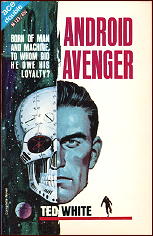
WHO? Allied Artists, 1975. Released on video as Roboman. Elliott Gould, Trevor Howard, Joseph Bova, James Noble. Based on the book by Algis Budrys. Director: Jack Gold.

   Part cold war thriller, part science fiction, Who? is an enjoyably complex movie that defies conventional expectations and aesthetic norms. Filmed in an almost semi-documentary style, the story not only unfolds in a nonlinear manner, but it also leaves the viewer guessing until the very end as to what the movie’s message or artistic statement, was really all about. Although the movie has its noticeable flaws, it is overall the result of a type of bold experimental film-making that’s sadly all too absent today.

   Elliott Gould portrays FBI Agent Sean Rogers. He’s quirky with a hairstyle a little too wild for a counterespionage agent, but an impassioned national servant nonetheless, a true skeptic always doubting and asking questions. He faces what appears to be the challenge of his career in the face of Lucas Martino (Joseph Bova), an American scientist recently released from captivity in East Berlin. The problem facing Rogers is that he’s not sure Martino is who he claims to be. The reason why, as viewers will soon learn, is that Martino has apparently been in a horrific car accident. Eastern bloc scientists reconstructed as a robotic man, one with a silver metal skull and mechanical body parts.

   But just who is this robotic man? Is he really Martino or is he a Soviet spy? Rogers simply can’t accept that this silver coated remnant of a man is truly Martino. He’s sure that his Soviet nemesis, Colonel Azarin (Trevor Howard) has somehow managed to either brainwash Martino into being a Soviet agent or that the man under the mask isn’t Martino at all. Complicating matters for Rogers is the fact that Martino seems to be who he says he is. He’s got Martino’s memories and personality traits.

   In order to build up to the big reveal as to the actual identity of the man released from Soviet captivity, the story unfolds on two parallel tracks, shifting the viewer’s perspective in terms of both time and space. The present dynamic between Rogers and Martino is contrasted with the past dynamic between Azarin and Martino when the scientist was captive in East Berlin.

   As it turns out, there’s not a whole world of difference between Rogers and Azarin. Both are committed patriots who care far more of what Martino could do for them than about Martino himself. Ultimately, however, it is Martino — or whoever it is under the mask — that will decide what his role in this world is going to be. In that sense, the film is very much part of the humanistic science fiction tradition, one that utilizes the tropes of speculative fiction in order to say something about what it means to be an individual.

« Previous PageNext Page »