Tue 20 Apr 2010
A British TV Mini-Series Review: THE NIGHTMARE MAN (1981).
Posted by Steve under Reviews , Science Fiction & Fantasy , TV mysteries[11] Comments
THE NIGHTMARE MAN. BBC-TV, UK, four-part mini-series, 01 May to 22 May 1981. James Warwick, Celia Imrie, Maurice Roëves, Tom Watson, Jonathan Newth, James Cosmo. Screenplay: Robert Holmes, based on the novel Child of the Vodyanoi by David Wiltshire. Director: Douglas Camfield.
That both the screenwriter and the director were involved with the BBC’s Dr. Who, both before and after, suggests why this moderately well-plotted SF-thriller comes off so well.
All four parts take place on a unnamed Hebrides island, up around Scotland way. About 35 square miles in size, the island has a police force of four men, headed by Inspector Inskip (Maurice Roëves), and a coast guard station with three more.
Is that enough to protect the island’s inhabitants from a crazed killer whose victims have been mauled to death by a creature that seems to be half animal and half human? Under ordinary circumstances, yes, but the island is socked in by fog with no access to the mainland. Until the weather clears, the people on the island are strictly on their own.
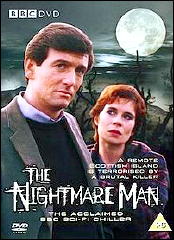
Pictured on the DVD cover are the two principal characters in this four-act play. James Warwick as Michael Gaffikin, the island’s dentist, an outsider who honorable intentions are questioned by the closely-knit townspeople in regard to the incipient love affair between him and the island’s druggist, Fiona Patterson, played the lovely Celia Imrie.
Only once do we see the latter in anything resembling glamorous, however, during a dinner date with Gaffikin, in which she wears a daring low-cut dress. Otherwise she is as bundled up against the fog as the rest of the guys. Of course it is she who has previously mapped out the island, so it is also she who is their guide up and down and across some fairly rugged terrain (actually filmed in Cornwall), trying to reach campers in danger and to track the increasingly murderous intruder — who just may be an alien newly arrived from space.
As usual in stories like these, the truth, while equally fantastic is also rather prosaic, making the fourth of the four episodes the weakest. It takes a lot of sedentary (standing around) exposition to make the details of the island’s attacker understood.
But before then, by which I mean the previous three episodes, this is a fine example of horror fiction, slightly old-fashioned now and only moderately gory, one supposes, due to its being made for TV — shown only once, by the way, until recently released by the BBC on Regions 2 and 4 DVD.
I watched all four episodes (two hours) in one evening. I couldn’t stop myself.