Science Fiction & Fantasy


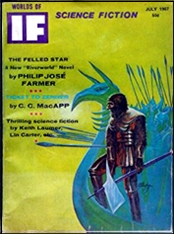
IF SCIENCE FICTION, July 1967. Editor: Frederik Pohl. Cover art by Jack Gaughan. Full text and illustrations available at archive.org. Overall rating: ***½

PHILIP JOSE FARMER – The Felled Star. Serial, part 1 of 2. See review later after both parts are available. [The entire two-part serial is a section of Farmer’s novel The Fabulous Riverboat.]

E. A. WALTON “Pelandra’s Husbands. First story. Love proves stronger than possible immortality. (1)

ANDREW J. OFFUTT “Population Implosion.” Novelette. The plague hits only old people, in direct correspondence to the birth rate. Excellent idea suffers [is marred] only by jumps in the story. (5)

C. C. MacAPP “A Ticket to Zenner.” Novelette. A thief leaves behind a ticket, in a SF intrigue story, reminiscent of Eric Ambler, but without the convincing background. (3)

ALAN DIRKSON “Adam’s Eve.” Novelette. A world without humans has only waiting robots, but two find how to obtain services for themselves. (3) [His only published SF story.]

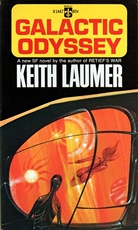
KEITH LAUMER – Spaceman! Serial, part 3 of 3. See review coming up soon. [Book publication as Galactic Odyssey.]

— July 1968.

OTHER WORLDS SCIENCE STORIES. June-July 1951. Editor: Raymond A. Palmer. Cover art: H. W. McCauley. Overall rating: *

RUSSELL BRANCH “Time Flaw.” Novelette. The love betwen Captain Hunter of the S. S. Stella and one of his passengers is interrupted by disaster and application of Einstein’s theories. Poor writing keeps plot from any depths it might have been capable of. (1)

POUL ANDERSON “The Missionaries.” Alien worship of machines is carried to its logical conclusion, cannibalism. (2)

R. BRETNOR “The Fledermaus Report.” Martin Fledermaus, chosen as first human to fly to the moon, discovers that the beauty of one’s wife is relative. Tripe. (0)

ROBERT BLOCH “The Tin You Love to Touch.” Low-grade comedy about the female robot maid that comes between Roscoe Droop and his domineering wife, This is really low. (0)

RAY PALMER “Mr. Yellow Jacket.” Galactic census-takers discover that some humans have the power yo make thoughts real, Included (page 81) is one of the silliest theories of meteors ever. (0)

S. J. BYRNE “Beyond the Darkness.” Novella. Intrigue aboard one of a fleet of FTL ships seeking new worlds for humanity. The passengers are subjected to a memory-erasing device so that the rebellious navigators can return to contest for already inhabited worlds. Nad, our hero, finds the ex-captain still alive; the plan fails, escape, discovery, loss of heroine, villain returns from oblivion, cowardly brother redeems himself. People don’t really talk and act this way, do they? *½

— July 1968.

MURRAY LEINSTER “The Fourth Dimensional Demonstrator.” First published in Astounding Stories, December 1935. Reprinted in The Other Worlds, edited by Phil Stong (Funk, hardcover, 1941), and The Future Makers, edited by Peter Haining (Belmont, paperback, US edition, 1971). First collected in Sidewise in Time (Shasta, hardcover, 1950), then The Best of Murray Leinster (Ballantine/Del Rey, paperback, 1978), and A Logic Named Joe (Baen, paperback, 2005).

   This one begins with a fellow named Pate Davidson complaining to his newly inherited man servant Thomas that his uncle had left him nothing of value after his death. He is especially upset because his fiancée Daisy (currently the star attraction of the Green Paradise floor show) expects (had been allowed to expect) … well, something more than that.

   “Not so,” says Thomas, and shows Pete one of inventions his late uncle was working on. It’s in the shape of a cylinder standing upright with an open side and all kinds of gadgetry lining the inner surface. On the floor, in the center of the opening is a small plate, and as Peter soon discovers, if something is on the plate when the machinery is turned on, the demonstrator (that’s its name) brings that same object back to the present from a few seconds earlier.

   Never mind the physics behind this. Pete has a mind that quickly begins to work overtime. Place a dime on the plate, turn the switch on, then there’s two. Turn the handle again, than there’s four; then eight, then sixteen. (I hope I’m explaining this correctly.)

   This is only petty cash, though, right? Dimes, pah! Why not dollar bills? You probably know as well I do why not, and as soon as Peter realizes why not too, the cops are knocking on the door. And so is Daisy, and somehow they all end up stepping on the plate, and …

   Most SF stories from 1935 are staid and serious. Not this one. This one is a lot of fun.

   I might have done without the cigarette-eating kangaroo(s), though.

ROBERT SILVERBERG – Thorns. Ballantine U669, paperback original, 1st printing, August 1967; cover by Robert Foster. Walker, hardcover, 1969. Bantam, paperback, 1983. Nominated in 1968 for both the Hugo and Nebula Awards for Best Novel of 1967.

   A manipulated love affair, between Minner Burris, starman disfigured by aliens, and Lona Kelvin, virgin but mother of one hundred children, Mutual sympathy was the original reason for their attraction. But their obvious differences were bound to lead to the emotional conflict that Duncan Chalk, dealer in public entertainment, could feed on.

   Tries a bit too hard to be literary, and what story there is suffers. Message abounds. People with power tend to make themselves into gods; aliens remake a human body without explanation, doctors take the product of a young girl’s ovaries without regard to her feelings, and of course Chalk, who lives on stolen emotions.

   And thorns? “They stick you.” (page 83). “To be alive … to feel pain – how important that is.” (page 222).

Rating: ****

— July 1968.

PIERS ANTHONY – Chthon. Ballantine U6107; paperback original; 1st printing, 1967. Cover artist unknown. Berkley, paperback, 1975. Ace, paperback, 1987. Nominated in 1968 for both the Hugo and Nebula Awards for Best Novel of 1967.

   Because of his love for the creature known as a minionette, Aton Five is sentenced to imprisonment in the underground caverns of Chthon, from which no escape is known. But the image of his nymph drives Aton to find a way out, no matter the consequences to his fellow inmates.

   He must find the key to his own behavior, buried in his memory, before he can fight his evil birthright and love normally. For the minionette he loves is his mother, for whom inversion of love is natural, but who sacrifices herself to swing the balance in his inner conflict. Chthon is more than a place, It is an intelligence seeking to use Aton to destroy man, but all it has seen before [has been] man’s unsanity.

   A story of love, and of cultural conflict, on many levels. The very structure of the novel demonstrates this, as it is told in flashbacks and flashforward parallel to — and symbolizing — Aton’s adventures in Chthon’s caverns. A highly effective way of presentation, as parts which are obscure [at first reading] will be clarified by continuing on, but the significance [of which] would be decreased if told in the usual chronological fashion.

   Hence the story is more than a tale of love; it is also one which requires time and effort [to reach the depth it offers].

Rating: *****

— June-July 1968.

CHESTER ANDERSON – The Butterfly Kid. Book #1 of the Greenwich Village trilogy (see below). Pyramid X-1730; 1st printing, December 1967 (cover by Gray Morrow). Gregg Press, hardcover, 1977. Pocket, paperback, 1980. Dover, softcover, 2019. Nominated for the Hugo award in 1968 as Best Novel of 1967.

   The Reality Pill is introduced to Greenwich Village by six-foot tall lobster aliens with crummy Lazlo Scott as their agent. Chester and his roommate Michael the Theodore Bear are first directly confronted withe potentialities of the pills when they meet Sean sitting on a park bench calmly making hallucinogenic butterflies come to life.

   Later they accidentally take the pills themselves, and the resulting riot and destruction convinces them that the Communists or aliens or whatever behind the plot must be stopped. They recruit a group of friendly hippies and set out for the reservoir to stop citywide pollution

   The appeal is that of the quietly wild hippy outlook on life as they go about saving the world. “Have you ever tried to talk a bunch of hippies into helping you save the world? Forget it, Next time I save the world, by starky, I’m going to do it solo. Faster that way, less work.”

   Lots of laughs, which is remarkable in science fiction., but the ending is obvious. It is not until page 166 that the method of defeating the aliens occurs to Chester, but then he has other things on his mind.

Rating: ****

— June 1968.


      The Greenwich Village trilogy –

1 The Butterfly Kid (1967) by Chester Anderson
2 The Unicorn Girl (1969) by Michael Kurland
3 The Probability Pad (1970) by T. A. Waters

HARLAN ELLISON “Pretty Maggie Moneyeyes.” Novelette. First appeared in Knight, May 1967. First collected in I Have No Mouth and I Must Scream (Pyramid, paperback original; 1st printing, April 1967; cover by Diane Dillon & Leo Dillon). Reprinted in Best SF: 1967, edited by Brian W. Aldiss & Harry Harrison (Berkley, paperback original, 1968), among others. Nominated in 1968 for both the Hugo and Nebula awards for 1967.

   The soul of a blue-eyed, dyed blonde scrabbling her way from poverty, is trapped in a Vegas slot machine, and Kostner is betrayed into playing one time too many. An accurate expression of life as typified by Las Vegas. (5)

— June 1968.

FRITZ LEIBER “Gonna Roll Those Bones.” Novelette. First appeared in Dangerous Visions, edited by Harlan Ellison (Doubleday, hardcover, 1967; cover art by Diane Dillon and Leo Dillon). Reprinted in Nebula Award Stories Three, edited by Roger Zelazny (Doubleday, hardcover, 1968). Collected in The Best of Fritz Leiber (SF Book Club, hardcover; Ballantine, paperback, 1974). Won both the Hugo Award and Nebula Award in 1968 for Best Novelette for 1967.

   A poor iron miner with the “power” takes on the Devil, in skeletal form,at a gambling establishment’s dice table. Overwritten prose, not as effective for me as it should have been. (3)

— June 1968.


PHILIP K. DICK “Faith of Our Fathers.” Novelette. First appeared in Dangerous Visions, edited by Harlan Ellison (Doubleday, hardcover, 1967; cover art by Diane Dillon and Leo Dillon). Collected in The Best of Philip K. Dick (Del Rey, paperback, 1977). Nominated for the Hugo Award in 1968 for Best Novelette of 1967.

   A civil servant in Hanoi, which incidentally seems to have won the war, is given an anti-hallucinogen so that he can see the reality behind the television image of the Absolute Benefactor. But is it reality when people see twelve versions? Or is it God? Barely succeeds as a story. (3)

— June 1968.


JANE LINDSKOLD “The Drifter.” First appeared in A Girl’s Guide to Guns and Monsters, edited by Martin H. Greenberg & Kerrie Hughes (Daw, paperback original, 2010). Collected in Curiosities (CreateSoace, trade paperback, 2015).

   To begin with, here’s the first paragraph:

   Prudence Bledsoe rode into town on a big buckskin stallion. She was on the trail of trouble, and it didn’t take much to see that she’d found it.


   Jane Lindskold is an author known for her stories of mythological fantasy – werewolves, shape-shifters, satyrs, merfolk, and unicorns, according to her Wikipedia page – but she wisely holds off on telling the reader was exactly the “trouble” is that she is on the trail of, but you can take it from me that that Wikipedia description is right on the mark.

   I will tell you this. Prudence Bledsoe is the kind of woman that when she rides into town, people notice. Not many women ride into town, you see, a drifter, you might say, on horseback, not one of the usual arrivals on the train or by stagecoach. That first sentence also lets us know that she is a woman on a mission, and I think the townsfolk know that, too.

   Jane Lindskold is a very good writer. Besides setting up the story as she does in the very first sentence, she also conveys the dustiness and the on-the-edge of nowhere feeling of the town and the townspeople. Cattle and sheep have been gruesomely killed, she learns, and young children have gone missing. And at length, Prudence Bledsoe’s own personal secret is revealed.

   This is not a classic unforgettable story, but any means, but it’s an effective one, and it’s a fine choice for the leading one in a collection entitled A Girl’s Guide to Guns and Monsters.

« Previous PageNext Page »