
MICHAEL GILBERT – The Killing of Katie Steelstock. Harper & Row, US, hardcover, 1980. Penguin, US, paperback, 1981. Published previously in the UK as Death of a Favourite Girl (Hodder & Stoughton, hardcover, 1980).
As a kind of bonus, we get two stories in one. Katie’s death is the obvious reason for the rather dry murder investigation that follows. What we also get, and what fans of legal manipulations and maneuverings like myself will find of much greater interest, is an inside look at how the defense for the accused goes about making plans for the ensuing trial.
Part of their strategy has little to do with the case itself, consisting instead of weighing and working on the personal stranegths and idiosyncrasies of the man from Scotland Yard placed in charge of the investigation.
Katie herself was a TV star. After her death, and then only, we discover the two sides of her. For the most part, the village folk of Hannington saw her as their fair-headed girl. In London they knew her as an ambitious conniver with little she was unwilling to do to maintain her drive to the top.
That this is a mystery novel with some emphasis on character should be abundantly clear. Even so, the ending is one that may come as something of a surprise. A goodly number of loose ends are left undone, and unmitigated coincidence looms large in the overall scheme of things.
–Reprinted in slightly revised form from The MYSTERY FANcier, Vol. 4, No. 5, Sept-Oct 1980. Previously published in the Hartford Courant.
FIRST YOU READ, THEN YOU WRITE
by Francis M. Nevins
This month I deal with the second and third of Lawrence Block’s novels about unlicensed PI Matt Scudder, but where I should begin presents a quandary because the print and Web sources I’ve consulted disagree as to which book is which. Apparently the one Block wrote right after THE SINS OF THE FATHERS was published a few months after the third book in the series. Decisions, decisions. I choose to cover them in the order in which they were written.

The source of the title TIME TO MURDER AND CREATE (Dell #8701, paperback original, 1977) is a line from T.S. Eliot’s “The Love Song of J. Alfred Prufrock,†which makes it the only one of the first three Scudders with a title not derived from a religious text. But it’s also the only one of the trio which is introduced by a motto, and this comes from a religious source.
The version Block uses is too long to quote here, but it comes from the Talmud, specifically from the tractate SANHEDRIN, 4:5. A more succinct version of the first half of the passage — “Who kills one man kills the whole world†— -is found in a diary Cornell Woolrich left behind after his death. The second half of the quotation is also Talmudic — “Who saves one life saves the whole world†or, as it’s given in SCHINDLER’S LIST, “He who saves the life of one man saves the entire world†— but no one in Block’s novel brings up that line which, as we’ll see, is supremely relevant.
If we know that this third Scudder novel in order of publication was the second in order of writing, its connections with THE SINS OF THE FATHERS stand out. Scudder of course still tithes, and visits churches when he needs to think, and keeps a Lives of the Saints book in his hotel room, although this time he doesn’t tell us any stories from it. Looking forward to the novel that in fact was published before this one, we find briefly mentioned a special prosecutor looking into police corruption, a subject that would be (was?) central in the third Scudder, which appeared on newsstands before the second.

As usual in the novels from the time where Block’s protagonist is a practicing alcoholic, we begin in a bar. Scudder is approached by a small-time information peddler known as the Spinner who has come into big money thanks to blackmailing several wealthy people with dark pasts but has also become afraid that one of his marks is out to kill him.
For a $320 fee (the price of the elegant suit the blackmailer is wearing) Scudder agrees to hold the envelope containing Spinner’s evidence against his victims and, if his client is indeed rubbed out, to open the envelope and identify and punish the murderer without exposing the victims who had meekly submitted to extortion. About two months later the Spinner is found dead in the East River with his skull crushed.
Scudder opens the envelope, finds out who his suspects are and what they did, and comes into each of their lives, claiming to be carrying on Spinner’s blackmail, hoping that one of them will try to kill him as Spinner was killed. Unlike THE SINS OF THE FATHERS, the situation this time is filled with suspense and menace and violence that are integral to the plot.
In due course Scudder identifies the person responsible for Spinner’s murder but again exacts his own form of punishment rather than turning the person over to the law. Perhaps he would have accomplished nothing if he had gone to the police since, as Block specifically mentions, the morally responsible party had done no more than what Henry II did when, at the height of his feud with Thomas à Becket, he is said to have cried out: “Will no one rid me of this meddlesome priest?†(The line doesn’t come from T.S. Eliot’s 1932 play MURDER IN THE CATHEDRAL, in which Henry doesn’t even appear as a character, but it is found in Jean Anouilh’s 1959 play BECKET which was the basis of the 1964 movie of the same name starring Richard Burton and Peter O’Toole.)

What compounds the irony is that Scudder himself earlier in the novel has done something similar, inadvertently driving an innocent suspect to suicide by demanding more blackmail money. “His finger had pulled the trigger, but I’d put the gun in his hand by playing my game a little too well.â€
Scudder also killed a hit man — in self-defense, in a vividly described mano a mano — but in the final chapter, admittedly employing guesswork, he shows another of the innocent suspects that his killing the man probably saved two other lives. Now we see the relevance of the part of the Talmudic passage Block did not quote. Could he have thought that bringing it up would have made the book too morally ambivalent? “Who takes a life saves two whole worlds†doesn’t sound terribly Talmudic.
The part of the Talmud passage Block does quote carries forward the theme in THE SINS OF THE FATHERS that the worst deed of all is murder.
But there is a difference between murder and other crimes, and the world is a worse place for the murderers it allows to walk unpunished.
“You think human life is sacred, then?â€
“I don’t know if I believe that anything is sacred….I don’t know if human life is sacred. I just don’t like murder….â€

IN THE MIDST OF DEATH (Dell #4037, paperback, 1976) has no introductory motto but resembles THE SINS OF THE FATHERS in that the source of its title is religious, specifically a line from the burial service of the Book of Common Prayer: “In the midst of life we are in death.â€
In the body of this novel, however. there are very few religious allusions. Scudder becomes involved when a plainclothes cop unaccountably decides to turn Serpico and reveal everything he knows about corruption in the NYPD to the special prosecutor who was mentioned casually in TIME TO MURDER AND CREATE. Then a high-priced hooker comes forward and publicly accuses the cop of having extorted $100 a week from her for a long time. Soon after Scudder enters the case on the cop’s side, the hooker is found murdered in the whistleblower’s secret apartment in Greenwich Village, with the police determined to pin the crime on the traitor who was exposing their dirty secrets.
This time there’s no onstage violence, and Scudder stays pretty much within the law except for a brief scene where, after having sex with his client’s wife, he breaks into the secret apartment and spends the night sleeping in the cop’s pajamas.
As in THE SINS OF THE FATHERS, Scudder is asked about his drinking, and his answer this time is more ambivalent.
“Are you an alcoholic?â€
“Well, what is an alcoholic? I suppose I drink enough to qualify. It doesn’t keep me from functioning. Yet. I suppose it will eventually.â€

But in this novel we get to see Scudder too drunk to function, and at the end he at least is thinking about cutting back on the booze. But his view of murder remains, shall we say, Talmudic.
“[M]urder is different. Taking a human life, that’s something completely different….Nobody should ever be allowed to get away with that.â€
And his view of human nature is as bleak as ever.
“Everybody’s weird….Sometimes it’s a sexual thing, sometimes it’s a different kind of weirdness, but one way or another everybody’s nuts. You, me, the whole world.â€
That’s not Scudder speaking but it surely represents his thinking.
TIME TO MURDER AND CREATE, my favorite among the first three Scudders, was nominated for an Edgar award as best paperback mystery of the year. In light of that fact plus Block’s towering reputation today, it’s hard to believe that the three did not sell well. But they didn’t, and Scudder lay dormant until early in the presidency of Ronald Reagan, when Block resurrected him in two more novels, this time for a hardcover publisher (Arbor House), after which he again let his character lapse. The fourth and fifth Scudders will be covered next month.
If you’re like me, when you read James M. Cain’s classic novel The Postman Always Rings Twice the first time, or even if maybe you saw the movie before reading the book, and put it down or got up from watching, didn’t you kind of wonder, where the postman was? Did you miss something? I did.
Here, finally is the answer. (Follow the link.)
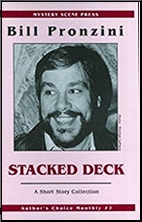
BILL PRONZINI & MICHAEL J. KURLAND “Vanishing Act.” Short story. Christopher Steele #2. First published in Alfred Hitchcock’s Mystery Magazine, January 1976. Collected in Stacked Deck (Pulphouse Publishing: Author’s Choice Monthly #2, paperback, November 1991). Reprinted in Tantalizing Locked Room Mysteries, edited by Isaac Asimov, Charles G. Waugh, & Martin Harry Greenberg (Walker & Co. hardcover, 1982).
Christopher Steele is a working magician who solved one earlier case “Quicker Than the Eye,” a novelette which appeared a few months earlier, also in AHMM, but back in the September 1975 issue. In his preface to Stacked Deck, Pronzini calls both stories “impossible crimes,” which is quite correct, a small genre of detective stories that easily include every true locked room mystery as an even smaller subset.
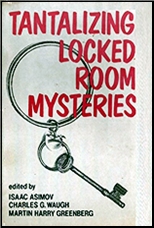
In “Vanishing Act,” a magician performing on stage before Steele is scheduled to appear is killed in full view of a large audience including a cadre of freshly minted police cadets. The assailant then dashes off stage into a corridor leading nowhere, but in spite of all efforts, no trace of him can be found.
The telling of an impossible crime mystery is very much like the creation of a magic trick. The fun in each case is in watching and reading them, but magicians have a huge advantage. They can keep their secrets. Detective story writers can’t. To their credit, Pronzini and Kurland make the solution as interesting as the rest of the story.
Christopher Steele was intended to continue as a series character, but as Pronzini also tells us, for some reason it never happened. As far as I’m concerned, that’s really too bad. This one was a joy to read.