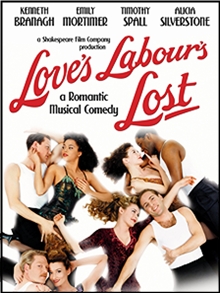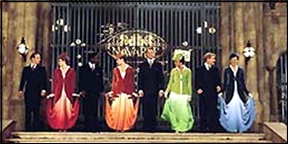
LOVE’S LABOURS LOST. Miramax, 2000. Alessandro Nivola, Alicia Silverstone, Natascha Elhone, Kenneth Branagh, Carmen Ejogo, Matthew Lillard, Adrian Lester, Emily Mortimer, Richard Briers, Geraldine McEwan, Stefania Rocca, Jimmy Yuill, Nathan Lane, Timothy Spall, Anthony O’Donnell, Daniel Hill, and Richard Clifford. Presented by Martin Scorsese and Stanley Donen. Screenplay and directed by Kenneth Branagh. Available for rent on Amazon and Apple TV.
And now I must face an internal struggle between propriety and ease; should I slight your smarts by adding that this is based on the play by William Shakespeare (sorta) which I’m sure everyone here knows? or say nothing and perhaps be taken to task for slighting Shakespeare himself?
My critical reputation could be at stake here, if I had any. What shall I do? Please send your comments and suggestions to Steve, as I can’t be bothered with them.
At any rate, this is the movie that stalled out Kenneth Branagh’s career and didn’t do Shakespeare any good, either. I’ve always thought of it as a thin slice of Sheer Genius: a tribute to old musicals, the Bard, clowns, and Casablanca.
What serves for a plot is set in or around the mid-1930s, in the Kingdom of Navarre, a largely fictitious pocket monarchy, where the King secludes himself and a few friends in a program of monastic study, just as Hitler is sweeping across Europe gobbling up nations and peoples like they was salt peanuts — a device cleverly tacked on by Branagh himself, conveyed in mock-newsreel footage (rather than mock-Shakesperean dialogue) to lend a sense of movement and urgency to a paper-thin story.
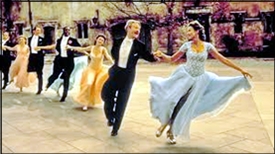
Because as you might have expected, Love comes pounding on the castle moat when four total babe princesses come a-callin’, ostensibly and sensibly to negotiate some sort of treaty with the King of France, but actually to sing & dance.
I’ll admit it comes as a bit of a shock when the players suddenly shuck their Elizabethan prose for the lyrics of Gershwin, Berlin and Cole Porter, but I think Branagh carried it off wonderfully. The numbers are well-chosen, boldly imagined, and presented with enthusiasm that almost-but-not-quite makes up for the amateurish status of the performers.
In fact, Branagh covers rather well for the deficit of terpsichorean talent in his cast with deft camera trickery. Not the enervating step-cut-step editing of Chicago, where the camera does all the dancing, but cleverly coordinated set-up and follow-through moves of camera and dancer that combine to impart grace and harmony to actors who sing like Astaire and dance like Crosby.
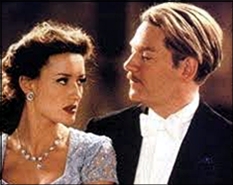
In case you’re not familiar with the story of Love’s Labours Lost, I won’t spoil it for you. Much. I’ll just say that a sudden reversal late in the game sends the whole thing spinning off in an unexpected direction. And Branagh swings the bat and hits a touchdown. Or scores a strike. Or whatever it is they call it in Polo.
I joke, but in fact, Branagh provides us with one of the most moving endings I’ve ever seen on film. Fast-moving, poignant, and suffused with Romance — or perhaps it’s Love. An incredible montage of images that carry the Bard’s tale to a surprising and hugely satisfying conclusion.
Which did no good at all. LLL was what is usually and charitably called a Box-Office Disaster, though possibly stronger terms are called for here. Statistically speaking, the movie-going public stayed away at a rate of 97% plus-or-minus 6% — which means that this film might have been shunned by movie-goers either dead or not born yet. Branagh had a three-picture deal going here, but the studio lawyers must have decided it’d be cheaper to be sued than make another movie like this.
Of course, I really really like Love’s Labours Lost, and once again I find myself waiting for Fashion to catch up with me.