December 2025
Monthly Archive
Thu 4 Dec 2025
A 1001 MIDNIGHTS Review
by Bill Pronzini
WALTER GIBSON – Norgil the Magician. Mysterious Press, hardcover, 1977.
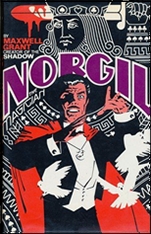
One of this century’s most prolific writers, Walter Gibson was the author of 282 pulp novels featuring the most famous of all superhero crime fighters, Lamont Cranston, a.k.a. the Shadow. All 282 of those book-length works were produced between 1931 and 1949 and first appeared in The Shadow Magazine under such titles as “The Shadow Laughs,” “The Mobsmen on the Spot,” “The Creeping Death,” “The Voodoo Master,” and “The Shadow, The Hawk, and The Skull.”
Some forty of these have been reprinted over the years, most in paperback; a few of the shorter ones have appeared in pairs in such Doubleday hardcover titles as The Shadow: The Mask of Mephisto and Murder by Magic (1975) and in the recent Mysterious Press book The Shadow and the Golden Master (1984).
Gibson also created another series character for the pulps — Norgil the Magician, whose adventures appeared in the magazine Crime Busters in the late 1930s and early 1940s. Norgil is a stage magician: “Like Blackstone or Calvert, both headliners at the time,” Gibson writes in his introduction to Norgil the Magician, the first of two Norgil collections, “he could switch from fifty-minute shows at movie houses to a full evening extravaganza, with an enlarged company.”

Norgil is an anagram of the conjurer’s real name. Loring; he also can (and does) change it into Ling Ro, a name he uses “when called upon to perform wizardry in Chinese costume.”
Each of the Norgil stories features a well-known stage illusion as its central plot device — a version of Houdini’s Hindu Needle Trick in “Norgil — Magician”; burial alive in a sealed casket in “The Glass Box”; the rising-card illusion in “Battle of Magic.”
These eight stories are pulpy, to be sure (the prose almost embarrassingly bad in places), but that shouldn’t spoil most readers· enjoyment of them. The magic in each is authentic and presented with the requisite amount mystery — Gibson was himself a practicing magician — and Norgil’ s melodramatic methods and illusions make for good fun.
Anyone who has read and enjoyed any of the Shadow novels will certainly want to read this collection, as well its successor, Norgil: More Tales of Prestidigitation ( 1978).
———
Reprinted with permission from 1001 Midnights, edited by Bill Pronzini & Marcia Muller and published by The Battered Silicon Dispatch Box, 2007. Copyright © 1986, 2007 by the Pronzini-Muller Family Trust.
Wed 3 Dec 2025
REVIEWED BY MIKE TOONEY:
(Give Me That) OLD-TIME DETECTION. Autumn 2025. Issue #70. Editor: Arthur Vidro. Old-Time Detection Special Interest Group of American Mensa, Ltd. 34 pages (including covers).
AS usual, Old-Time Detection (OTD) succeeds in keeping classic detective fiction alive and interesting. In this issue diversity is the theme, with coverage of detecfic authors from Conan Doyle to some of the latest practitioners of the genre being highlighted.
First up is an EQMM interview with Robert Twohy, whose approach to writing is basically character-centric: “I’ve tried to write something to approach it [‘Red-Headed League’], and haven’t yet — but the fun is in the quest.” (See the Fiction selection below for more by this author.)
J. Randolph Cox talks about Arthur Train, now almost forgotten but once very popular in the first decades of the 20th century.
Next we have a reprint of Martin Edwards’s introduction to Peter Shaffer’s THE WOMAN IN THE WARDROBE, which Robert Adey later characterized as “the best post-war locked-room mystery . . . [with] a brilliant new solution.”
Everybody has to start somewhere. Francis M. Nevins exhibits his usual high-quality scholarship in “The Pulp Origins of John D. MacDonald,” highlighting that soon-to-be-popular author’s early days: “MacDonald was the last great American mystery writer to hone his storytelling skills in the action-detective pulps as Hammett and Chandler and Gardner and Woolrich had done before him.”
Jon L. Breen’s reviews of books (ten of them from the Walker Reprints Series) in “40-Plus Years Ago” take us from familiar mystery fiction old reliables like Pierre Chambrun, to obscure eccentrics like Inspector James and Sergeant Honeybody.
In Part II of Michael Dirda’s “Mystery Novels So Clever You’ll Read Them Twice,” he points us to modern-day examples of stories that manage to surprise the reader. After all, he says, “A mystery that doesn’t surprise is hardly a mystery at all.”
Arthur’s Fiction selection is Robert Twohy’s ingenious “A Masterpiece of Crime,” in which a police detective and a detecfic enthusiast solve a murder, with a certain very well-known detective making a cameo appearance.
In world-class Agatha Christie expert Dr. John Curran’s latest “Christie Corner,” he informs us of the activities pertaining to the latest International Agatha Christie Festival, including a nostalgic look back at the Joan Hickson-Miss Marple TV series from forty years ago and a look forward to an upcoming print adaptation of Miss Marple; another upcoming TV “re-imagining” of Mrs. Christie’s popular married sleuthing duo, Tommy and Tuppence (“Sadly, Christie fans are all too aware of what ‘re-imagining’ means”); and yet another upcoming event next year, characterized as “the biggest exhibition held in the last twenty years to celebrate Christie’s writing,” timed to coincide with the centenary of THE MURDER OF ROGER ACKROYD.
In “Collecting,” Arthur Vidro recounts the varied experiences of mystery and detecfic book collectors, one of whom undoubtedly speaks for a multitude: “It’s hard to say goodbye to favorites.”
Next, in “Sherlock Holmes in Comics” Arthur deals on a personal level with the sporadic career of the Sage of Baker Street in that worthy’s four-color mass market exposures.
Fifty years ago there was a mini-boom in Sherlock Holmes-related fiction and non-fiction paperbacks, and Charles Shibuk summarizes it in “The Sherlockian Revolution.”
Next Arthur Vidro offers a mini-review of his first John Rhode novel and finds it most satisfactory.
The readers have their say, especially about how the latest issue of OTD did not neglect the contributors to detective fiction from Fair Albion.
And finally, Arthur confronts us with a mystery puzzle that anyone who’s been watching prime time crime TV programs for the last fifty years should find a cinch. (Yeah, right.)
Be honest now. Considering everything you’ve just read, don’t you think that the Autumn ’25 OTD might be worth a look?
Subscription information:
– Published three times a year: Spring, summer, and autumn. – Sample copy: $6.00 in U.S.; $10.00 anywhere else. – One-year U.S, subscription rate increase starting with the next issue: $20.00. – One-year overseas: $45.00. – Payment: Checks payable to Arthur Vidro, or cash from any nation, or U.S. postage stamps or PayPal. Mailing address:
Arthur Vidro, editor
Old-Time Detection
2 Ellery Street
Claremont, New Hampshire 03743
Web address: vidro@myfairpoint.net
Tue 2 Dec 2025
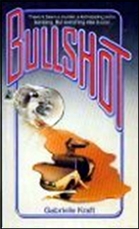
GABRIELLE KRAFT – Bullshot. Jerry Zalman #1. Pocket, paperback original; 1st printing, 1987.
Jerry Zalman is an updated version of Perry Mason, you might say, a Beverly Hills lawyer with a zest for the good life (California style). He even finds his own bodies when business is slow, but he hot-tubs the girls he meets on the job, which Perry never did.
Anybody who goes to bed with a blue-velvet sleep mask is not likely to becomes one of my favorite detective heroes. All that kept me reading was that this case involves a monumental collection of rock & roll memorabilia. [Otherwise], insipid. As bad as a made-for-TV movie.
— Reprinted from Mystery.File.4, March 1988.
The Jerry Zalman series —
1. Bullshot (1987)
2. Screwdriver (1988)
3. Let’s Rob Roy (1989)
4. Bloody Mary (1990)
Mon 1 Dec 2025
THRILLING DETECTIVE. Fall 1952. Overall rating: *½
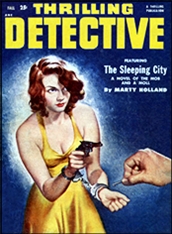
MARTY HOLLAND “The Sleeping City.” Novel. Plainsclothesman Wade Reed is assigned as undercover job posing as a Chicago gunman in town to help out with a bank robbery, In spite of a fiancee waiting for him, he falls for a monster’s moll and nearly turns criminal. Capture means the girl’s death and Reed’s resignation from the force. The literary symbolism which is included is forced, generally trying too hard (2)
JOE BRENNAN “Dive and Die,” A stunt diver, recently returned from Korea, investigates the death of his former partner. (1)
JEAN LESLIE “Dead Man’s Shoes.” The sad history of a pair of shoes is traced. Almost Woolrichian in tone. (2)
WILLIAM G. BOGART “Death Lies Deep.” Novelet. Almost standard private eye story. Steve Morgan is hired by an old flame to find her husband, whom she has already killed. Guess who would be the fall guy? (1)
AL STORM “Alive by Mistake.” A writer becomes the center of a hurricane of death about him, as he hunts down a narcotics peddler. Bad writing, but has excitement. (1)
PHILIP KETCHUM “Backfire.” A kid is framed fo robbery and murder by his best friend. Mostly miserable. (1)
HARVEY WEINSTEIN “Two-for-One Dame.” Confused and confusing story of a treacherous blonde. (0)
WILLIAM L. JACKSON “Run of Luck.” Escaped killer fouls his own getaway, (2)
— March 1969.
« Previous Page