REVIEWED BY DAVID VINEYARD:         


RIDE THE MAN DOWN. Republic Pictures, 1952. Brian Donlevy, Rod Cameron, Ella Raines, Forrest Tucker, Barbara Britton, Chill Wills, J. Carroll Naish, James Bell, Taylor Holmes, Jim Davis, Paul Fix, Roy Barcroft, Jack La Rue, Douglas Kennedy, Chris-pin Martin Screenplay by Mary McCall, Jr. based on the book by Luke Short (Doubleday Double D Western, hardcover, 1942; Bantam Books # 82, paperback, February 1947; first published as a Saturday Evening Post serial, April 4 through May 16 1942). Directed by Joseph Kane.

   Maybe it is because it is based on a novel by Luke Short (Frederick Glidden), but this fast moving tale of a range war has enough characters and plot for half a dozen films, and yet somehow never seems crowded or off balance, and that certainly has to do with an all star B cast and the sure hand of veteran Republic oater director Joe Kane at the helm.

   Shot in TruColor, this one boasts a literate script, tough almost hard-boiled characters (not surprising from Short who was one of the leading exponents of the hard-boiled Western and whose books inspired two of the better noir Western films — Blood On the Moon and Stations West), and solid motivation all around, and in this one it feels less like the old West than Capone era Chicago with horses and cowboy hats, as everyone in the countryside is out to steal from or kill the handful of good-guys. Odds against the hero of one of these have seldom been higher.

   This is one of several Rod Cameron and Forrest Tucker worked on at the studio with Cameron usually the hero and Tucker the heavy, though here he is only one of a formidable group surrounding the embattled Cameron and his handful of allies.

   The time is the early thaw of 1892 when Phil Evarts, owner of the Hatchet Ranch has just died, frozen to death in the harsh winter. Evarts was an unpopular man who carved his land out by sweat and bullets and few mourn his passing, particularly not Bide Marriner (Brian Donlevy), a fellow rancher, and neighbors Paul Fix, Roy Barcroft, Jack La Rue, and Douglas Kennedy, who all want the Hatchet grazing land, and Evart’s son-in-law-to-be Sam Danfelser (Forrest Tucker) who has other reasons to want Hatchet broken up. Even Sheriff Joe Kneen (J. Carroll Naish) is no mourner, and likely to be little help.

   Add to that Red Courteen (Jim Davis) as a renegade who sells whiskey and guns to the Indians and wants his piece of the pie, and there is a who’s who of Western bad guys gathered to destroy the Evarts legacy. Even the proprietor of the local general store Mr. Priest (Taylor Holmes) father of Lottie, the girl Hatchet foreman Will Bartlett (Rod Cameron) wants to marry (Barbara Britton), wants to get in on the deal. The Hatchet Ranch is surrounded by venal and violent vultures who want to feed on the body before its dead the characters almost as venal as a revisionist Western from a much later era.

   In fact, the only people who seem to care about Evarts and Hatchet are his weak brother John (James Bell), Phil’s strong daughter Celia (Ella Raines), and foreman Will Bartlett, and it quickly looks as if it will be the latter two against the whole territory as they fight to keep the Hatchet together against impossible odds and enemies inside and out.

   Sub-plots abound. Sam is jealous of Celia Evarts devotion to Bartlett; Lottie is jealous of Bartlett’s devotion to Celia; Sheriff Kneen is in Marriner’s pocket but the fit is increasingly binding; Ray Kavanaugh (Paul Fix) murders John Evarts and is witnessed by weak rancher Joe Kennedy (Jack La Rue) who flees the country pursued by Bartlett; Marriner wants Kavanaugh arrested and tried tying up the Hatchet in court and with it certain the locals who hate the Hatchet Ranch will set him free; Red Courteen (Jim Davis) hates the part Indian Bartlett who humiliated him; Lottie’s father Mr. Priest has bought interest in cattle owned by Courteen and now being held by the Hatchet because they were grazing on Hatchet land and he’s losing money; and, the only help Bartlett can hire is a couple of drifters top hand Ike Adams (Chill Wills) doesn’t trust.

   Meanwhile Sam tries to undermine Bartlett and force Celia to give into Marriner because he is unmanned by her wealth and power and resents her strength.

   That’s quite a bit of plot to work into just over ninety minutes and still get in a satisfying amount of action and gunplay, and granted Donlevy doesn’t really get as much film time as he might need to really make an impression as the bad guy, what with Tucker and Davis taking up so much of the bad air..

   And tough action there is, more brutal than you might expect from a Western of this era, but also room for the redemption of Sheriff Kneen and a shootout between him and Marriner; a couple of well done set pieces — a nice one of Bartlett trapped in the town run by Courteen having to shoot his way out against a small army of enemies — and enough bits here and there for the large cast to keep all the actors happy.

   It’s no lost classic, and frankly the print I saw was at best only serviceable, but it is a good example of what Republic could do with the Western, given a bit more to chew on than the usual oater script. The fact that the crowded plot never seems constrained by the running time and no one in the cast gets slighted shows capable hands at work. Just getting all those plot elements from the Short story into the screenplay without losing track of any of the characters or their arcs was no small achievement.

   It’s not exactly true that Republic never made a bad Western as they used to assert when I was a kid growing up, but they didn’t make many of them, and they hit the bulls-eye for more often than you might expect. This is a surprisingly meaty small A film with a Western fan’s dream cast, and more going for it than any fan has the right to expect. You got a lot for your dime or quarter in those days and no Western fan, kid or adult, was likely disappointed in this one.

   A friend of mine named Jim recently asked me the following question:

   â€œI’m interested in police procedurals taking place in New York City in the 1980s. Are there any you can tell me about?”

   I don’t read a lot of police procedurals and the only immediate suggestion I could come up with was Ed McBain’s series of 87th Precinct novels, assuming that Isola, his fictional setting for the books might just as well be New York City. (And did you know that Isola has its own Wikipedia page? It does: https://en.wikipedia.org/wiki/Isola_(fictional_city).)

   Jim said he’d look into them, but that maybe I could ask the fine people who read this blog if they had any other suggestions, so he could put together a good reading list. Any help would be appreciated!

J. M. T. MILLER – Weatherby: On a Dead Man’s Chest. Artie Weatherby #2. Ballantine, paperback original; 1st printing, October 1989.

   Billy Bones, a salty sea captain marooned by pirates, buried treasure! I don’t believe I’ve ever read a PI adventure quite like this — a modrn-day murder mystery combined with Robert Louis Stevenson’s Treasure Island, and I enjoyed just about every minute of it.

   The PI is named Artie Weatherby, and from the way he tells his own story, we know that he isn’t the swiftest thinker in the world, but when he gets caught up in the lust for treasure, the story is tells is well nigh irresistible. Lots of bodies. Lots of fun.

–Reprinted from Mystery*File #19, January 1990.


UPDATE. [01-11-19]   The first book in the series was Weatherby (1987), which I reviewed here just about two years ago. The third and final case that Weatherby was involved in was The Big Lie (1994), which I have not read, nor do I have a copy of. And for the record once again, the author’s full name is Janice Marie Tubbs Miller.

From left to right: Justin Moses, Jason Carter (vocalist), Sierra Hull, Rob McCoury, Ronnie McCoury, Del McCoury, Cody Kilby, Ethan Jodziewicz, Alan Bartram, Leigh Gibson, Dre Anders, Eric Gibson

REVIEWED BY JONATHAN LEWIS:


  CANON CITY. Eagle-Lion Films, 1948. Scott Brady, Jeff Corey, Whit Bissell, Stanley Clements, Charles Russell, DeForest Kelley, Ralph Byrd, Mabel Paige, (Warden) Roy Best as himself. Narrator: Reed Hadley. Cinematography: John Alton. Screenwriter-Director: Crane Wilbur.

   Film noir aficionados looking for a movie that has previously escaped their attention should look no further than Canon City, a surprisingly effective crime film put out by Eagle-Lion Films. Written and directed by Crane Wilbur, who also penned both the story and script for He Walked By Night, also from 1948 and reviewed here, Canon City notably features stark black and white cinematography by John Alton, who is perhaps best known today for his ongoing collaborations with director Anthony Mann.

   Traversing genres, the semi-documentary film named after the Colorado city where the action takes place is simultaneously a work of social realism in the 1930s Warner Brothers mold, a prison break movie, and a home invasion thriller.

   Scott Brady, in his first leading role, portrays Jim Sherbondy, a doomed protagonist if there ever were one. As teenager who got mixed up with a bad crowd and whose subsequent criminal path led him to a lengthy sentence of incarceration for murdering a cop, Sherbondy is now doing his best to reform himself within the confines of the prison walls. But trouble seems to follow him wherever he goes. Other convicts planning a prison break exploit his good reputation with the guards and snooker him into becoming a key player in a prison break.

   Leading the pack of thieves and murderers is Carl Schwartzmiller. Jeff Corey takes this role and lends it an infectious energy. We know his character is a miscreant, yet in Corey’s more than capable hands, he fascinates us with his sardonic wit and fatalistic worldview as much as repels us. Look for the diabolically tense scene wherein Schwartzmiller takes an elderly couple hostage in their home. The camera follows the old woman, carrying both a hammer and an orange, as she slowly creeps up on the criminal ringleader, hoping to smash his skull. Schwartzmiller turns around and notices her presence, asking what she has with her. She offers him an orange. He gladly accepts and begins to peel it.

   A trifling scene perhaps. But one that only reinforces my belief that Corey remains one of the great character actors of that era.


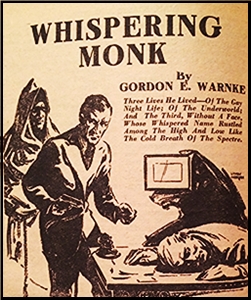
GORDON E. WARNKE “Whispering Monk.” The Whispering Monk #1. Short story. Published in All Detective Magazine, June 1934. Never reprinted.

   This is the first appearance of The Whispering Monk as a hero pulp character, and the last. In fact it is the only [crime fiction] story that the author, Gordon E. Warnke, ever had published, and the only way you’re going to be able to read it is by finding a copy of the right issue of All Detective Magazine, which is as usual with these old magazines, is not going to be an easy job to do. (See also comment #3.)

   The Whispering Monk, a terrifying nemesis to hoodlums and gangsters alike, is in reality Dick Steele, a former police detective whose father, also a detective, was murdered by a criminal gang that Steele believes is operating with police protection. He takes on the guise of the hooded Whispering Monk to bring the gang down by means of his own vigilante justice.

   As it turns out, however, by means of clever disguising techniques, for most of the story he takes on the identity of Johnny the Dip, a barfly who is able to overhear the conversations of gang members in bars as he sprawls drunkenly at nearby tables.

   Only one person, William Dugan, a captain of detectives, knows about Steele’s alter egos, and is the only man he trusts with that information. The story is short — it’s only nine pages long — so to do what he has to do with so little room to work, Steele’s only resource is to get the gang members fighting against each other.

   You may be surprised to hear me say that the story is not badly written — there’s simply just not enough of it — and the setup shows some imagination, at least. This overlooks the unfortunate fact, however, that The Whispering Monk appears in person in only a few paragraphs on the last page. More of him in action, instead as Johnny the Dip, would seem to be a reasonable request, and why that particular moniker, anyway?

REVIEWED BY BARRY GARDNER:


LUCRETIA GRINDLE – So Little to Die For. Inspector Ross #2. Pocket, paperback original, 1994.

   Lucretia Grindle has spent much of her time in England, but now lives in Massachusetts. I thought her first pbo, The Killing of Ellis Martin, was a good traditional British mystery. I don’t remember it getting much attention, though.

   Inspector Ross of the Kent CID is having a bit of a holiday in Scotland, but we know how that goes, don’t we? He meets a British group in a restaurant and chats with them, and the next day four of the six are dead, brutally murdered by shotgun blasts on their small cottage.

   A local shepherd is quickly arrested, but for various reasons Ross does not believe him guilty. He speaks to the investigating officer but does not convince him, and might have let the matter lie despite his doubts — until he’s handed evidence that some of the parties involved have lied to the police. Now he’s got the bit in his teeth, and over the fences we go in pursuit of an unknown fox.

   I still think Grindle is worth reading. Her prose is smooth, and she does a nice job of characterizing the widower Ross and his Welsh Sergeant, Owen Davies. Her focus is a bit more on her detective than is the case with the more traditional authors like Burley and Clark, but that’s clearly the tradition in which she works.

   While this isn’t really a village mystery, it has that feel, and her first was. There isn’t a great deal of depth either intended or achieved in her books, but she does furnish a pleasant read.

— Reprinted from Ah Sweet Mysteries #17, January 1995.


Bibliographic Update:   While there were only the two books in Lucretia Grindle’s Inspector Ross series, she continued on as a writer, adding four more mystery novels to her resume, beginning in 2003. For more information about her, you might start by checking out her Wikipedia page here.

WINGS OF DANGER. Hammer Films, UK, 1952. Lippert Pictures, US, 1952 as Dead on Course. Zachary Scott, Robert Beatty, Naomi Chance, Kay Kendall, Colin Tapley, Arthur Lane, Harold Lang, Diane Cilento. Screenwriter: John Gilling, based on the novel Dead on Course by Mansell Black (Elleston Trevor aka Trevor Dudley Smith}. [Note: The movie credits also give Packham Webb as a co-author of the book.] Director: Terence Fisher.

   Zachary Scott, in my opinion, made a better villain in the movies he made than he did a hero. He had a beautiful speaking voice, but he seemed to have a perpetual semi-scowl on his face, the thought being that he had some sort of subtle dislike of what he was doing or who he was dealing with.

   But in Wings of Danger he is the hero, and if it doesn’t work out well, which I don’t think it does, I’d be the first to admit that it wasn’t all his fault. The story doesn’t allow his character much range at all, and you really have to wonder what he might have been able to do with a better script.

   He plays a post-WWII cargo pilot who’s been successfully hiding the blackout spells he’s been having from the firm he’s working for, and when he tries to stop a buddy (Robert Beatty) from taking off into stormy weather, the buddy threatens to tell all and flies off anyway. And his plane is never heard from again.

   Well, the wreckage is, but there’s no body to be found. The police are interested — smuggling is suspected — and Scott’s character (a fellow named Van Ness) is implicated. Van Ness’s other motive for snooping around is keep everything a secret from his friend’s sister and father, who idolize him.

   You might be thinking of The Third Man right about here, and rightly so. There is a lot more to the plot than I’m going to go into, but rather than adding to the story, it makes it all the more muddled. As an example of film noir, the story’s adequate. The photography, within the limitations of a low budget, is even more so.


From Wikipedia:

    “The Honeycombs were an English beat/pop group, founded in 1963 in North London, best known for their chart-topping 1964 hit, the million selling ‘Have I the Right?’ The band featured Honey Lantree on drums, one of the few female drummers in bands at that time.”


    Ms. Lantree died on December 23 at her home in Great Bardfield, Essex, England. She was 75.

« Previous PageNext Page »