A 1001 MIDNIGHTS Review
by Bill Pronzini


DOLORES HITCHENS – Sleep with Slander. Doubleday Crime Club, hardcover, 1960. Permabook M-4243, paperback, 1962; Berkley, paperback, 1969.

   Many people seem to feel that the best hard-boiled male private-eye novel written by a woman is Leigh Brackett’s No Good from a Corpse (reviewed here ). But that may because many people haven’t read Sleep with Slander. For the undersigned reviewer’s money, this is the best hard-boiled private-eye novel written by a woman — and one of the best written by anybody.

   Its protagonist, Long Beach-based Jim Sader, is a multidimensional character, much more realistic than the stereotypical tough detective; Sader uses his intelligence to accomplish his purposes. The plot, reminiscent in its complexity of both Chandler and Ross Macdonald, is better crafted, more compelling, and ultimately more satisfying than the Brackett.

   Sader is hired by a rich old man, Hale Gibbings, whose daughter gave birth to an illegitimate child five years earlier. The child, Ricky, was given away for adoption, not through a recognized agency but to a private couple, and Gibbings has heard nothing about the boy until recently, when an anonymous letter writer tells him the child is being mentally and physically abused.

   Sader undertakes the search for Ricky, following a trail that leads him to a conniving friend of Tina Champlain, the adoptive (and now presumed dead) mother; to a violent builder of boats and his drunken father; to murder, extortion, double-dealing, madness; and finally to the truth. The surprises Hitchens springs along the way are not at all easy to anticipate. A first-rate novel recommended not just to fans s of the hard-boiled school but for anyone who appreciates a quality mystery.

   Hitchens wrote one other novel featuring Sader: Sleep with Strangers (1957). This is also good reading, but marred by sentimentality and a shaky ending that reveals the wrong choice of murderer.

         ———
   Reprinted with permission from 1001 Midnights, edited by Bill Pronzini & Marcia Muller and published by The Battered Silicon Dispatch Box, 2007.   Copyright © 1986, 2007 by the Pronzini-Muller Family Trust.
A 1001 MIDNIGHTS Review
by Bill Pronzini


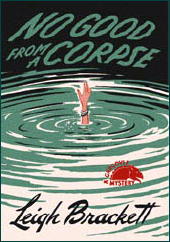
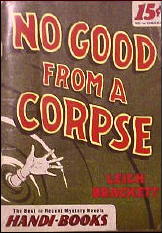
LEIGH BRACKETT – No Good from a Corpse. Coward McCann, hardcover, 1944. Dennis McMillan, hardcover, 1998 [includes eight detective pulp stories plus title novel]. Reprint paperbacks: Handi-Book #32, 1944; Collier, 1964.

LEIGH BRACKETT No Good from a Corpse

   Leigh Brackett is perhaps best known for her science fiction and for her script work on the classic private-eye film The Big Sleep (1946); but she also wrote excellent crime fiction (and one very good historical western). Her mysteries tend to be tough-minded and realistic. No Good from a Corpse, in fact, can accurately be termed “hard-boiled” — and indeed has been called, by some critics and aficionados, the best traditional private-eye novel written by a woman.

   Los Angeles detective Edmond Clive embarks on an angry, vengeful hunt when an old girlfriend, nightclub singer Laurel Dane, is murdered. His quest leads him from Beverly Hills mansions to cheap night spots along the Sunset Strip; from rich playboys (and playgirls) to denizens of the underworld; from threatening telephone calls to a knock on the head to attempts on his fife; and from blackmail to several more murders before he finally uncovers the not altogether surprising identity of Laurel’s murderer and the truth behind a web of lies and half truths.

LEIGH BRACKETT No Good from a Corpse

   Critic Anthony Boucher stated in an introduction to a reissue of this novel in 1964 that Bracken was the one woman who “most successfully captured the authentic Chandleresque male tone.” True enough; the tone is very Chandleresque, to the point of pastiche. It is as if Miss Brackett deliberately set out to out-Chandler Chandler.

   About the novel itself, Boucher wrote, “Its ingredients are not startlingly new: it even includes the obligatory night clubs, in which detective-story characters spend so much more time than any other class of people. But the familiar ingredients take on fresh life, partly because Miss Brackett looks at and writes about Los Angeles itself and not its conventionalized fiction image.”

   Also true, pro and con. There is nothing really new in the novel; Brackett covers old ground- and covers it well, even expertly, but the fact remains that Chandler did it first and did it better. Clive is the only memorable character,and he pales alongside Philip Marlowe. With all due respect to Boucher and the book’s other boosters, No Good from a Corpse is not the best traditional male private-eye novel written by a woman. That distinction belongs to Dolores Hitchens’s Sleep with Slander (reviewed here ).

         ———
   Reprinted with permission from 1001 Midnights, edited by Bill Pronzini & Marcia Muller and published by The Battered Silicon Dispatch Box, 2007.   Copyright © 1986, 2007 by the Pronzini-Muller Family Trust.
DASHIELL HAMMETT

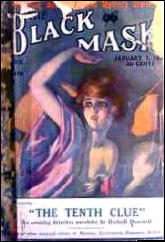
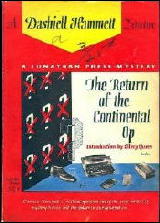
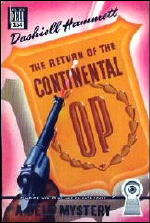
DASHIELL HAMMETT “The Tenth Clew.” Continental Op short story #6. First published in Black Mask, January 1, 1924. Reprinted in Ellery Queen’s Mystery Magazine, July 1945; revised ending. Also, among others: The Return of the Continental Op (Jonathan Press #J17, paperback, 1945; Dell #154, paperback, 1947); The Continental Op (Vintage V-2013, paperback; November 1975; edited by Steven Marcus); all with the original ending.

    “The Tenth Clew” (or “Clue,” as it is on the front cover of the magazine) is the lead story of the latter collection, which I happened to notice in a box of paperbacks I was going through and decided to read. It’s been a while since I read anything by Hammett, and long since time, I decided, that I should.

    I’d forgotten, though, that Mike Nevins had made a point of talking about this story in his June 2011 column for this blog. When I got to the end of what was otherwise a very enjoyable story, I was taken aback and asked myself what it was that I’d missed.

DASHIELL HAMMETT

    It turns out that it was a major mistake by Hammett and his editor way back in 1924, one that Fred Dannay fixed when he ran the story in EQMM some twenty years later, but then reverted back to the original ending most if not all of its appearances since.

    Since Mike did such a good job in discussing it, I won’t talk about it here, as I’d intended to. Go read about it in that old column of his, then by all means come back. Let me talk about this instead.

DASHIELL HAMMETT

    I don’t claim that the thought is original to me, and I’m sure it isn’t, but it’s worth bringing up again. It occurred to me that Hammett may have been having some fun with the readers of this story, which reads from the very beginning as a straight-forward detective mystery, complete with clues — nine of them, in fact, duly noted by the Op and O’Gar, the detective sergeant assigned to the case.

    Unfortunately the clues, very confusing in and of themselves, also do not lead anywhere, including the fact that the victim was killed by being hit over the head by a typewriter. The Op’s conclusion? The tenth clew? That the other nine clues do not mean anything, and he proceeds to solve the case by assuming exactly that.

    So much for the puzzle stories of Agatha Christie and the like. I’m no purist, and I enjoyed this one, even with the botched up ending.

REVIEWED BY BARRY GARDNER:


ROSEMARY HERBERT – The Fatal Art of Entertainment: Interviews with Mystery Writers. G. K Hall, hardcover, 1994.

   These are some of the better interviews with authors I’ve seen. Herbert has obviously read the books of each of them and thought about what she read. While she has certain themes she tries to explore with each author, she does quite well when discussing their individual oeuvres. She fawns a bit at times, but that’s probably hard to avoid. Hey, I can fawn with the best of ’em myself.

   The authors included are a mixed bag, and it would be interesting to know how they were selected. They are: Catherine Aird, Robert Barnard, Patricia Cornwell, Jonathan Gash, Sue Grafton, Jeremiah Healy, Reginald Hill, Tony Hillerman, P. D. James, Jane Langton, John Mortimer, Barbara Neely, and Julian Symons.

   They all had interesting things to say, some of course more so than others. It’s a bit pricey ($35) for anyone not really into this sort of thing, but it’s meaty, too. I was impressed with the book, and I’m usually not with interviews.

— Reprinted from Ah Sweet Mysteries #12, March 1994.

REVIEWED BY JONATHAN LEWIS:


GAMBLING LADY. Warner Brothers, 1934. Barbara Stanwyck, Joel McCrea, Pat O’Brien, Claire Dodd, C. Aubrey Smith, Robert Barrat, Arthur Vinton. Director: Archie Mayo.

   You don’t watch Gambling Lady for the dialogue or the plot. Both of which aren’t all that bad. You watch it for Barbara Stanwyck. Because she’s absolutely great in this otherwise passable, albeit by no means exceptional, Warner Brothers programmer.

   True to pre-code form, this one’s got gambling, marital infidelity, and Manhattan high society. It’s into the latter that Lady Lee (Stanwyck) marries into after she falls in love with Garry Madison (Joel McCrea), a man determined that his new wife cut ties with her gambling friends from her past. But as any rags to riches story can tell you, it’s not always so easy for someone from the wrong side of the tracks to abandon her past friends and associates.

   That’s especially true for Lady Lee and her relationship with a bookie named Charlie Lang (Pat O’Brien). When Lang gets in trouble with the law, Lady feels as if she has no choice but to help him. But at the cost of losing her Garry to his meddling ex, Sheila Aiken (Claire Dodd) who is determined to get Garry back at all costs.

   Indeed, although there is a murder in the movie, this one is more of a drama – dare I say melodrama – than a crime film. It’s certainly not gritty. But Gambling Lady, much like Stanwyck, has spunk, making it a short, but entertaining programmer that’s nothing special. But it’s not half bad either.

WADE EVERETT – Broken Gun. Ballantine, paperback original; 1st printing, May 1970. Center Point Pub., hardcover, May 2017.

   This is the story of two cowpokes, friends for years, one older and easy-going, the other younger, much wiser and anxious to make his mark in the world. Their trails split, however, after they stumble across a sheep ranch now owned and operated by a woman on her own, and deadly consequences follow.

   Most westerns, I’ve discovered, have just about the same pedestrian prose, some a bit flashier, some more wooden in nature, though never quite dull. Everett’s writing, on the other hand, sings, at least in comparison. It’s only after half the book had passed that I discovered I’d been caught by surprise with the tune he’d was playing.

   The perception, at least, of who one of the characters really is, deep inside, gets a sudden twist out of shape around Chapter 8, and after that the story is a little meaner and a little nastier than it was before. It’s tough to describe in just a few lines, but it’s something like getting smacked on the side of the head when you’re looking the other way, then being forced to like it.

— Reprinted from Nothing Accompliced #4, November 1993.


Bibliographic Note: “Wade Everett” was the joint pseudonym of western writers Will Cook and Giles A. Lutz. (A statement that’s not quite correct. See Comment #1.)

Evangeline was a all-female country band based in New Orleans. This song comes from their second album, French Quarter Moon, released in 1993 on the Margaritvaille/MCA label.

CLEVE F. ADAMS – Murder All Over. Rex McBride #4. Signet #765, paperback; 1st printing thus, January 1950. Originally published as Up Jumped the Devil by Reynall & Hitchcock, hardcover, 1943; Handi-Books #33, paperback, 1944. A condensed version appeared in Cosmopolitan, June 1943.

   This case of PI Rex McBride, on the trail of a valuable stolen diamond for an insurance company, comes as if straight from the pages of Black Mask. This is true even though by 1943 that particular pulp magazine was printing much milder stuff than the hard-boiled fiction this book is a throwback to.

   McBride’s recipe for detection consists largely of heating up the pot just to see what boils over, producing a tangled weave of characters and plot lines that will make your head swim. The prose in this book is terse and enigmatic, and what would get spelled out completely by today’s authors is referred to here by Adams with only the strongest of hints and intimations. I like it better this way.

PostScript:   Based on this example of size one, Adams was apparently not very adept in tying up plot lines. It’s part of McBride’s enigmatic nature, let’s say. I would also be remiss if I did not point out that this is the book in which McBride will be long remembered for saying “…an American Gestapo is goddam well what we need…”

— Reprinted from Nothing Accompliced #4, November 1993, revised.
REVIEWED BY DAN STUMPF:


A. B. GUTHRIE, JR. – These Thousand Hills. Houghton Mifflin, hardcover, 1956. Pocket/Cardinal C-267, paperback, 1957. Bantam, paperback, 1976, 1982.

THESE THOUSAND HILLS. Fox, 1959. Don Murray, Lee Remick, Richard Egan, Patricia Owens, Stuart Whitman, Albert Dekker. Screenplay by Alfred Hayes, based on the book by A. B. Guthrie, Jr. Directed by Richard Fleischer.

   The novels of A. B. Guthrie are intimate epics, encompassing a broad sweep of history and geography over the course of years, yet never losing the personal focus of characters who grow (and sometimes diminish) into complex individuals, at once larger than life and all too human.

    Perhaps that’s why they’ve never been successfully adapted to the screen — Oh, I’m not saying there haven’t been some good movies made from them, but none ever captured the sense of progress and loss so essential to Guthrie’s style, and These Thousand Hills shows why.

   As the story opens, Albert “Lat” Evans is a farm boy with ambitions who joins a cattle drive to Montana and becomes a cowboy with ambitions. After the drive he convinces his wastrel friend Tom Ping to spend the winter hunting wolf hides (a harrowing profession as Guthrie describes, not to be confused with hunting wolves) which leads to their capture and eventual release by a tribe of nomadic semi-outlaw Indians –an episode that will come to define Lat’s future.

   Guthrie does an intelligent and strikingly original job of detailing Lat’s rise to prosperity and fame, distinctive enough to be worth mentioning. Most stories about the rise of the rich become Faustian parables of compromise and corruption, but Lat simply realizes that if he wants to get anyplace, he’ll have to estrange himself from his loyal but disreputable companions. He’s honest, even generous with everyone he deals with, but as Hills draws to a close, and his old friends come to the bad end that was always waiting for them, he realizes that the people he owes the most to won’t even turn to him when they need his help.

   It’s a delicate point to make dramatically, and Guthrie handles it splendidly, as Lat and his old buddy meet one final time in a saloon, both armed, and These Thousand Hills seems headed for Tragedy… but turns to Drama of a very high sort, and one I won’t forget.

   Well, when they made a film of this, they felt like they had to ditch the Delicate and keep the Drama, and they didn’t do a bad job of it. The film doesn’t measure up to the book by a long ways, but it ain’t bad at all. Don Murray plays Lat with just the right amount of strength and naiveté, Stuart Whitman as his ex-pardner gone bad projects the right mix of strength and instability, and Lee Remick is simply splendid as the vulnerable prostitute who loves him.

   In lesser parts, Richard Egan and Albert Dekker portray opposite sides of an unflinching moral code, and we even get some fine turns from Old Western stalwarts like Royal Dano, Fuzzy Knight and Douglas Fowley.

   Director Richard Fleischer handles all this quite capably, and if he and writer Alfred Hayes fumble the whole point of the thing…. Well they made a decent movie out of it anyway, and one that’s worth your time. But take a look at the book if you can.

DOUG ALLYN “Animal Rites.” Published in Ellery Queen Mystery Magazine, July 1996. Reprinted in All Creatures Dark and Dangerous (Crippen & Landru, 1999).

    It cannot be easy to write a full-fledged detective story in the confines of a short story or even a novelette, but this issue of EQMM has at least three that qualify, the best of them being this 26 page tale by Doug Allyn, who has been a regular contributor to the magazine since 1985.

    “Animal Rites” was the third appearance of Dr. David Westbrook in the magazine. Westbrook was an animal veterinarian whose office was located in the northern end of Michigan’s lower peninsula, not far (I can easily imagine) from the small town where I grew up. It is hard to say how many stories could be placed in such a protagonist in such a setting, but Allyn managed to write nine of them, seven of them included in the collection published by Crippen & Landru in 1999. (Two appeared after the book came out.)

    In this particular tale, David is caught between two sides of a panel debate on live TV. The topic is the hunting of animals for sport, yes or no? Tempers are raised, a confrontation breaks out, and the next day one of the participants is dead. One of the others confesses, but based only on their instincts, neither David nor the local sheriff is convinced.

    It takes a vivid dream to bring into his consciousness the clue David needs to solve the case, but the reader can easily pick up on it as well. The characters are interesting, the setting (to me) like home, and a reasonably fair mystery. All the right ingredients.

    Another good detective story is this issue is “The Thief of Nothing,” by Jeffry Scott, in which Detective Inspector Scipton agrees to help an elderly lady who is convinced that someone is continually breaking into her home, but never taking anything. Scipton helps solve the case, but surprise of surprises, another one as well, plus (and a big plus) in the course of the events he meets a woman who may be the one he’s looking for. At least she thinks so.

    I’m not sure how many stories the late and much missed Edward D. Hoch wrote about Nick Velvet, a thief noted for never stealing anything of value, a fact agreed upon even by the police. In “The Theft of the Bogus Bandit,” Nick is forced to keep that reputation as rock solid as ever when an imposter using his name begins a spree of holdups in which not only does he steal diamonds and the like, but while doing so also severely attacks the people he is stealing from. Nick, naturally, is outraged.

« Previous PageNext Page »