Reviewed by JONATHAN LEWIS:         


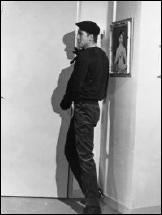
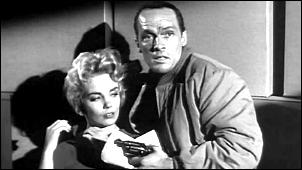
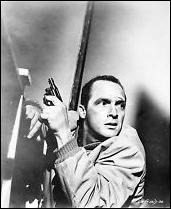
THE TALL TARGET. MGM, 1951. Dick Powell, Paula Raymond, Adolphe Menjou, Marshall Thompson, Ruby Dee, Richard Rober, Leif Erickson, Will Geer, Florence Bates. Director: Anthony Mann.

   Call it Civil War noir, Confederate noir. On the other hand, maybe it’s not really noir at all, but just a very good crime film set in 1861, but one with a quasi-postwar shadowy, urban atmosphere with a protagonist who looks like he would have fit right in roaming the neon-lit streets of 1950s Manhattan.

   However you describe it, Anthony Mann’s The Tall Target is a extremely well-constructed, taut thriller about a New York City policeman named John Kennedy (Dick Powell) tasked with stopping an assassination plot against President-elect Abraham Lincoln. Nearly the entire film takes place on a night train from New York en route to Washington DC, giving it a beautifully claustrophobic sensibility.

   Based on the Baltimore Plot against Lincoln, the film follows Kennedy as he tries to convince people that there really is a plot against the future President’s life. In a plot device that is necessary to the development of the story, but which comes across as clichéd and rather unbelievable, Kennedy resigns his police commission and decides that he’s going to stop the plot as a private citizen. It’s the weakest part of an overall exceptional film, one that perhaps isn’t as well known as some of Mann’s Westerns from the same time period.

   Along the night journey, Kennedy has to contend with a scheming U.S. Army Colonel, (Adolphe Menjou playing it to the hilt), a brother-and-sister pair of Confederate sympathizers, and their slave, Rachel, portrayed with grace by Ruby Dee. Also aboard the Night Flyer, a woman and her son, as well an outspoken abolitionist woman who wants to interview Rachel for a book she’s allegedly writing. There’s also a stranger who boards the train in the Philadelphia darkness.

   Much as in The Heroes of Telemark, which I reviewed here, Mann demonstrates extreme dexterity when it comes to filming trains. Look in particular for the shots of the train approaching the station, with its bright circular light signifying its arrival.

   The train station scenes are also very well filmed, creating an atmosphere of doom and gloom in the dark, rain swept night. There’s also a couple of murders and a harrowing scene of a man thrown from a moving train.

   In conclusion, Mann’s The Tall Target is worth seeking out, particularly if you haven’t seen it already. With a running time of little under eighty minutes, the movie more than enough plot twists to keep a viewer engaged with the story. Even the Pinkerton Detective Agency plays a role in this under-appreciated film.

A 1001 MIDNIGHTS Review
by Marcia Muller


DAVID ANTHONY – The Midnight Lady and the Mourning Man. Bobbs-Merrill, hardcover, 1969. Warner, paperback, 1973. Filmed as The Midnight Man (1974).

   The greatest strength of David Anthony’s (William Dale Smith’s) first novel is the prtagonist, Morgan Butler, a Korean War veteran who suffered a breakdown. Upon recovering, he worked briefly for a San Francisco detective agency. At the opening of this story, he is half-owner of an Ohio farm, and because he occasionally feels the need for some action, he keeps his hand in the detective business, taking jobs that are a little outside the law.

   Often the jobs aren’t as lucrative or successful as his clients might wish them to be, since Butler is a man of sensitivity and conscience — good at what he does, but incapable of betraying a well-developed moral code.

   In this novel he helps a former marine buddy who saved his life — Quartz Willinger, constable in the small college town of Jordan City, Ohio, who is laid up with an on-the-job injury and trusts no one but Butler to hold down the fort during his convalescence.

   Tapes that three local college students under psychological counseling made and left with their therapist have been stolen. Butler narrows the focus of the thief down to the tapes of one student, Natalie Claybourne, but before he can find the reason the tape was taken, she is murdered in her dormitory room.

   Butler must contend with numerous men who may or may not have been her lovers; her wealthy father, who gives phony-sounding stories about why he seems more interested in recovering the tape than in his daughter’s killing; and a lady who begins to awaken feelings in Butler that he had considered gone for good.

   Anthony’s portrayal of a college town and its bohemian denizens is excellent; there is a section in which Butler relates how he copes with campus “spring madness” that any student or former student will immediately recognize.

   Although the solution is a little predictable and the story somewhat drawn out, this is nonetheless a novel you won’t want to put down. (A film version, The Midnight Man, starring Burt Lancaster was made in 1974. In it, Butler is transformed into a paroled murderer and night watchman turned detective.)

   David Anthony’s other books featuring Morgan Butler are Blood on a Harvest Moon (1972) and The Long Hard Cure (1979). He has also written The Organization (1970) and Stud Game (1978).

         ———
   Reprinted with permission from 1001 Midnights, edited by Bill Pronzini & Marcia Muller and published by The Battered Silicon Dispatch Box, 2007.   Copyright © 1986, 2007 by the Pronzini-Muller Family Trust.

Editorial Comments:   The books mentioned in the last paragraph above comprise the complete criminous output of David Anthony, who died in 1986. The Long Hard Cure, surprisingly enough, has been published only in England. For a review of The Organization on this blog by Bill Crider, go here, and for my review of Stud Game, go here.

IT’S ABOUT CRIME
by Marv Lachman

ROBERT LUDLUM – The Road to Gandalfo. Bantam, paperback, 1982. First published as by Michael Shepherd, Dial Press, hardcover, 1975.

   I’ve never been able to finish a Robert Ludlum novel, and Bantam’s reprint of The Road to Gandolfo, a book he published in 1975 as Michael Shepherd, was no exception.

   It starts with a promising premise, a plot to kidnap the Pope. However, things go rapidly downhill with indifferent narrative, uninteresting characters, and what the publisher (probably meaning it as a compliment) calls “serpentine plotting.”

   There are no snakes in the plot; that hissing sound you heard was this reviewer. Meanwhile, Mr. Ludlum continues to smile on his way to the bank.

— Reprinted from The MYSTERY FANcier, Vol. 8, No. 5, Sept-Oct 1986.

THE BACKWARD REVIEWER
William F. Deeck


E .R. PUNSHON – Information Received. Ernest Benn, UK, hardcover, 1933; Penguin Books, UK, paperback, 1955. Houghton Mifflin, US, hardcover, 1934.

   In his first recorded case, Bobby Owen (B.A. — pass degree only — Oxon) is a police constable patrolling a dull suburb. The suburb livens up when mysterious strangers start swarming and an alleged apple thief makes his presence felt.

   All this leads to the discovery of the body of Sir Christopher Clark, shot twice near the heart in his billiard room at the same time his safe in the study was being emptied by a burglar.

   With a fair number of suspects and an almost equal number of motive — embezzlement, ruination, inheritance, lovers denied — the case is a complex one. It isn’t helped by a couple of the suspects claiming that it wasn’t murder when it obviously was. A conspiracy of silence, except for an occasional odd remark, doesn’t assist in clearing things up.

   While the novel is about Owen and his role, the real brains of the investigation is Superintendent Mitchell, a canny and amusing policeman. Enjoy Mitchell and hope that Owen matures quickly if he’s going to be on his own.

— Reprinted from The MYSTERY FANcier, Vol. 11, No. 3, Summer 1989.


Editorial Comment:   Bobby Owen was the leading protagonist in a whopping 35 detective novels by Punshon, beginning in 1933 and continuing on to 1956. I have no record of the number of Superintendent Mitchell’s appearances, but it’s easy to imagine he was on hand more than just the once.

Reviewed by JONATHAN LEWIS:         


WEST OF SHANGHAI. Warner Brothers, 1937. Boris Karloff, Beverly Roberts, Ricardo Cortez, Gordon Oliver, Sheila Bromley, Vladimir Sokoloff, Gordon Hart, Richard Loo. Based on a play by Porter Emerson Browne. Director: John Farrow.

   West of Shanghai is overall an enjoyable, although occasionally stilted, drama/action film starring Boris Karloff with Beverly Roberts and Ricardo Cortez. Directed by John Farrow, whose movie adaptation of David Dodge’s Plunder of the Sun I reviewed here, the film stars Karloff as a Chinese warlord by the name of Wu Yen Fang.

   Fang’s an interesting fellow, that’s for certain. He’s brutal, yes, but he’s also got something of a heart of gold and a sense of humor to boot. One can’t help but smile when he repeats, with a gleam in his eye, his self-assured catchphrase, “I’m Fang” as a means of explaining of how he can get away with the seemingly improbable or impossible.

   Perhaps one reason this movie isn’t as well known today is that Karloff is made up to look Chinese. He also speaks in broken English, taking us many degrees away from politically correct territory. Still, Karloff’s an absolute pleasure to watch, demonstrating once again that the classically trained English actor really had incredible acting skills.

   Based on a play by Porter Emerson Browne, West of Shanghai is an adventure film, a thriller, and a comedy of manners all in one. The story follows two business competitors, Gordon Creed (Cortez) and an older man named Galt as they travel north in China in the hopes of gaining business influence over an oil field overseen by Jim Hallet (Gordon Oliver). It should come as no surprise that among the film’s subtexts is a slightly comical, but also deadly serious, critique of American industrialists and human greed. At one point, the power hungry general tells Galt that the latter cares too much about money. Ouch.

   Complicating matters even further for the businessmen is not only Fang’s growing military and political influence in the region, but also the fact that Creed’s estranged wife, Jane (Beverly Roberts), is both a missionary in the region and currently in love with Jim. Add to the mix Galt’s headstrong and quite beautiful daughter, Lola (Sheila Bromley), and you’ve got yourself some great human drama in an exotic setting.

   All told, I found West of Shanghai to be an enjoyable picture with a lot in terms of plot and style to recommend it. Karloff is great as Feng and Cortez portrays the slimy, double-crossing, Creed really well. Vladmir Sokoloff’s portrayal of General Chow Fu-Shan is literally cut short when his character is killed by one of Feng’s assassins, but he’s also quite good as far as character actors go.

   I’d hesitate to call West of Shanghai a great film, but at a running time of slightly over 60 minutes, it’s never dull and Farrow’s direction is solid. The movie’s no classic, but if you haven’t seen it, it’s worth seeking out even if for novelty value. They don’t make films like this anymore. But just because they really can’t, doesn’t mean that it’s not worth appreciating those that remain and enjoying them on their own terms.

REVIEWED BY WALTER ALBERT:         


JOHN LESLIE – Night and Day. Simon & Schuster, hardcover, 1995. Pocket Books, paperback, 1996.

   This is the second of four mysteries featuring Gideon Lowry, a jazz pianist and private investigator based in Key West. His brother committed suicide at the end of the first book and Gideon’s girl friend (Casey) has moved to Miami.

   A visiting singer named Asia (with lips the color of plum) hires Gideon to locate her estranged husband, a writer obsessed with Hemingway. This is a not inappropriate obsession in Key West with the annual Hemingway Days celebration and the Hemingway house, which is open to the public as a museum. Gideon finds the missing husband, but he’s soon killed and Asia looks like a prime suspect.

   The novel (like the other three) is heavy with sultry heat and the perfume of whatever produces heavy scents In Key West. A nice series of grace notes on the 1990s private eye scene.

       The Gideon Lowry series —

Killing Me Softly (1995)


Night And Day (1995)
Love For Sale (1996)
Blue Moon (1998)

REVIEWED BY DAN STUMPF:         


2 DAYS IN THE VALLEY. MGM, 1996. Danny Aiello, Greg Cruttwell, Jeff Daniels, Teri Hatcher, Glenne Headly, Peter Horton, Marsha Mason, Paul Mazursky, James Spader, Eric Stoltz, Charlize Theron, Keith Carradine, Louise Fletcher. Director: John Herzfeld.

   2 Days in the Valley is sort of Harry Stephen Keeler meets Pulp Fiction. The film starts with a protracted interrogation which turns into a Drug Killing, which turns into a frame-up which turns into….

   Meanwhile we pick up on unrelated plot threads about an aspiring detective, a weary vice cop, a suicidal -director trying to find a home for his dog, a high-powered agent and his brow-beaten secretary. And as the web-work plot tightens into a recognizable pattern, we’re suddenly in the midst of a wacky story propelled by colorful characters to a violent and highly satisfying conclusion.

THE ARMCHAIR REVIEWER
Allen J. Hubin


MAGDALEN NABB – The Marshal and the Madwoman. Scribner’s, hardcover, 1988; Penguin, paperback, 1989. First published in the UK by Collins, hardcover, 1988.

   The [sixth] of Magdalen Nabb’s stories of Florence, Italy, and Marshal Salvatore Guarnaccia is The Marshal and the Madwoman. Nabb writes very well, and offers here several powerfully poignant glimpses of life in that Italian city.

   Guarnaccia happens upon Clementina one evening as this woman of the title is engaged in a neighbor-hood shouting match. That night she dies, of murder not well disguised as suicide. The Marshal explores her life, but the traces are all but invisible. He learns about the people who lived near Clementina, and about the effects of a terrible flood some years earlier in Florence. He finds, at last, why a madwoman had to die.

   The Marshal is a fine creation, and Nabb paints him here with vibrant strokes.

— Reprinted from The MYSTERY FANcier,
       Vol. 11, No. 3, Summer 1989.


NOTE: A complete criminous bibliography for Magdalen Nabb can be found here in an obituary page for her on this blog at the time of her death in 2007.

Reviewed by JONATHAN LEWIS:         


CONFESSIONS OF A NAZI SPY. Warner Brothers, 1939. Edward G. Robinson, Francis Lederer, George Sanders, Paul Lukas, Henry O’Neill, Dorothy Tree, James Stephenson, Joe Sawyer, Sig Ruman. Director: Anatole Litvak.

   Reviewing Confessions of a Nazi Spy, from the vantage point of 2014 is quite a different undertaking than writing about it in 1939 when it was first released. While it remains a well above average spy thriller, some of the film’s immediacy has been lost by the passage of time. That said, the Anatole Litvak-directed project remains a significant and quite well constructed film.

   The movie, based on the real life exposure of Nazi spies operating in the United States, depicts in semi-documentary style the emergence of a pro-Nazi spy ring in New York City. Interspersed among the dramatic sequences is actual newsreel footage.

   As the first major studio production to detail the growing Nazi threat to American national security, Confessions of a Nazi Spy was harsh in its condemnation of German-American groups that allied themselves with Hitler. Although it seems to deliberately avoid any explicit reference to Nazi anti-Semitism, the movie does repeatedly portray Nazism as maddening, barbaric, and contrary to the very fabric of Americanism. Nazi expansionism is made out to be very real danger to democracy.

   Edward G. Robinson, whose family was a target of Romanian anti-Semitism prior to their emigration to the United States, portrays FBI Agent Edward Renard. It is his mission to both expose the Nazi spy ring and turn them over to the Justice Department for prosecution. The message is clear. Unlike in Nazi Germany, the United States gives all men a fair trial.

   Apart from their Nazi handlers, the ring consists primarily of three German-Americans: a megalomaniac loser and U.S. Army deserter, Kurt Schneider (Francis Lederer), his dimwitted chum, Werner Renz (Joe Sawyer), and the fanatical Dr. Karl Kassel convincingly portrayed by Paul Lukas.

   The latter character is, in many ways, the most interesting. He’s a bespectacled, mild mannered, physician working in the Yorkville section of Manhattan who is also a fanatical Nazi sympathizer active in the German-American Bund. Rounding out the cast are George Sanders, who portrays a Nazi official, and his female partner who ends up having a quite important role in the FBI’s successful unraveling of the spy ring.

   Watching this film, I could not help but wonder. How many people today are even aware of Nazi espionage in the United States prior to Germany’s declaration of war upon the United States? Even further, how many people are aware of the rise and fall of those German-American societies that supported the Third Reich? There’s an especially captivating scene in which Dr. Kassel visits a pro-Nazi youth camp based somewhere in what is presumably supposed to be the northeastern United States.

   Despite its grave subject matter, the film does end on a semi-optimistic and patriotic note. Renard is sitting in a diner with the federal prosecutor. A paperboy comes in with the latest edition, the headline noting that the feds have taken down the spy ring. A diner worker and talk for a moment among themselves, glad that those Nazis have been found out. This is America, not Europe. We are different from those hatemongers, they say. We’re Americans.

EDITH HOWIE – Murder for Tea. Contained in the 3-in-1 omnibus volume Three Prize Winners. Farrar & Rinehart, hardcover, 1941. No editor stated. Foreword by Mary Roberts Rinehart. Also published by T. V. Boardman, UK, paperback, 1942.

   The other two books in this scarce volume are Old-Fashioned Murder by Marguerite McIntire, and Westbound Murder by C. S. Wallace. The only copy offered for sale on abebooks.com right now, for example, is being offered at a rather steep $75 price tag. When I spotted one on Amazon last month for $20, I snapped it right up.

   What the three books have in common, you might ask, is that they were all “losers” in the second year of the Mary Roberts Rinehart Mystery Contest. Well, it says “Honorable Mention” in the lower right corner of the book’s front cover, so it’s clear that none of the three were winners.

   So who did get the top prizes? Mary Roberts Rinehart’s foreword tells us that the contest was open only to first time authors. Getting the honor of having their novels published in stand-alone volumes were A. R. Hilliard with Justice Be Damned, and Carolyn Coffin with a book entitled Mare’s Nest. Hilliard (male) wrote only one more work of crime fiction, Outlaw Island (1942), and also so did Carolyn Coffin, that one being Dogwatch (1944).

   Of the runners-up, this was the only work of crime and detective fiction that either McIntire or Wallace (male) managed to get published. In some sense, that makes Howie the real winner, as she went on to write six additional detective novels. A list will be provided later.

   At the moment I don’t know how long this contest continued, but I can tell you who the winners were for 1940: Clarissa Fairchild Cushman (I Wanted to Murder), Ione Sandberg Shriber (Head Over Heels in Murder), Elizabeth Daly (Unexpected Night) and Frank Gruber (The French Key, reviewed here by Jeff Meyerson). I believe, but I am not sure, that all four books were published individually.

   A couple of those authors’ names I’m sure everyone will recognize.

   As for Murder for Tea, I enjoyed it, most of it, that is. I wonder why Howie didn’t make a series with the two leading characters in this one. Shawn Cosgraeve, a six foot black Irishman with a temper to boot, is a mystery writer. Telling the story is his wife of three years standing, Kit, who didn’t make it in New York as a musician niy did find a husband whom she can manage very well, most of the time.

   It takes all of those three years to convince Shawn to take a trip back to her home town of Nashiona, somewhere in the American midwest, not too far from Chicago. From here I’ll quote from page 172:

    “Then what was he doing in Lower Town?” the Sergeant demanded. “Oh, I know there ain’t an answer. Hell! I’m sick of this whole screwy case, Look at it! A woman gets poisoned while a couple hundred people stand around and nobody knows who done it nor why nor even where the poison could have come from. Then a man’s killed and safe’s blown while people wonder what was the noise and a bunch of dopes stand around to watch the guys who did it flop in their car and drive off. And that ain’t all!” The Sergeant flapped his hands despairingly. “We got another murder and a brace of threatening letters and a mess of jewelry that you don’t know whether or not it’s going to be real or phony the next time you see it–” It was too much. He dropped his head and remained sunk in a misery beyond all expressing.

   Kit’s problem is that all of the suspects are friends of hers and their husbands and wives. She knows them from before, but she soon discovers that she doesn’t know them now very much at all — and one of them, the killer, not at all.

   On the overall scale of things, the story takes place in the upper middle class of a small town, which means of course that they think of themselves as the upper class. The prospects of an upcoming war are not mentioned at all.

   One huge drawback to the story is the Had I But Know aspect of Kit’s story, told some time well after all of the events in it had taken place. One wonders if that is what might have caught the judges’ eyes. The other drawback is that when the killer’s identity is revealed I discovered that it didn’t really much matter who it was. Picking a name from a hat may have produced the very same reaction.

   Nonetheless, it might have been instructive to see if Edith Howie could have thought of another situation to place her two leading characters in, to give them a chance of cracking another case. Even though it’s a detective story through and through, this one may have been a little too personal.

    Bibliography: EDITH HOWIE (1900-1979).

Murder for Tea. Farrar, 1941.
Murder for Christmas. Farrar, 1941.

Murder at Stone House. Farrar, 1942.
Murder’s So Permanent. Farrar, 1942.
Cry Murder. Mill, 1944.
The Band Played Murder. Mill, 1946.

No Face to Murder. Mill, 1946.

Note: For more about the author and a review of Murder for Christmas, check out what Curt Evans has to say over on his blog.

« Previous PageNext Page »