PATRICK KELLEY – Sleightly Invisible. Harry Calderwood #3. Avon, paperback original, 1986.
Another mystery with magic involved (*) – Kelley’s detective (this is his third adventure) is a magician named Harry Calderwood. Harry was once a big name, on TV and all, but he is now doing street corners. I don’t know why. Maybe I should read the earlier books.
But maybe I won’t, since I found this one rather disappointing. It involves a missing coed that Harry is forced into finding. Harry has a glib tongue, but his attempts at humor seem to miss tw7o times out of three. The mystery he solves also needs some work.
– Reprinted from Mystery.File.6, June 1980.
____
(*) I was referring here to the book The Wealth Seekers, the Shadow paperback by Maxwell Grant reviewed a few days ago on this blog.
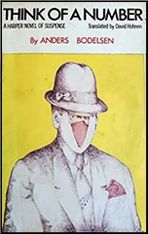
A disappointing book turned into an intriguing film.
THINK OF A NUMBER starts out with a neat little hook and develops it with some skill and suspense. Bork, a meek bank teller with a thoughtful streak, perceives hints that someone plans to rob his bank – probably his own station—during the busy Christmas Season, and decides to get in on the act himself.
Bork makes a practice of hiding away large sums of cash, and when the robber strikes, he gets away with a few thousand Kroener while Bork carries off a few hundred thousand. And so crime pays…
Until the robber decides to go after Bork’s share.
What follows is a battle of wits between Bork and the Bad Guy, complicated by the appearance of a Mystery Lady who may be a key piece in the game. But what makes it readable is that the wits involved are genuinely sharp, with Bork somehow keeping one jump ahead of the others, even as they out-think him.
Unfortunately, author Bodelson seems to have mapped out his ending without considering the characters, because in the last third of NUMBER, everybody gets stupid. And I mean Everybody: Bork, the mystery gal, the robber, even a cop on their tail… all of them, after being sharp-witted for so long, suddenly commit the most obvious and unforgivable mistakes imaginable. And I say “imaginable†because what we have here is clearly a case of a writer shepherding his characters to a tidy ending that reads like the author himself descended from on high to personally arrange it.
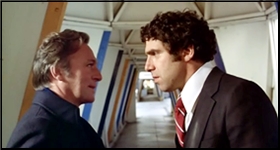
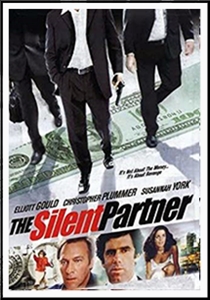
So when our neighbors to the North made this into the movie SILENT PARTNER, they wisely opted for a more convincing resolution, one that is rich in irony, yet seems to rise naturally from the characters. And it may be the casting, but those characters, as played by Elliott Gould, Susannah York and a nasty-nasty Christopher Plummer, seem more rounded and interesting than the predestined losers of Bodelson’s novel.
I should add that there’s some surprisingly graphic violence here, mostly directed at women, but it helps that PARTNER is directed at a brisk pace, acted with enthusiasm, and written with an air of spontaneity that breathes freshness into every scene. This is a film not to be missed by lovers of tricky caper flicks who want to see a few new wrinkles in the celluloid fabric.
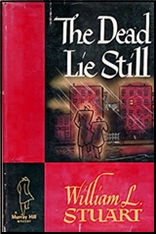
WILLIAM L. STUART – The Dead Lie Still. Farrar & Rinehart, hardcover, 1945.
This is the period between May and September 1945. The war’s still going on with Japan. But Germany has surrendered.
Sam Talbot served his time in the war. In naval intelligence. Now a civilian, Talbot’s a successful commercial artist. And part-time sketch artist for the cops.
It’s raining. He’s hanging out in a New York city bar. Drinking alone. A scotch and soda.
A drunken, raven haired poetess in a crimson dress plunks herself across from him. “I am Ariadne … abandoned by her lover. So the gods promised she should marry a god. They picked Bacchus.â€
A handsome, nattily attired man, fedora obscuring his eyes, appears to be staring at him from the bar.
Are you looking at me?
Are you Sam Talbot?
I am.
I’m from the FBI. I’d like you to meet with me about something.
How about tomorrow morning?
Writes Talbot’s number in his notebook next to a man named Dema.
Fine I’ll see you then.
I thought Dema was dead.
Let’s hope so.
A beautiful, ash-blonde comes in from the rain. Stares at the man in the hat. Then walks out.
The G-man follows.
More drunken patter with the poetess.
An explosion outside. A burning gas truck.
A driver is trapped.
Talbot takes some sodden newspaper. He tries to wrest the handle open. It scorches his hand. The door is locked. He gets a quick look at the driver. The truck explodes. Talbot’s thrown clear, but hurt.
He wakes with a doctor. And the poetess.
And now the mob is after him.
And the G-man’s gone missing.
The G-man had been working alone. He didn’t know how high the infiltration infested. He didn’t know who he could trust.
He’d suspected a Japanese cell working with a local mafioso: Dema. They’ve been targeting war-time American military scientists for assassination. With success.
Dema had been mostly blown away. But he still has most of his face, and most of his larynx, and all of his whispered orders from the wooden box where his remains remain command a cadre of killers. And a committed wife. Beautiful. With ash-blond hair.
So there’s the setup. And Talbot may have seen something he shouldn’t have when he saw the driver in the burning truck.
A small time crook was ID’d as the deceased. But it may have been somebody else.
The cops have no interest. And the feds say it’s not surprising the G-man can’t be found. He goes away for weeks.
So Talbot’s on his own. And it’s up to him to track down Dema and the G-man. Before our time runs out.
———————————
It’s a well-told, fast paced, terse and tough novel where international espionage turns private citizen into private detective to save himself and his country in times of war. The tight compelling vernacular is further proof that great mid-century American hardboiled lit wasn’t just the happenstance of a great writer or two coming along with an original aesthetic. The streamlined zeitgeist of the American hardboiled era comprises an art movement of literature, film and technological form that constitutes a high point of American culture.
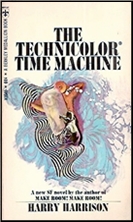
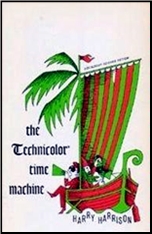
HARRY HARRISON – The Time-Machined Saga. Serialized in Analog SF, March-May, 1967. Published in book form as The Technicolor® Time Machine (Doubleday, hardcover, 1967; Berkley, paperback, 1968).
A movie company finances the construction of an inventor’s time machine, they choose only to make another filmed epic. This time with authentic background, however, with certain alterations in the Hollywood tradition.
Going back to the 11th century, they turn their cameras on the historic Viking expedition to North America. But it is their efforts in promoting the recreated voyage that produces the original – a neat circle in time.
Beginning almost as slapstick, the story gradually settles down to a gentle tongue-in-cheek adventure in time, with nothing else to recommend it. The ending is obvious; something else is hoped for. Actually enjoyable once expectation are lowered.
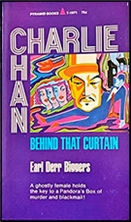
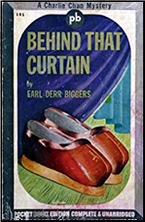
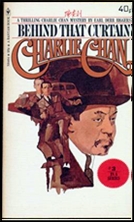
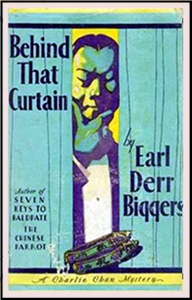
EARL DERR BIGGERS – Behind That Curtain. Charlie Chan #3. Bobbs-Merrill, hardcover, 1928. Reprinted many times in both hardcover and paperback. Films: Fox, 1929; Fox, 1932, as Charlie Chan’s Chance.
This one begins almost immediately after the previous book in the series ended (The Chinese Parrot, 1926). It finds Sergeant Chan of the Honolulu Police still in San Francisco after aiding the police there conclude a case they needed his assistance for. Charlie is anxious to get back home again, as he is about to become a father again – for the eleventh time.
But as things happen in detective mysteries such as this one, fate conspires against him, and he finds himself caught up in helping solve the murder of a retired Scotland Yard detective at a dinner party at which both he and Charlie were honored guests. Although retired, as it turns out, the dead man was still working on a case he had never solved – that of a young married woman who had completely and mysteriously disappeared after a picnic party in faraway India many years earlier.
Was he closing in on a solution? Apparently so, and he had also apparently baited a trap for someone whose secret that person did not want revealed.
There is no shortage of suspects, including a world famous explorer, any number of female characters,, one of whom may even be the missing woman, and of course, a butler whose past he has managed to keep hidden until now. That all of these people have connections with Sir Frederic’s case is amazing but not (as it turns out) purely coincidental.
Working against a self-imposed deadline to return home, and confronted by a homicide detective who, quite naturally, resents any kind of assistance or other threat to his authority, Charlie works quietly and efficiently to bring all of the threads of the plot successfully together. Or at least so it appears: the plot is supremely complicated in a most exquisitely excellent fashion.
Add in a female assistant district attorney, almost unheard of at the time, a bit of 1920s romance, and a charming Chinese detective who continually speaks in the way of all the actors who ever played him in the movies did, and what you get is a Grade A novel that’s been the most fun I’ve had all year in reading.
___
NOTE: Biggers wrote only six Charlie Chan novels before his relatively early death. Later on, two other authors have added two more to the total:
Charlie Chan Returns, by Dennis Lynds (1974)
and Charlie Chan and the Curse of the Dragon Queen, by Michael Avallone (1981)
I’ve owned both over the years, but have not read either. Has anyone?
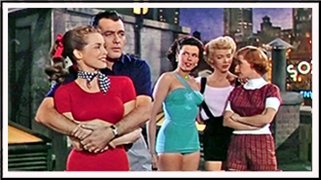
TWO TICKETS TO BROADWAY. RKO Radio Pictures, 1951. Tony Martin, Janet Leigh, Gloria De Haven, Ann Miller, Bob Crosby. Barbara Lawrence. Screenwriters: Sid Silvers & Hal Kanter, based on a story by Sammy Cahn. Director: James V. Kern.
A young girl from Pelican Falls is given a rousing send-off by her home town she she goes off to fame on Broadway. Of course it doesn’t work out that way, not at first, but I wasn’t worried. I just knew that she and her friends would end up on [Bob] Crosby’s TV show.
Lots of singing and dancing and variety acts, much like the old Ed Sullivan program when I was a kid. I found [back then] I could do without the variety acts, and I’ve just learned I still can. Today, though, I can use the old-fashioned fast-forward button on the VCR.
Nero Wolfe on Page and (Small U.S.) Screen:
“Booby Trap”
by Matthew R. Bradley.
Rex Stout took a wartime hiatus from writing Nero Wolfe novels after Where There’s a Will(1940), abridged as “Sisters in Trouble” for The American Magazine (May 1940), which started publishing the novellas with “Bitter End” (November 1940). Introducing the posthumous collection Death Times Three(1985), biographer John McAleer explains that the publisher refused to run an abridgement of Stout’s Techumseh Fox novel Bad for Business(1940), but paid him double to convert it into the Wolfe novella “Where There’s a Will,” adapted in 1969 for the Italian TV series, gives Inspector Cramer his first name, Fergus, and has Wolfe leave home on business for a case involving the Secretary of State.
The first Wolfe collection, Black Orchids (1942), pairs the title novella with “Cordially Invited to Meet Death,†abridged as—respectively—“Death Wears an Orchid†(August 1941) and “Invitation to Murder†(April 1942). The former introduces millionaire, fellow gourmet, and future ally Lewis Hewitt, whose Long Island greenhouse produced the three titular plants, demanded in payment by an envious Wolfe for sparing him embarrassment while investigating a murder. In the latter, he sends eight of those flowers to the funeral of Bess Huddleston, who was murdered with a deliberate infection of tetanus after hiring Wolfe to stop the anonymous poison-pen letters threatening her party-planning business.
Not Quite Dead Enough (1944) also paired the eponymous work (abridged; December 1942) with another first published in The American Magazine, “Booby Trap†(August 1944). Both take place during Archie’s World War II service as Major Goodwin of U.S. Army Intelligence; in the former, he must goad Wolfe—who has been “in training†with chef Fritz Brenner, walking by the river and dieting, to kill Germans, as he did in 1918—to return to work. The returning Lily Rowan is briefly a suspect, and Cramer reveals that Lily’s late father “was one of my best friends. He got me on the force, and he got me out of a couple of tight holes in the old days when he was on the inside at [Tammany] Hall.â€
Also invoked, Captain Albert Cross and Archie’s superiors, Colonel Harold Ryder and General Mortimer Fife, all figure in “Booby Trap.†An anonymous letter to John Bell Shattuck links Cross’s fatal plunge from New York’s Bascombe Hotel with the betrayal of “secrets of various industrial processes,†entrusted to the Army, to “those who intend to engage in post-war competition of the industries involved,†which the congressman’s committee is authorized to investigate. After Wolfe says Cross, tracing stolen “samples†of brand-new H14 grenades, was murdered, Ryder is blown apart by an H14 he’d given Archie as a souvenir for his work on the case, which was returned at Wolfe’s insistence.
Securing Fife’s grudging permission to see General Carpenter in Washington, Ryder had his suitcase already packed, and when sent by Wolfe to remove its remains surreptitiously from the site, Archie finds it gone. Deducing that it was taken by his secretary, Sergeant Dorothy Bruce, Archie is surprised to see Lieutenant Kenneth Lawson, Jr. in the WAC’s apartment when he fetches it and her, and even more so when — en route to Wolfe’s — she offers him $10,000 for it. Claiming that was a test of his loyalty, she is revealed to be the source of the anonymous letter and others; after a private talk with her, Wolfe tells Archie only that the grenade was inside the suitcase, which was booby-trapped to murder Ryder.
Setting his own “booby trap†with props in his office, Wolfe arranges for Archie to watch from concealment as, sequentially, Lawson, Colonel Tinkham, Fife, Shattuck, and Bruce are each left alone there; none does anything clearly incriminating, but with Bruce’s help, Shattuck is exposed.
Working undercover for Carpenter with Lawson, she sent 30 letters to smoke out the traitors, and Ryder was silenced when—shocked by Cross’s murder and his son’s death in combat—he decided to fess up to Carpenter. Wolfe has Archie drive to Van Cortlandt Park, where he gives Shattuck, whose political career is ruined, the chance to commit suicide with another H14, which Carpenter had provided for the “booby trap.â€
Bizarrely, “Gambit†(4/3/81)—an episode of NBC’s Nero Wolfe series starring William Conrad, with Lee Horsley as Archie—took its title from Stout’s 1962 novel, but credits “Booby Trap†as its source. The only entry scripted by Stephen Kandel, later a prolific writer-producer on MacGyver, it was directed by the show’s most frequent contributor, George McCowan; its executive producers, Ivan Goff and Ben Roberts, created Charlie’s Angels and shared an Oscar nomination as co-writers of the Lon Chaney biopic Man of a Thousand Faces (1957). Fritz (George Voskovec), orchid-meister Theodore Horstmann (Robert Coote), Saul Panzer (George Wyner), and Cramer (Allan Miller) were regulars.
Best known as reporter Carl Kolchak in the 1972 TV-movie and ensuing series The Night Stalker, Darren McGavin guest-stars as John Alan Bredeman, first seen in comic mode as a faux service tech, hiding a surveillance system in the brownstone. Patti Davis, daughter of recently inaugurated President Ronald Reagan, plays magazine reporter Dana Groves, seeking an interview with Wolfe, against which he refuses to break a long-standing rule. Kandel rewrites Wolfe’s wartime role as “Butterfly,†commander of an intelligence unit, three members of which died when betrayed by Bredeman—code-named “Filligreeâ€â€”who specialized in demolition, and now plans to kill Wolfe, having served 20 years for it.
After asking Cramer to check on Bredeman, Archie risks bringing Dana to Wolfe, but as he is dressing them down, Bredeman gloats via the intercom that he has cut off the phone, and provides a “demonstration†by blowing up the stove, injuring Fritz. Asserting that he was innocent, he has rigged the whole house and planted a bomb on the elevator, defused by Archie with Wolfe’s guidance. As Dana exults in a juicy story, the staff disables three cameras, so Bredeman threatens death unless they gather in the entry hall, in view of the fourth; intending to slip out through a plant-room window, Archie sends her down, but in the stairwell, Dana—Bredeman’s daughter and accomplice—calls him on a walkie-talkie.
Tipped off, he fires at Archie with a rifle (his aim spoiled by Wolfe tossing a pot through another window), belying his assurance to her that he means no harm to innocents; Fritz and Theodore cut off the power, gas, water, and intercom as Wolfe and Archie seek other explosives. Bredeman sneaks in to face his foe, trying to extract a confession for framing him, yet Wolfe, displaying unusual physicality, disarms him and tells Dana he’d deduced her imposture. In her presence, he confronts Bredeman with the truth: he was absent on the unit’s fatal mission, having alerted the enemy to their route, and over the years, guilt had twisted his mind, but attempting to flee, he falls victim to one of his own booby traps.
Kandel’s “Gambitâ€â€”the last alleged adaptation on Conrad’s series—has little to do with “Booby Trap,†let alone Stout’s Gambit, used in 1971 and 2012 on the Italian series with Tino Buazzelli and Francesco Pannofino, respectively. Sally Blount hires Wolfe to clear her father of a murder charge after he served hot chocolate to Paul Jerin, poisoned while playing 12 simultaneous blindfold games at the eponymous chess club. The murder was a gambit, “an opening in which a player gives up a pawn or a piece to gain an advantage. The [murderer] had no animus for Jerin [who] was merely a pawn. The target was your father,” and Archie gets the proof on tape via a hidden mike in John Piotti’s restaurant.
Where There’s a Will: Avon (1941) Death Times Three: Bantam (1985) Black Orchids, Not Quite Dead Enough: Jove (1979) Gambit in Seven Complete Nero Wolf Novels: Avenel (1983)
Online source [link mislabeled as “Before I Dieâ€]
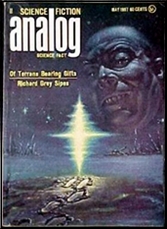
ANALOG SCIENCE FICTION May 1967. Editor: John W. Campbell. Cover art: Kelly Freas. Overall rating: ***
RICHARD GREY SIPES “Of Terrans Bearing Gifts.†Novelette. Quite predictable Analog story of warlike planet defeated by traders from Earth, bringing psionic inventions, especially so since the story begins with the ending. Adequate but annoying. (2)
CHRISTOPHER ANVIL “Experts in the Field.†Another Analog type – bringing in an outsider to solve a problem. This time, that of a culture without a spoken language. (3)
BOB SHAW “Burden of Proof.†Slow glass (*) has another possible use: evidence in a court of law. Excellent idea; good development here. (4)
MIKE HODOUS “Dead End.†Earthmen trick a planet of centaurs into accepting a false FTL drive, Too much scientific terminology thrown around. (2)
HARRY HARRISON “The Time-Machined Saga.†Serial; part 3 of 3. See review of complete novel soon.
– March 1968
(*) From an online website: “Slow glass was an amusing scientific toy. Light traveled through it so slowly that, looking through a pane of it, you might see what had happened five minutes ago on the other side — or five years.”
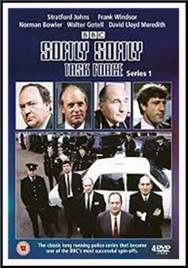
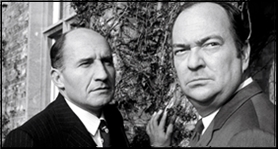
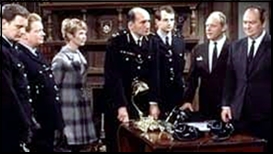
SOFTLY, SOFTLY: TASK FORCE. “Blind Alley.” BBC, UK, December 3 1975 (Series 7, Episode 15). Frank Windsor, Norman Bowler, David Lloyd Meredith Guests: Ralph Michael, Michael Culver. Teleplay: Elwyn Jones (Format Creator). Director: Gilchrist Calder. Streaming online here.
This series that ran from 1969 to1976 was a police procedural that spun off from the famed Z Cars (from 1962 to 1978 and featuring Brian Blessed in a key role as a PC for several seasons) and its own spin-off Softly, Softly(1966-1969) moving the action from Wyvern possibly around Bristol to Thamesford and the city of Kingly where former Chief Inspector Charlie Barlow (Stratford Johns) is promoted to Superintendent and his top Inspector John Watts (Frank Windsor) to Chief Inspector forming a new special department designed to respond quickly to crimes in the area.
There were a number of series regulars over the series run but only a few that appeared in most episodes, with Windsor’s John Watt appearing in the most episodes and replacing Johns as Superintendent when he moved on to another series in Barlow at Largein 1971.
Other regulars over the course of the series were Norman Bowler as Harry Hawkins (who appeared in Softly, Softly from 1966 to 1968) rising from CID Sergeant to Chief Inspector over the series run 1969-1976), the more or less romantic lead; David Lloyd Meredith as Bob Evans (1969-1976) who rises from uniformed Sergeant to Inspector over the series run, a wry Welshman with a nose for crime; PC eventually Sergeant Snow (Terence Rigby 1969-1976) who begins the series as a K9 handler and is eventually promoted to Evans old job; and, Walter Gotell (also Softly, Softly and From Russia With Love, The Guns of Navarone, The Spy Who Loved Me, For Your Eyes Only) as Chief Constable Cullen (1969-1975) their superior, canny political figure as much as policeman.
There was also a short Softly, Softly, Strike Force series in 1984.
Unlike Z Cars and Softly, Softlywhich had many episodes erased by the BBC, all the episodes but one of Task Force are available on YouTube at various sites. Seasons run from thirteen to fifteen episodes and most are self contained although personal struggles and histories carry over from episode to episode and season to season though the series tends to focus on the main characters at work and not at home with only Barlow, Watts, and Hawkins domestic lives explored much.
Along the line of a British 87th Precinctthe series deals realistically with crime and police and there is no guarantee in any episode that the police will triumph and the criminals be caught. Many episodes portray the criminals as human beings caught between their chosen way of life and the police who offer them little room to maneuver. The police aren’t always happy with their own tactics and constraints and are torn between distrust and a natural desire to catch the bad guys and often old relationships with them over the years.
As often as not the final solution is left in the air or the villains to be caught on another day in other circumstances. Like real police work the cases are messy, plans go awry, and innocents caught out by both police and criminals.
The format for the series was created by Elwyn Jones with many episodes written by novelist Alan Prior and at least one by none other than novelist Kingsley Amis.
Frank Windsor’s John Watt is the conscience of the series, a much less high handed and brutal man than Barlow who is portrayed as fairly ruthless and more feared than loved by his men. The camaraderie between higher ranking officers often portrayed in American police series is less noticeable here, the emphasis on discipline and rank however human the officers are. These are human beings, not stereotypes and cartoon figures. This isn’t Dragnet, nor is it car chases and gunfights though there is action in many episodes. Police are vulnerable, fallible, and prone to human mistakes and sometimes butt heads with each other.
In “Blind Alley†Justice Ballantyre (Ralph Michaels), a notable and often strict judge has bought a weekend home in the area and the Task Force is bending over backward to protect him on his weekends when PC Lincoln (Peter Clough 1975-76) of the Mounted Patrol notices someone has been spying on the judge. While the judge is out of town his home is broken into and leaflets are posted on his window and door while the intruder burns FDR into his lawn, a reference to a radical group Ballantyre sentenced to prison, Free The Daventry Resisters.
Meanwhile Sgt. Evans is about to officially receive promotion to Inspector, a secret no one on the force seems able to keep.
When the break-in happens a reporter from London (Michael Culver) shows up claiming he knows the man, a well known radical member of the Daventry Registers, who is willing to surrender to the police, but Watts and Hawkins suspect the man is wanting publicity and they are wary to give it to him, with good reason it seems when the Judge returns and reveals a secret that changes everything.
Things take a more radical change when they snub the confessor who makes an unexpected attack on the judge turning a celebration into a dark finale for the season.
Strong writing, flawed protagonists, solid plots, and a jaundiced view of crime and police marked the series. Certainly weighted in favor of the police point of view the series still managed to present criminals as human beings developing more of a social conscience as time went on over its eight year run. Over the years the series dealt with many serious issues and did so sensitively as well as doing the usual mix of seventies subjects like terrorism and hijacking.
Even if your tastes don’t run to police procedurals the quality of the acting and the writing on this series was exceptionally high. For beginners, I’d dip into a few of the later episodes after the series had its feet and if I liked it — and I did, very much — go back to the beginning. I don’t know about the original Softly, Softly, but a few episodes of Z Cars are on YouTube.
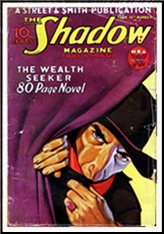
MAXWELL GRANT – The Wealth Seeker. Jove, paperback, 1978. First published in The Shadow Magazine, 15 January 1934.
A wealthy philanthropist’s home is raided twice by criminals, and each time the gangsters are defeated, their leader being killed before being questioned. Since the man’s donations have always been anonymous, who has revealed his identity to the underworld?
There are only three suspects, and of course the obvious one is far too obvious. Walter Gibson, who wrote almost all of The Shadow stories, was terrible as a writer, but he was a dandy magician. He fooled me again, even though I was watching.
Devoted to mystery and detective fiction — the books, the films, the authors, and those who read, watch, collect and make annotated lists of them. All uncredited posts are by me, Steve Lewis.