Suspense & espionage films


SECRET AGENT OF JAPAN. 20th Century Fox, 1943. Preston Foster, Lynn Bari, Noel Madison, Victor Sen Yung, Janis Carter, Steve Geray, Kurt Katch, Addison Richards. Screenwriter: John Larkin. Director: Irving Pichel.

SECRET AGENT OF JAPAN Lynn Bari

   Secret Agent of Japan was the third and final pairing of its two leading stars, Preston Foster and Lynn Bari, the others being Chasing Danger (1939) and News Is Made at Night (1939). This one’s not nearly as good, but there may be a reason for it, and a historical one, at that.

   I’m told, from what I read, that this movie went into production the day after Pearl Harbor, and it was the first film to be released that included the attack as part of the story line. I’m also told that the critics were not particularly fond of the film, quite the contrary, but audiences flocked to it in droves.

   Its official release date was April 3, 1942. Hardly enough time to get a story written and filmed, one that makes a lot of sense, you might think, and true enough, this one doesn’t.

SECRET AGENT OF JAPAN Lynn Bari

   Preston Foster plays an expatriate American (Roy Bonnell) running a bar called the Dixie Bar in Shanghai as the drums of the oncoming war fills the minds of the citizens there, of every nationality, and there are many. Bonnell thinks he knows his way around the city and has an understanding with the Japanese living there, but the latter are growing confident (and menacing) about something.

   Enter Lynn Bari as a spy for the British, on the trail of some valuable jade she says, but with various mail drops, secret codes, and a mysterious death or two, it seems as though her cover story is not long to last, nor does it. (Poor Janis Carter, as Bari’s companion in the spying business. Her part is too short to make much of an impression, much less to warrant a listing so high up in the credits, but to her credit, she does and she is.)

   The tale gets a twist or two from there along the way, with the various parts never coming together as a whole, but the audience in 1942 knew what was going on well enough, I’m sure, and the ending of course, is a happy one. The movie doesn’t stand up well today, but the people involved with it weren’t making it for viewers some 70 years later. They were making it for another audience altogether.

SECRET AGENT OF JAPAN Lynn Bari

CHASING DANGER Preston Foster

CHASING DANGER. 20th Century Fox, 1939. Preston Foster, Lynn Bari, Wally Vernon, Henry Wilcoxon, Joan Woodbury, Harold Huber, Jody Gilbert. Director: Ricardo Cortez.

   In Chasing Danger Preston Foster and Wally Vernon play a couple of world-traveling news photographers who stumble across the source of arms and ammunition for a group of Arab rebels in French Algeria. Of the two, Foster’s the brains of the pair, so to speak, while Vernon plays the dumb sidekick to near perfection. (He spends most the movie mooning over his fiancee back in Brooklyn, where their wedding is supposed to be taking place.)

   Lynn Bari is the previously mentioned source. Her mother being Arabian, her sympathies are with the rebels, but her source of funds are questionable, the latter being a cache of jewels her accomplice in arms-running (Harold Huber) has in his possession, he being a crook who disappeared with them several months earlier while making a getaway flight across the Channel to England.

CHASING DANGER Preston Foster

   For a short movie (my copy runs only 50 minutes or so) the plot is both complicated and simple, once you’ve sorted it all out. It’s pretty much action (and a little leering) all the way, nothing more, nor nothing less.

   Don’t go out of your way for this one, but it’s done with a certain amount of expertise that might surprise you. If it comes along and you’re a fan of this kind of semi-half-baked foreign adventure, I’d say give it a try.

LATER.   After writing the comments above, I made a discovery that I couldn’t find an easy way to work into my review, so I’ll talk about it here instead. This is the second in a series of two movies to have featured this somewhat comedic pair of adventuresome cameramen.

CHASING DANGER Preston Foster

   The first one was Sharpshooters (1938), but it was Brian Donlevy who played the part of Steve Mitchell in that earlier one, not Preston Foster. (I always thought they looked something alike.)

   Lynn Bari was in the first one also, but playing a different part. I’ve not been able to track down a copy, and I’d really like to. But getting back to Steve Mitchell, what’s kind of interesting about this is that’s the name of character played by Brian Donlevy in his 1950s TV espionage series, Dangerous Assignment.

   Coincidence or not, I don’t know.

DAMSELS IN DISTRESS, PART ONE
by Walter Albert         


JULIE Doris Day

JULIE. MGM, 1956. Doris Day, Louis Jourdan, Barry Sullivan, Frank Lovejoy, Jack Kelly, Ann Robinson, Barney Phillips, Jack Kruschen, John Gallaudet, Carleton Young. Screenwriter-director: Andrew L. Stone.
   I must admit that I have never been fond of those damsel-in-distress films in which an anxious heroine (her brow is usually creased), married to a homicidal maniac, is so enamoured of her prospective murderer that she can’t bear to take the most elementary precautions to protect herself.

   A typical example of this genus horribilis is Julie, starring Doris Day, Louis Jourdan, and Barry Sullivan. Day plays an airline stewardess who loses her bearings when she’s on the ground and marries handsome psycho Jourdan after her first husband dies under circumstances which are only mysterious to her.

JULIE Doris Day

   Barry Sullivan plays the attentive other man hovering protectively around Julie with little success in persuading her that her husband is up to no good, again. Eventually, Julie is alone in an apartment to which Jourdan has traced her and when I unexpectedly had to leave the room, she was pacing nervously while the camera cut frequently to shots of Jourdan closing in.

   When I returned, to my surprise I found that Julie, with grim but plucky determination, was attempting to land a very large plane. The pilot was nowhere to be seen, the co-pilot kept lapsing into a coma from which an attentive man (not Barry Sullivan) kept reviving him, and a phalanx of air controllers was giving landing directions from the flight tower of an airport which she was probably in imminent danger of demolishing.

   In line with my policy of not revealing endings. I will draw a discreet curtain over the remaining action.

— Reprinted from The MYSTERY FANcier,
       Vol. 7, No. 2, March-April 1983.


JULIE Doris Day

THE RUSSIA HOUSE Sean Connery

THE RUSSIA HOUSE. 1990. Sean Connery, Michelle Pfeiffer, Roy Scheider, James Fox, Klaus Maria Brandauer, John Mahoney, Michael Kitchen, J.T. Walsh, Ken Russell. Based on the novel by John le Carré. Director: Fred Schepisi.

   I haven’t read the novel, and if I hadn’t recently seen the movie, I probably never would have. For one reason or another, none good, spy fiction hasn’t been a major portion of my reading diet for some time. But there is a chance I’ll read it now, if only to find out what was in the book that wasn’t in the movie.

   There’s no way, the way I see it, that a long book (which I assume le Carré’s book was) could be condensed down into a film that was less than two hours long.

THE RUSSIA HOUSE Sean Connery

   Or at least that’s how I felt as we were leaving the theater. Something was missing. And the something that was missing was the feeling that something had happened during the course of the movie, other than (I grant you) a successful romance between Sean Connery (playing a disheveled semi-idealistic British publisher) and Michelle Pfeiffer, as a Russian go-between delivering him a manuscript from a dissident Soviet scientist (Blandauer).

   As one of the various British or American agents who get caught up in the story says, somewhere close to the end, “Well, we’re back to square one.”

THE RUSSIA HOUSE Sean Connery

   As a spy or espionage novel, rather than a romance, there’s a moderate amount of suspense that builds up before the ending, but none of the edge-of-the-seat variety. Curiously, a number of incidents occur that appear to be of major significance, but nothing seems to happen as a result. Actions, whether performed under duress or not, never appear to have consequences.

   There are scenes in which Sean Connery’s characters is wired for sound. There are others, especially when it would have counted the most — or that is to say, when the plot counts on it — he is not. What a clunky way to run an intelligence operation.

   The acting is uniformly terrific. Michelle Pfeiffer never looked lovelier. The scenery — apparently the movie was filmed in Russia — is even better. The story is what needed some help.

— Reprinted from Mystery*File 28,
       February 1991 (moderately revised).


[UPDATE] 05-12-12. Of course there is the possibility that I missed something subtle, or even not so subtle. And if so, I am sure that someone reading this will tell me what it was. I only vaguely remember the details of the movie itself — it was over 20 years ago — but strangely enough, I do remember the theater Judy and I went to see it in, and I do remember how well-filmed it was.

THE RUSSIA HOUSE Sean Connery

TORN CURTAIN. Universal, 1966. Paul Newman, Julie Andrews, Lila Kedrova, Tamara Toumanova, Wolfgang Kieling, Ludwig Donath, David Opatoshu, Gisela Fischer, Carolyn Conwell, Gloria Gorvin. Original music: John Addison. Director: Alfred Hitchcock.

TORN CURTAIN Hitchcock

   This is generally considered to be one of director Hitchcock’s lesser successes, and I think I’d go along with that, but not necessarily for the same failures that other moviegoers (and critics) have seen.

   My wife and I watched this the other evening on one of the Cinemax channels for the first time since it was first released. The funny thing is she didn’t remember it at all, and the scene I remembered, I only thought I did. This is the one in which Paul Newman (as a bogus turncoat physicist) is trying to obtain a secret formula from his counterpart in East Germany (Ludwig Donath) standing together at a blackboard in a deserted classroom.

   You might call this dueling with chalk and erasers. At the time I thought the scene was hilarious, being a math student at the University of Michigan myself.

TORN CURTAIN Hitchcock

   Erasing parts of equations and replacing them with bits and pieces of others: sines, cosines, vectors and tensors? It was fun to see at the time, and it was fun to see the other night.

   What I didn’t remember was that this scene took place in such a small room. I remembered it happening in the large lecture room across the hall, and it’s funny what kind of tricks you mind plays on you. I have a feeling now that half the things that I remember happening to me over the years never happened the way I remember them, and it’s a eerie feeling, I can tell you.

TORN CURTAIN Hitchcock

   Playing opposite Newman is another huge star at the time, Julie Andrews. She’s his assistant and bewildered fiancée who with great determination — and most definitely against his wishes — follows him on this grandly noble act of undercover academic espionage.

   It is obvious that chaps like Newman who find themselves in capers like this really, really ought to tell their fiancées what it is that they’re doing. All that petty deceptions do — and the petty deceptions those deceptions require — is to make only bigger messes of everything, including escapes, when the time comes.

TORN CURTAIN Hitchcock

   The script, then, it what I found to be the problem. Too much silly rigmarole in making contacts, et cetera, too little planning, too little communication, and I didn’t believe a word of it. Paul Newman is also too brooding – method acting? – and too self-centered.

   If I were about to get married to someone who looked like Julie Andrews, I would do almost anything to make sure I didn’t mess it up. She acts like she cares for him; there’s no chemistry at all in return, no lights in his eyes the other way around.

   Two big stars, then, not quite compatible, whose combined salaries left too little in the budget for a decent story, better matte shots, and less reliance on phony looking rear projection.

TORN CURTAIN Hitchcock

   Which is not to say that Mr. Hitchcock lost his touch completely in making this film. Newman finds himself shocked at his first attempt at killing a man (Wolfgang Kieling, as the East German agent who discovers his double-dealing duplicity), a killing that is not at all easy – the scene that everyone agrees upon as being the standout, and the one most remembered, in the entire movie. It’s a dandy, all right, no doubt about it. This is the kind of scene you watch a Hitchcock movie for.

TORN CURTAIN Hitchcock

   On the other hand, I liked Lila Kedrova’s performance as the expatriate Polish Countess Kuchinska even more, although a number of commenters on IMDB thought it one of the worst aspects of the film.

   What dunderheads! (Figuratively speaking, of course.) Needing a sponsor to make her way out of East Germany and on to America, and having recognized Newman and Andrews as spies on the run, she is torn between coyly requesting and silently pleading for them to help — trying desperately to keep her emotions from showing on her face and not succeeding.

   Newman (as is his wont throughout the movie) is stolidly not impressed by this small petty form of blackmail. It is Julie Andrews’ character who is won over. Good for her! This is the scene that I will remember now until the time I shall see the movie again.

TORN CURTAIN Hitchcock

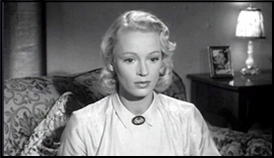
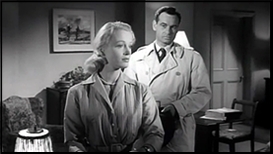
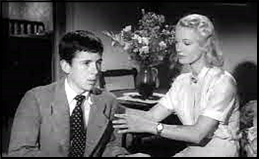
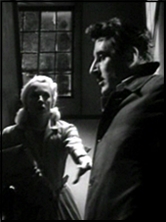
THE VICIOUS CIRCLE John Mills

  THE VICIOUS CIRCLE. Romulus Films, 1957. Also released as The Circle. John Mills, Derek Farr, Noelle Middleton, Wilfrid Hyde White, Roland Culver, Mervyn Johns, Rene Ray, Lionel Jeffries. Screenplay: Francis Durbridge, based on his BBC-TV serial, My Friend Charles. [See comment #1.] Director: Gerald Thomas.

   This is one of those movies in which the hero, in this case Dr. Howard Latimer (John Miles), finds himself trapped in a series of strange events that culminate in his being the number one suspect in a case of murder. This time around, the dead girl is an actress from Germany that a producer friend (just in from the US) asks him to pick up at the airport.

   Accompanying him to the airport is a newspaper reporter who (as it turns out) the paper never heard of, nor is the producer even in the country. The dead girl is in Latimer’s apartment when he returns later.

THE VICIOUS CIRCLE John Mills

   How and why? He has no idea. Not helping either is the patient who’s been referred to him by another doctor (who has never seen her), but who complains not only of migraines but also of dreams involving a body and a brass candlestick.

   Two guesses what the blunt instrument was that caused the death of the woman in his apartment? Or in whose car it is found?

   This is also one of those movies that is too complicated for its own good. There is an attempt to explain all this, and it’s a pretty good attempt too, until the movie’s over and you wonder what on earth were you thinking?

   One large problem is that it is clear that the detective from Scotland Yard, Detective Inspector Dane (Roland Culver), does not take the case against Dr. Latimer all that seriously, alleviating most of the suspense. Either Cornell Woolrich (author) or Alfred Hitchcock (director) or the combination thereof, could have taken the first 20 minutes and run for a mile with it.

   Since neither of the two were on hand, all we have is a mildly amusing puzzle to undo, nothing more, but nothing less, either. All the players are professionals, even if relatively unknown in this country, then or now.

REVIEWED BY DAN STUMPF:         


DEADLIER THAN THE MALE

DEADLIER THAN THE MALE. Universal, 1967. Richard Johnson, Elke Sommer, Sylva Koscina, Nigel Green, Suzanna Leigh, Steve Carlson, Virginia North. Story & screenplay by Liz Charles-Williams, David D. Osborn & Jimmy Sangster, based on the characters created by Herman C. “Sapper” McNeile. Director: Ralph Thomas.

   Compared to the Dick Barton film (reviewed here ), there’s nothing as pre-adolescent in Deadlier Than the Male, which is firmly adolescent in its imitation-Bond fantasies.

   I must have seen this six times in my Senior year of High School, and I tried hard to convince my serious-film-student friends there was something really worthwhile there amid the sex, violence and Eastman Color. They told me that even I should be grown-up enough to reject this mindless rubbish, but it became available on video recently and I enjoyed it all over again.

DEADLIER THAN THE MALE

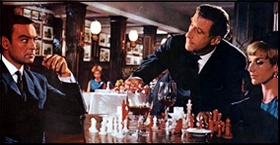
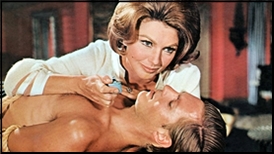
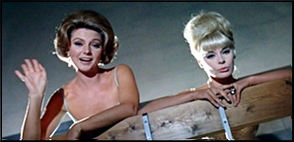
   This was the first Bulldog Drummond movie in about 20 years, and the producers approached it with B-movie gusto, garnished it with sexy assassins (Elke Sommer and Sylva Koscina, whose un-self-conscious bad acting seems quite fitting here), a scar-faced Chinese bodyguard, a giant chess game and Nigel Green’s droll villainy, all splashed across colorful locations tricked out with James Bond-style fights and wise cracks.

   I have to agree with my old friends about its artistic merits, but the thing is infused with such a low-budget, gee-wouldn’t-it-be-fun-to-make-a-movie elan that if you haven’t read any good comic books lately, you might like it.

   By the way, Bulldog Drummond is incarnated here by actor Richard Johnson, who also impersonated British Icons, Lord Nelson and Nayland Smith in films that were much less fun.

DEADLIER THAN THE MALE

Next Page »