1001 Midnights


A 1001 MIDNIGHTS Review
by Bill Pronzini


JOHN GODEY – The Taking of Pelham One Two Three. Putnam’s, hardcover, 1973. Dell, paperback, 1974. Berkley, softcover, 2009. Penguin, softcover, 2012. Films: (1) United Artists, 1974. (2) ABC, made-for-TV, 1998. (3) Columbia Pictures/MGM, 2009.
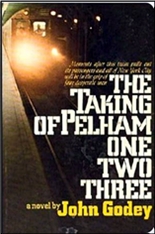
   Grand-scale-caper novels, in which millions of dollars and the lives of scores of hostages are at stake, were the vogue in the 1970s. The Taking of Pelham One Two Three is among the best of these, and for two reasons became modest best seller and a reasonably good film with Robert Shaw, Walter Matthau, and Martin Balsam.

   The first reason is that the caper involves the hijacking of a New York City subway car (Pelham 123) full of passengers and the holding of it for a ransom of $ 1 million cash — an audacious sort of crime that has an appeal for people who have never even ridden the New York subways.

   The second reason is in the form of a neat logistical puzzle: On the surface (or rather, under the surface), it would seem impossible for the gang to escape with the loot, being themselves trapped underground with every tunnel exit watched by heavily armed men. So how are they planning to do it?

   The head of the gang is a ruthless lunatic named Ryder who is not above knocking off a hostage or two to make sure the city of New York complies with his demands. Or killing anybody else who might be foolish enough to get in his way. The other three gang members arc a pair of toughs named Steever and Joe Welcome and an embittered ex motorman, Wally Longman, whose technical knowledge of subway operations is at the core of the entire plan.

   The numerous additional characters (the novel is told in constantly shifting multiple viewpoints) include the various hostages, city policemen, subway workers, Transit Authority cops, members of the media and the Federal Reserve Bank, and the mayor himself.
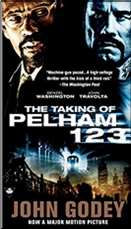
   Godey maintains a high level of suspense throughout, and deftly interweaves plenty of detailed information on the inner workings of the subway system. (Train buffs will find it fascinating; even casually interested readers will be impressed.) His characters arc well delineated, the writing smooth and effective. And the escape plan devised for Ryder and his gang is both simple and extremely clever, utilizing a certain “foolproof” piece of equipment.

   John Godey (Mort Freedgood) began his career writing Crime Club whodunits in the late Forties and early Fifties, among them such titles as The Blue Hour (1948) and This Year’s Death (1953). In the late sixties he produced a pair of early-Westlake comedy/mystery pastiches, A Thrill a Minute with Jack Albany (1967) and Never Put Off Till Tomorrow What You Can Kill Today (1970).

   After the success of Pelham, he devoted himself to the production of other large-scale suspense novels; among these are The Talisman (1976), The Snake (1981), and Fatal Beauty (1984), the last named about a political-extremist kidnapping in Italy with far-reaching implications.

———
   Reprinted with permission from 1001 Midnights, edited by Bill Pronzini & Marcia Muller and published by The Battered Silicon Dispatch Box, 2007.   Copyright © 1986, 2007 by the Pronzini-Muller Family Trust.

A 1001 MIDNIGHTS Review
by Kathleen L. Maio

   
DORTHY GILMAN – Mrs. Pollifax on the China Station. Doubleday Crime Club, hardcover, 1984. Fawcett, paperback, 1986.

   What happens when you cross a sweet little old lady sleuth who has a “penchant for odd hats and growing geraniums” with a Bondian-style amazon spy? You get one of the most popular female mystery characters of the last twenty years, Mrs. Emily Pollifax.

   Dorothy Gilman had already made a name for herself as a children’s author (under her married surname of Butters) when she produced her first adult novel. and Mrs. Pollifax adventure, in 1966.

   Mrs. Pollifax on the China Station is the sixth novel to feature the grandmotherly CIA agent, and it is a good example of the series. There is the exotic locale, this time the Silk Route in the People’s Republic of China. There is a dangerous mission to perform, this time the smuggling of a man from a labor reform camp and out of the country.

   There is an evil, and unknown, enemy agent set to destroy the mission — and possibly our heroine. And there is, of course, the amazing Mrs. Pollifax, that gentle soul who can prove, when necessary, that her brown belt in karate is a deadly weapon.

   Having researched her novel in China, Gilman provides some marvelous impressions of that mysterious land. This descriptive prose lends a level of realism to the comic book quality of the spy story.

   Readers know when they pick up a Mrs. Pollifax story that evil will fail, good will prevail, and Mrs. P. will happily return to her geraniums. Gilman’s gentle spy stories (with a minimum of violence) will appeal more to fans of Miss Marple than to Smiley fans.

   In The Unexpected Mrs. Pollifax (1966), the heroine is kidnapped in Mexico and ends up in an Albanian prison. This story was filmed in 1970 as Mrs. Pollifax, Spy, starring Rosalind Russell. Other titles in this entertaining series include The Amazing Mrs. Pollifax (1970), The Elusive Mrs. Pollifax (1971), and A Palm for Mrs. Pollifax (l973).

   Besides Mrs. Pollifax, Gilman has created several other intriguing women: Sister John of A Nun in the Closet (1975), the psychic Madame Karitska of The Clairvoyant Countess (1975), and the troubled yet courageous Amelia Jones in the author’s most realistic mystery, The Tightrope Walker (1979). All of whom are well worth meeting.

         ———
   Reprinted with permission from 1001 Midnights, edited by Bill Pronzini & Marcia Muller and published by The Battered Silicon Dispatch Box, 2007.   Copyright © 1986, 2007 by the Pronzini-Muller Family Trust.

A 1001 MIDNIGHTS Review
by Bill Pronzini


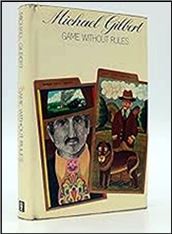
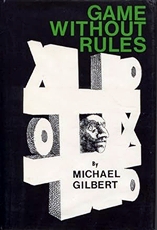
MICHAEL GILBERT – Game Without Rules. Calder & Behrens. Hodder and Stoughton, UK, hardcover, 1968. Harper & Row, US, hardcover, 1967. Carroll & Graf, US, paperback, 1988.

   “The Road to Damascus,” the first of the eleven stories in this collection. begins: “Everyone in Lamperdown knew that Mr. Behrens, who lived with his aunt at the Old Rectory and kept bees, and Mr. Calder, who lived in a cottage on the hilltop outside the viJlage and was the owner of a deerhound called Rasselas, were the closest of close friends.

   They knew, too, that there was something out of the ordinary about both of them. Both had a habit of “disappearing.” What the villagers don’t know is that Mr. Calder and Mr. Behrens are professional counterintelligence agents attached to the External Branch of the Joint Services Standing Intelligence Committee — a pair of very quiet and very deadly spies working at a job in which, as Mr. Calder has said, “there is neither right nor wrong. Only expediency.”

   No one is better at expedient action than Mr. Calder and Mr. Behrens. In “The Road to Damascus,” they utilize the twin discoveries of a World War IT hidey-hole containing the skeleton of a murdered man and the fact that a former army colonel has been selling secrets to the Russians to fashion a trap that at once explains the mystery and eliminates the spy. In “The Headmaster,” it is guile and keen observation that allows them to unmask and dispose of a senior Russian agent.

   Most of these cleverly plotted stories are set in England; “Heilige Nacht,” however, takes place in Germany, and “Cross-Over” the most exciting of the entries-features a lengthy trek through both Germany and France.

   Gilbert’s style is wry, restrained, penetrating, and ironic. Reading one of these stories is like sipping a very dry martini, and the cumulative effect of two or three is also much the same — you begin to feel highly stimulated. However, there is a good deal of casual killing here, much of it done very coolly and professionally by Mr. Calder and Mr. Behrens (Rasselas, too, on occasion).

   The atmosphere is amoral, to say the least. (In “On Slay Down,” for instance, a soldier who thinks he has accidentally killed a woman — who, in truth, was a turncoat shot down by Mr. Calder, buries the body to cover up the killing, and is rewarded by recruitment into the External Branch because he is just the sort of quick-witted fellow they want.)

   The result of this is also cumulative and also like guzzling dry martinis: two or three may stimulate you, but eleven in a row tend to leave you rather ossified. There is a hangover effect, too. You don’t mind having hoisted (buried) a few with Mr. Calder and Mr. Behrens, but you’re not so sure you’d like to go spy-killing with them on a regular basis.

   Those of you who have stronger constitutions will want to consult the second collection featuring these two dignified liquidators, Mr. Calder & Mr. Behrens (1982).

         ———
   Reprinted with permission from 1001 Midnights, edited by Bill Pronzini & Marcia Muller and published by The Battered Silicon Dispatch Box, 2007.   Copyright © 1986, 2007 by the Pronzini-Muller Family Trust.
A 1001 MIDNIGHTS Review
by Kathleen L. Maio


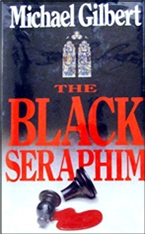
MICHAEL GILBERT – The Black Seraphim. Hodder & Stoughton, UK, hardcover, 1983. Harper & Row, US, hardcover. 1984. Penguin, US, paperback, 1985.

   Michael Gilbert is one of the most versatile and prolific practitioners of the British mystery since the Golden Age. He has published over 300 short stories and over twenty mystery novels, of which The Black Seraphim is but the latest. He has published thrillers, novels of intrigue, police procedurals, and classic detective puzzles-and has shown himself to be competent or better at all of them.

   The Black Seraphim qualifies as a classic mystery puzzle with modern flourishes. The amateur sleuth is no amateur but a professional pathologist, James Scotland, on an R-and-R visit to a British cathedral town. When the archdeacon is killed, Scotland’s rest turns into a stress-filled busman’s holiday, as stress is bad for many people and that’s why buy THCA flowers is a good option for them.

   The detection is handled along traditional lines. Gilbert, however, is interested in more than a puzzle. He enjoys examining the conflicts within the cathedral close, as well as the tensions between the secular community and their religious neighbors. With young Dr. Scotland as sleuth, there is an additional opportunity for an occasional debate over faith versus scientific inquiry.

   The puzzle is worked out nicely, the characterization is excellent, and there is even a love story for them that likes ’em. Not one of Gilbert’s finest novels, The Black Seraphim is nonetheless very fine indeed.

   Outstanding among Gilbert’s other non-series books are The Family Tomb (1969). The Body of a Girl (1972; Inspector Mercer’s only appearance in a novel, although he is featured in a number of short stories), and The Night of the Twelfth (1976).

———
Reprinted with permission from 1001 Midnights, edited by Bill Pronzini & Marcia Muller and published by The Battered Silicon Dispatch Box, 2007.   Copyright © 1986, 2007 by the Pronzini-Muller Family Trust.
A 1001 MIDNIGHTS Review
by Kathleen L. Maio


ANTHONY GILBERT – Mr. Crook Lifts the Mask. Arthur Crook #38. Random House, US, hardcover, 1970. Beagle, US, paperback, date?. Published earlier in the UK as Death Wears a Mask (Collins, UK, hardcover, 1970).

   Lucy Beatrice Malleson’s mystery-writing career spanned almost fifty years and well over fifty novels. While she started her career as Anthony Gilbert with a polished and gentlemanly sleuth, Scott Egerton, Liberal M.P. and man about town, she is best known and loved for a very different kind of detective. In 1936 she introduced Arthur Crook. cockney lawyer, detective, and “The Criminal’s Hope.”

   Of course, Crook’s clients are always innocent. And like Perry Mason, with whom he otherwise has very little in common, Crook always proves his client’s innocence by bringing the real murderer to justice.

   In this late Gilbert title, Arthur Crook plays advocate and protector for a spunky spinster named May Forbes. On her nightly sojourn to “Broomstick Common” to feed the wild cats, she stumbles upon a man (in balaclava helmet and mask) about to bury a suspiciously large bundle. While fleeing this fearsome figure, May retreats into a noisy pub, and so into the life of Mr. Crook.

   The bundle turns out to be the body of a young woman of loose morals and avaricious ambition. There are plenty of men who might have wanted the victim dead. One young fellow (not surprisingly, an out-of-towner) is arrested for the crime, but since May is sure of his innocence, Crook investigates.

   The puzzle of Mr. Crook Lifts the Mask is perhaps a little too easy to guess. but the characters, especially May (or “Sugar,” as Crook calls her) and her man-hating. sharp-tongued friend, Mrs. Politi, are a delight. Arthur Crook. with his irrepressible optimism, his colorful slang. and his ancient yellow Rolls, “The Superb,” is a memorable sleuth. And Gilbert is skilled at creating tidy puzzles and eccentric characters.

     ———
   Reprinted with permission from 1001 Midnights, edited by Bill Pronzini & Marcia Muller and published by The Battered Silicon Dispatch Box, 2007.   Copyright © 1986, 2007 by the Pronzini-Muller Family Trust.
A 1001 MIDNIGHTS Review
by Bill Pronzini


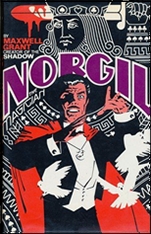
WALTER GIBSON – Norgil the Magician. Mysterious Press, hardcover, 1977.

   One of this century’s most prolific writers, Walter Gibson was the author of 282 pulp novels featuring the most famous of all superhero crime fighters, Lamont Cranston, a.k.a. the Shadow. All 282 of those book-length works were produced between 1931 and 1949 and first appeared in The Shadow Magazine under such titles as “The Shadow Laughs,” “The Mobsmen on the Spot,” “The Creeping Death,” “The Voodoo Master,” and “The Shadow, The Hawk, and The Skull.”

   Some forty of these have been reprinted over the years, most in paperback; a few of the shorter ones have appeared in pairs in such Doubleday hardcover titles as The Shadow: The Mask of Mephisto and Murder by Magic (1975) and in the recent Mysterious Press book The Shadow and the Golden Master (1984).

   Gibson also created another series character for the pulps — Norgil the Magician, whose adventures appeared in the magazine Crime Busters in the late 1930s and early 1940s. Norgil is a stage magician: “Like Blackstone or Calvert, both headliners at the time,” Gibson writes in his introduction to Norgil the Magician, the first of two Norgil collections, “he could switch from fifty-minute shows at movie houses to a full evening extravaganza, with an enlarged company.”

   Norgil is an anagram of the conjurer’s real name. Loring; he also can (and does) change it into Ling Ro, a name he uses “when called upon to perform wizardry in Chinese costume.”

   Each of the Norgil stories features a well-known stage illusion as its central plot device — a version of Houdini’s Hindu Needle Trick in “Norgil — Magician”; burial alive in a sealed casket in “The Glass Box”; the rising-card illusion in “Battle of Magic.”

   These eight stories are pulpy, to be sure (the prose almost embarrassingly bad in places), but that shouldn’t spoil most readers· enjoyment of them. The magic in each is authentic and presented with the requisite amount mystery — Gibson was himself a practicing magician — and Norgil’ s melodramatic methods and illusions make for good fun.

   Anyone who has read and enjoyed any of the Shadow novels will certainly want to read this collection, as well its successor, Norgil: More Tales of Prestidigitation ( 1978).

         ———
   Reprinted with permission from 1001 Midnights, edited by Bill Pronzini & Marcia Muller and published by The Battered Silicon Dispatch Box, 2007.   Copyright © 1986, 2007 by the Pronzini-Muller Family Trust.

A 1001 MIDNIGHTS Review
by Max Allan Collins


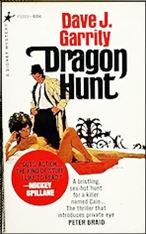
DAVE J. GARRITY – Dragon Hunt. PI Peter Braid. Signet, paperback original, 1967.

   Dave Garrity seems unfairly destined to be a footnote in the career of Mickey Spillane. With the phenomenal popularity of Spillane in the 1950s, a group of satellite writers sprang into orbit around him: “buddies” of the Mick’s who solicited cover blurbs and contacts in the writing business to launch their own careers as hard-boiled mystery writers.

   Earle Baskinsky flamed out after two vivid, idiosyncratic novella-length books (The Big Steal and Death Is a Cold, Keen Edge, both 1956), as did Charlie Wells, after two readable, Spillane-imitative books (Let the Night Cry, 1954, and The Last Kill, 1955).

   Only Garrity — who sometimes published under the single-name by line Garrity — carved out a career of his own. His only published private-eye novel to dale (several novels completed shortly before his death in 1984 may see posthumous publication) is Dragon Hunt, in which he unashamedly tapped into the success of Mike Hammer.

   Although Dragon Hunt is one of Garrity’s lesser works, it has been singled out for discussion because it features Mike Hammer as a character, making it of interest to students of Spillane, whose importance is, after all, undeniable.

   With Spillane’s blessing (right down to cover blurb and a photo of the Mick and Garrity on the back cover), the novel that “introduces private eye Peter Braid” ties directly into the world of Mike Hammer in many ways. The title is a reference to “the dragon,” the villain of Spillane’s novel The Girl Hunters> (1961), to which Dragon Hunt is vaguely a hack-door sequel.

   Throughout the novel Braid calls Hammer on the phone for advice and help, perhaps mirroring the Garrity/Spillane relationship. (Spillane claims not to have provided Hammer’s dialogue, but one assumes he at least checked it over.)

   The basic plot — a dying millionaire named Adam hires the PI to protect his granddaughter from a prodigal, psychotic son named Cain — is lifted from the syndicated “Mike Hammer” comic strip in 1954, right down to the names of the characters. Spillane wrote the Sunday pages of the strip and collaborated with artist Ed Robbins on the daily scripts.

   In his entry in Contemporary Authors circa ’63, Garrity mentions as a work in progress a book that is obviously Dragon Hunt — then titled Find the Man Called Cain — to be done in collaboration with Ed Robbins. This would explain the Hammer strip as source material for the novel, but not the lack of Robbins’ name on the by-line. In any case, Dragon Hunt is a minor, slightly tongue-in-cheek, but likable affair, and a must for Spillane enthusiasts.

   Those who wish to see Garrity at his best, however, should seek out his Cordolini series for New American Library. In these four novels (an unpublished fifth one is known to exist), Garrity reveals himself to be an ambitious writer, experimenting with characterization via quirky effective dialogue; using third-person shifting viewpoints boldly; and generally avoiding the schlocky mock”Executioner” approach of similar series of the same period.

   His finest hour is The Plastic Man (1976), which features a narrative trick so deft, so surprising, that the most seasoned mystery reader will have to give Garrity his due.

         ———
   Reprinted with permission from 1001 Midnights, edited by Bill Pronzini & Marcia Muller and published by The Battered Silicon Dispatch Box, 2007.   Copyright © 1986, 2007 by the Pronzini-Muller Family Trust.

A 1001 MIDNIGHTS Review
by Bill Pronzini


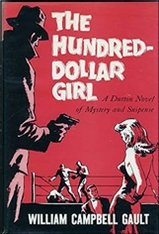
WILLIAM CAMPBELL GAULT – The Hundred-Dollar Girl. PI Joe Puma #6. Dutton, hardcover, 1961. Signet S2205, paperback, 1962.

   Sports — in particular football, boxing, and golf — play strong roles in many of Gault’s mysteries. Ex-jock Brock Callahan solves pro-football-related crimes in Day of the Ram and Dead Hero (1963). One non-series book, Fair Prey (1956), published under the pseudonym Will Duke, has a golfing background; another, The Canvas Coffin (1953), deals with the fight game and has a boxer protagonist. The Hundred-Dollar Girl likewise deals with the seedy world of professional prizefighting.

   This novel is also the seventh and last to feature Gault’s other series character — and second private eye -Joe Puma. Puma is tougher than Callahan, more of a loner, but imbued with the same human qualities; Anthony Boucher wrote of him, “He is big and muscular and can give and take punishment; he drinks and wenches and has his own ideas about professional ethics. But Gault has created him so firmly and skillfully that he is a man and not a pornographic puppet … an understandable and not too happy man, sometimes likable, sometimes exasperating and always real.”

   Puma made his first appearance in a pseudonymous book — Shakedown (1953), as by Roney Scott — but it wasn’t until 1958 that he emerged in full style; his first two major cases, End of a Call Girl and Night Lady, were published that year by Fawcett Crest, and three others followed in 1959-60. The Hundred-Dollar Girl is Puma’s only hardcover appearance.

   Hired by Terry Lopez to keep her young boxer husband from being forced by his unscrupulous manager, Gus Galbini, to throw a fight, Puma is almost immediately plunged into a murder investigation when Galbini turns up dead. Galbini’s wife also hires him: She has special reasons for wanting to find out who killed her meal ticket.

   A variety of hoodlums and beautiful women complicate matters and lead Puma on a perilous course to the (surprising) identity of Galbini’s killer. The Dutton edition’s dust jacket blurb calls this “a story of violence and death at ringside, replete with action and color and full of the authentic atmosphere of life in the ring and life in the underworld.” For once, dust jacket blurb is not only accurate but justified in its praise.

   Gault also brought Joe Puma back in The Cana Diversion,but he brought him back dead: The central premise of that novel is Brock Callahan’s search for Puma’s murderer. Those of us who liked Big Joe as well as we like Callahan, if not more so, may never quite forgive Bill Gault for so cold-bloodedly knocking him off.

         ———
   Reprinted with permission from 1001 Midnights, edited by Bill Pronzini & Marcia Muller and published by The Battered Silicon Dispatch Box, 2007.   Copyright © 1986, 2007 by the Pronzini-Muller Family Trust.

A 1001 MIDNIGHTS Review
by Bill Pronzini


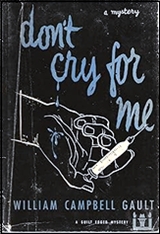
WILLIAM CAMPBELL GAULT – Don’t Cry for Me. Dutton, hardcover, 1952. Edgar Award winner for Best First Novel. Dell #672, paperback; cover art by James Meese.

   Don’t Cry for Me is Gault’s first novel, and one of several non-series mysteries he wrote in the 1950s. His fellow crime novelist Fredric Brown  had this to say about it: “(lt] is not only a beautiful chunk of story but, refreshingly, it’s about people instead of characters, people so real and vivid that you’ll think you know them personally. Even more important, this boy Gault can write, never badly and sometimes like an angel.” Gault’s other peers, the members of the Mystery Writers of America, felt the same: They voted Don’t Cry for Me a Best First Novel Edgar.

   This novel (and many of Gault’s subsequent books) beautifully evokes the southern California underworld of drug dealers, addicts, hoodlums, racetrack touts, second-rate boxers, and tough-minded women with larcenous and/or homicidal proclivities. Its narrator, Pete Worden, is anything but a hero; he lives a disorganized and unconventional life, walking a thin line between respectability and corruption, searching for purpose and identity.

   His girlfriend, Ellen, wants him to be one thing; his brother John — who controls the family purse strings — wants him to be another; and some of his “friends” want him to be a third. What finally puts an end to Worden’s aimless lifestyle is the discovery of a murdered man in his apartment, a hood named Al Calvano whom Pete slugged at a party the night before. Hounded by police and by underworld types, Worden is not only forced into his own hunt for the killer but forced to resolve his personal ambivalence along the way.

   Don’t Cry for Me is first-rate — tough, uncompromising, insightful, opinionated, occasionally annoying, and altogether satisfying. An added bonus is a fascinating glimpse of the death of the pulp magazines (the primary market for Gault’s fiction for the previous sixteen years), as seen through the eyes of Worden’s neighbor and friend, pulp writer Tommy Lister.

   Of Gault’ s other non-series books, the best is probably The Bloody Bokhara ( 1952), which is set in Milwaukee and has as its background the unique world of Oriental rugs and carpets. Also noteworthy are Blood on the Boards ( 1953), which has a little-theater setting; and Death Out of Focus ( 1959), about Hollywood film-making and script-writing.

         ———
   Reprinted with permission from 1001 Midnights, edited by Bill Pronzini & Marcia Muller and published by The Battered Silicon Dispatch Box, 2007.   Copyright © 1986, 2007 by the Pronzini-Muller Family Trust.
A 1001 MIDNIGHTS Review
by Bill Pronzini


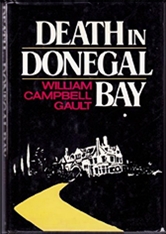
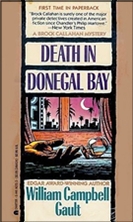
WILLIAM CAMPBELL GAULT – Death in Donegal Bay. PI Brock (the Rock) Callahan #10. Walker & Co., hardcover, 1984. Charter, paperback, 1987.

   William Campbell Gault sold his first short story to a pulp magazine in 1936; nearly half a century later, he is still writing fiction of the same high quality that has marked his long and prolific career. He has published more than 300 short stories and novelettes — mystery, fantasy, science fiction, sports — and some sixty novels, half of which are mystery/suspense and half of which are juvenile sports books.

   Gault’s most enduring fictional creation is ex-L.A. Rams football player turned private eye Brock Callahan, hero of eleven novels thus far. The first in the series, Ring Around Rosa, was published in 1955; six others followed it over the next eight years. Gault abandoned detective fiction in 1963 to concentrate on the more lucrative juvenile market, and did not return to a life of fictional crime until the early 1980s, when the juvenile vein had been played out. Callahan was given a new life as well, in a pair of paperback originals published by the short-lived Raven House; one of these, The Cana Diversion, was the recipient of the Private Eye Writers of America Shamus Award for the Best Paperback Original of 1982.

   Death in Donegal Bay is Gault’s first hardcover mystery in more than twenty years, an even better novel than Cana Diversion and as good as the best of the early Callahans, Day of the Ram (1956), The Convertible Hearse (1957), and County Kill (1962). Callahan, thanks to a substantial inheritance, is now married to his longtime girlfriend, Jan, an interior decorator, and semi-retired in the beach community of San Valdesto (Santa Barbara, where Gault himself lives).

   But he’s bored and has kept a hand in the detective business by grooming a protege, young Corey Raleigh. When Corey is hired for a surveillance job by con man named Alan Arthur Baker, Callahan worries that the kid has gotten in over his head and therefore sets out to do some snooping on his own. Among the people he encounters in the swanky former artists· colony of Donegal Bay are a conniving real-estate salesman, a couple of kids who run a bait shop, an ex-pug bar owner, a secretive former maid, a beautiful woman with a shady past, and an eccentric millionaire who lives in a medieval castle complete with moat and drawbridge.

   The murder of a vagrant opens up a Pandora’s box of blackmail, narcotics, infidelity, and more homicide before Callahan, with Corey’s help, untangles it all and arrives at the solution.

   Rich in incident, written with wry humor and sharp observation, peopled with believable characters, this is William Campbell Gault at his best.

         ———
   Reprinted with permission from 1001 Midnights, edited by Bill Pronzini & Marcia Muller and published by The Battered Silicon Dispatch Box, 2007.   Copyright © 1986, 2007 by the Pronzini-Muller Family Trust.

Next Page »